
Scandals & Feuds · 2010s
Brazil’s 1987 Title Dispute and the CBF’s Reversals
The 1987 Brazilian championship became a legal contest between Sport and Flamengo after the Brazilian Football Confederation changed its recognition of the winner. Brazilian courts ultimately left Sport as the sole champion, while separate FIFA and Swiss proceedings exposed the regulatory pressure surrounding football’s leadership.
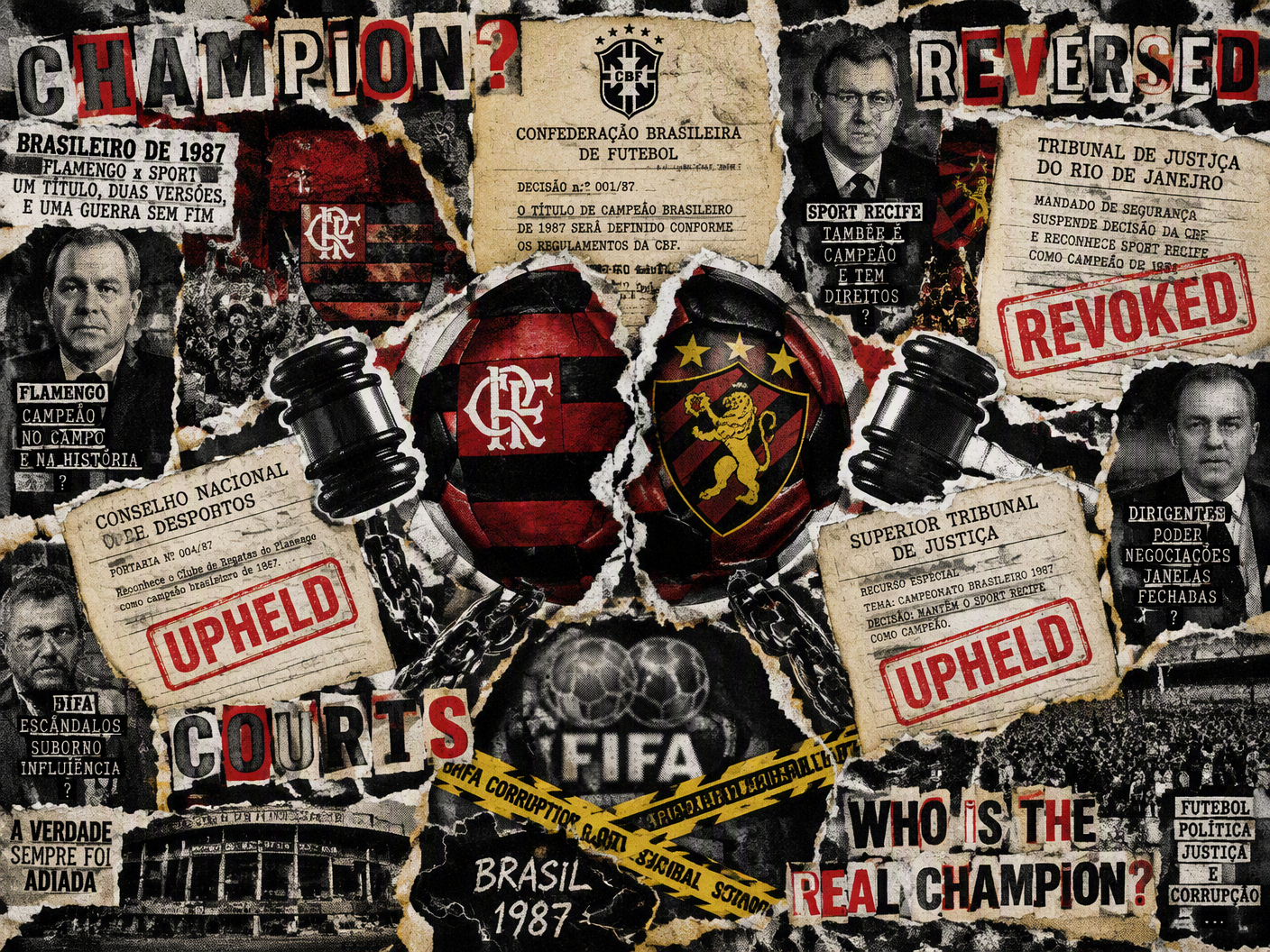
The Supreme Federal Court closed Brazil’s 1987 championship dispute on 16 March 2018, leaving Flamengo without another appeal. Sport Club do Recife remained the sole champion. The judgment ended a contest that had begun three decades earlier, when the championship split around the Copa União and produced rival claims to the title. What followed was not one continuous institutional position. The Brazilian Football Confederation changed its recognition, courts revisited the question, and each decision altered the legal room available to the two clubs.
The dispute centered on Sport and Flamengo, clubs whose claims emerged from the fractured structure of the 1987 Brazilian season. Flamengo’s position rested on its claim to the Copa União championship. Sport pursued recognition through the official championship framework and continued the challenge after the football federation adopted competing positions. The argument was therefore not confined to a result on the field. It became a question of which competition carried official authority, which institution could define the champion, and whether that definition could be changed after the season had ended.
For years, the Brazilian Football Confederation held the power to turn those rival claims into an official designation. Its decisions did not settle the dispute permanently. Instead, the federation recognized Flamengo, then reversed course and recognized Sport as the sole champion. That sequence gave the controversy an administrative life alongside its legal one. A title could be treated as settled in one official document and reopened by another, allowing both clubs to carry institutional recognition at different points in the same dispute.
On 21 February 2011, the CBF officially recognized Flamengo’s 1987 title. The decision gave Flamengo the federation’s formal acknowledgment after years in which the championship remained contested. It also established a position the federation would soon abandon. Four months later, on 14 June, the CBF again recognized Sport as the sole 1987 champion. The reversal restored Sport’s exclusive status and moved the dispute from a question of competing club claims into a direct challenge to the federation’s authority to change its own position.
Sport’s claim then moved through Brazil’s higher courts. On 8 April 2014, the Superior Court of Justice upheld the decision that Sport was the sole 1987 champion. The ruling strengthened the club’s position beyond the CBF’s administrative reversals. It also reduced the practical force of Flamengo’s earlier recognition, placing the title inside a judicial process whose decisions could not be altered by a federation announcement alone. The institution that organized Brazilian football had spoken twice. The court now spoke with greater legal authority.
Flamengo continued to appeal. On 4 March 2016, the Supreme Federal Court rejected the club’s appeal and upheld Sport as the sole champion. The decision carried the dispute to Brazil’s highest judicial authority and preserved the distinction between administrative recognition and a binding judgment. Flamengo’s claim had not disappeared from public argument, but its legal path narrowed. The court had accepted Sport’s exclusive title, converting a long-running contest over football governance into an outcome enforceable within the country’s legal system.
The Supreme Federal Court revisited the matter through its First Panel on 18 April 2017. The panel rejected Flamengo’s appeal by a 3-1 vote and reaffirmed Sport as the sole 1987 champion. The vote mattered because it tested whether the earlier ruling would survive another challenge. It did. The federation’s reversals remained part of the history, but they no longer supplied Flamengo with a route to judicial recognition. The legal contest had become a sequence of narrowing doors.
The final closure arrived on 16 March 2018, when the Supreme Federal Court’s decision was finalized. Flamengo had no further recourse in the title dispute. Sport retained the sole championship recognition that Brazilian courts had upheld through the Superior Court of Justice and the Supreme Federal Court. The result did not erase the CBF’s earlier recognition of Flamengo in February 2011, nor the reversal four months later. It fixed the consequence of those changes: administrative movement could not displace the final judicial outcome.
The dispute unfolded during a period of wider scrutiny over football’s governing institutions. On 27 May 2015, Swiss authorities arrested several FIFA officials on corruption charges and opened criminal proceedings concerning the awarding of the 2018 and 2022 World Cups. Those proceedings placed international football leadership under criminal investigation while the Brazilian title case continued on its separate judicial track. The arrests did not decide the 1987 championship. They showed instead how questions about official authority and institutional conduct were pressing on football from different directions.
That pressure reached the Brazilian federation’s own president. On 15 December 2017, FIFA’s independent Ethics Committee provisionally banned Marco Polo Del Nero from all football activities for 90 days. The sanction arrived three months before the Supreme Federal Court finalized Flamengo’s last avenue in the title case. Del Nero’s ban was a FIFA disciplinary action, not a judgment on the 1987 championship. The Swiss arrests likewise concerned corruption charges and opened proceedings, not a criminal conviction established by the events described here. Each institution imposed its own procedural consequence.
The title dispute therefore ended through accumulation rather than reconciliation. The CBF first recognized Flamengo on 21 February 2011, recognized Sport alone on 14 June, and then faced court decisions that sustained Sport’s exclusive claim in 2014, 2016, 2017, and 2018. Flamengo pursued the legal route available to it until the Supreme Federal Court closed that route. Sport emerged with the title recognized by Brazil’s highest courts. The federation’s changing announcements remained evidence of institutional conflict, but they no longer controlled the championship’s final legal status.
Investigative Dossier & Evidence
Read the companion investigation notes, verified source claims, and primary documents.
Read the Companion Notes & Evidence Record →