
Violence & Brawls · 2010s
The Fallen Opponent and the Judging Dispute at Jakarta 2018
The 2018 Asian Games pencak silat competition produced two separate Malaysian controversies: a kick delivered after a Singaporean opponent had fallen, followed the next day by an accusation of judging bias and damage to a changing-room partition. The incidents widened into complaints from several delegations and official denials of cheating.
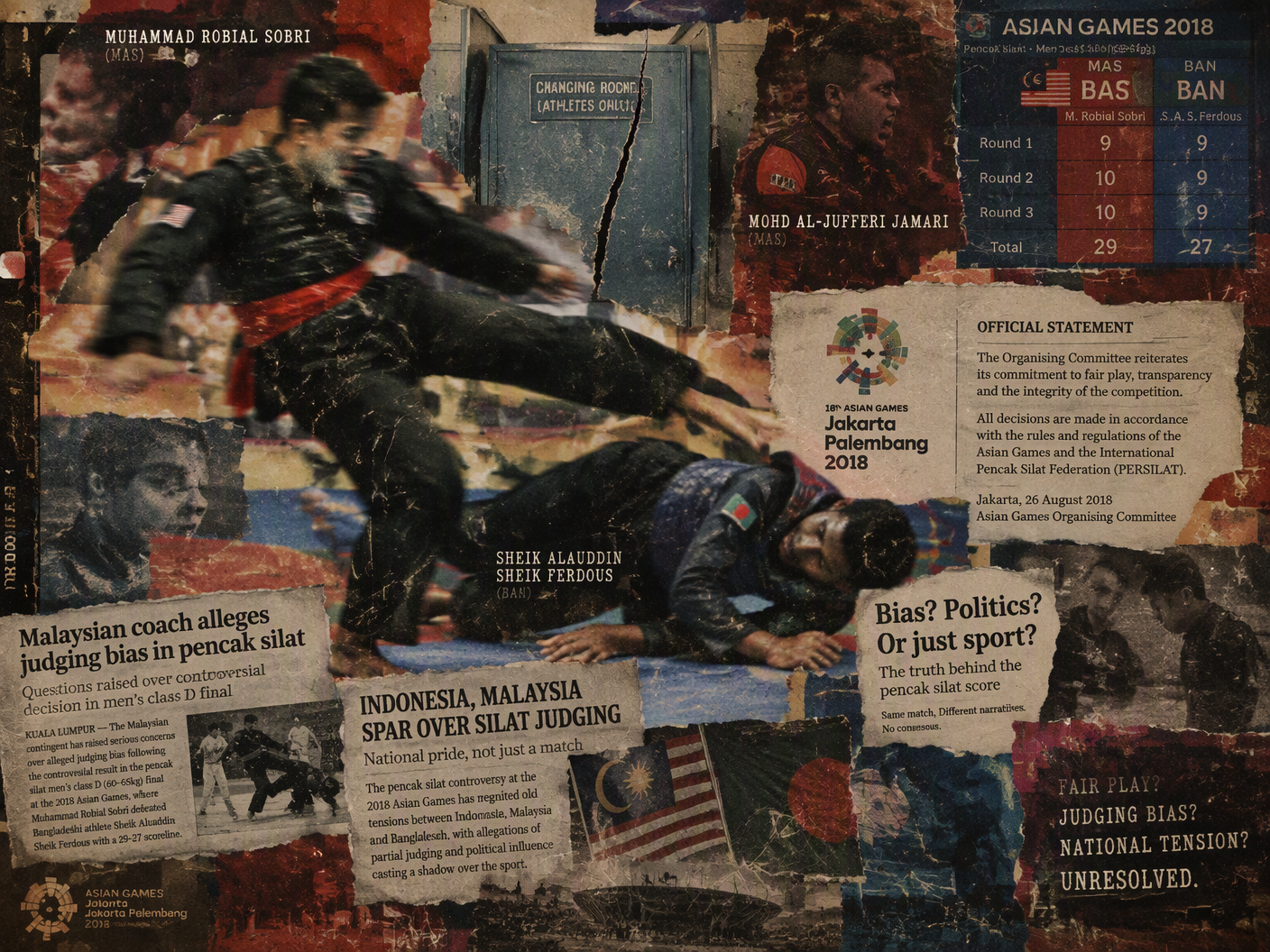
On 26 August 2018, inside the Asian Games pencak silat venue in Jakarta, Muhammad Robial Sobri entered the men’s tanding 85 kg to 90 kg semifinal as a Malaysian competitor. During the bout, his Singaporean opponent, Sheik Alauddin Sheik Ferdous, fell. Sobri then kicked him after the fall. The act separated itself from the ordinary exchange of a contest: the opponent was already down when the contact came. What happened next belonged not only to the two athletes but to the officials, delegations, and spectators who had to decide how a combat sport should respond when its boundaries were crossed.
Pencak silat’s tanding competition permitted striking, kicking, and controlled physical attack within a regulated bout. That structure made the moment legible to everyone present. A kick delivered while two competitors were contesting position could be treated as part of the exchange; a kick after one had fallen raised a different question. Sobri’s semifinal was therefore remembered not simply for its score or result, but for the point at which competition and conduct came apart. Sheik Alauddin Sheik Ferdous was identified as the fallen Singaporean opponent, while Sobri became the Malaysian athlete at the center of the incident.
The semifinal episode created the first controversy of the week, but it did not settle the larger dispute that soon gathered around the event. It involved a single bout, two athletes, and an act on the mat. The next confrontation would concern the judges themselves. In Jakarta, the order mattered. An incident involving a competitor’s conduct was followed by an accusation that the officials responsible for determining contests had failed in their own duty. The two episodes were later discussed together, although they arose from different matches and different forms of complaint.
On 27 August, Mohd Al-Jufferi Jamari competed in a pencak silat final and then accused the judges of bias. His protest shifted attention from a prohibited or disputed action by an athlete to the legitimacy of the decision-makers. The allegation carried consequences beyond one medal. Judging determines who advances, who wins, and which delegation leaves Jakarta with a national result to explain. Jamari’s complaint placed the officials under public scrutiny and gave the Malaysian delegation a second reason to challenge how the competition had been administered.
After the final, Jamari left damage in a changing-room partition. The Malaysian delegation apologized for that damage, adding a physical act of frustration to the public argument over the decision. The apology addressed the property that had been damaged; it did not resolve the accusation against the judges. In the space between those two matters—the conduct acknowledged by the delegation and the fairness alleged by the athlete—the controversy became easier to repeat and harder to contain. A dispute over points had become a dispute over authority, followed by an admission of disorder away from the competition area.
The Malaysian reaction did not remain confined to the team’s changing area or to the athletes involved. By 30 and 31 August, anger over the pencak silat incidents had become part of the wider Asian Games news cycle. The kick after the fall and Jamari’s judging complaint were treated as connected episodes in a competition under pressure. The connection was chronological rather than identical: one concerned what a fighter did after an opponent went down, while the other concerned whether judges had treated a final fairly. Both raised questions about the conduct expected inside a regulated arena.
The judging dispute also crossed national lines. Singapore and Iran were among the countries that complained about officiating in the pencak silat event. Their objections gave the controversy a broader field than a single Malaysian final. Complaints from multiple delegations did not by themselves produce one common account of what had happened in each bout, but they established that dissatisfaction was not limited to Jamari or to Malaysia. The event had become a contest over interpretation: athletes and teams measured decisions against their own understanding of fairness, while officials had to defend the results already entered.
The medal table intensified that argument. Indonesia won 14 of the 16 pencak silat gold medals on offer at the Jakarta Games. As host nation, Indonesia occupied the center of the event’s geography and its medal count. The concentration of victories made judging complaints more consequential in public discussion, because every disputed decision could be placed beside an overwhelming national result. A medal tally could show who had won; it could not, by itself, explain whether any individual decision had been improperly made. Yet the numbers supplied the background against which the accusations were heard.
Erick Thohir, chairman of the Indonesian Asian Games Organizing Committee, rejected accusations of cheating in the pencak silat competition. His response placed an official boundary around the controversy: complaints and suspicions were being voiced, but cheating was not accepted as the explanation for the results. The statement did not erase the kick involving Sobri, the accusation made by Jamari, or the damage acknowledged by the Malaysian delegation. It answered a broader charge—that the competition itself had been manipulated—and denied that charge publicly.
The two controversies therefore endured in different forms. Sobri’s kick after Sheik Alauddin Sheik Ferdous had fallen was a reported act within a named semifinal, involving identifiable athletes and a precise moment of contact. Jamari’s complaint concerned the judgment of a final, followed by damage to a partition and an apology from Malaysia. Singaporean and Iranian complaints widened the dispute, while Indonesia’s medal total and Thohir’s denial gave it institutional and national dimensions. The aftermath preserved the incidents, the objections, and the denial—not a finding that the judges had been biased or that cheating had been proved.
Investigative Dossier & Evidence
Read the companion investigation notes, verified source claims, and primary documents.
Read the Companion Notes & Evidence Record →