
Scandals & Feuds · 1992
Andrea Moda Formula: The 1992 F1 Entry That Ended at Spa
Andrea Moda Formula entered sixteen races in 1992, failed to pre-qualify for twelve and qualify for three, and was removed from the championship after its owner was arrested in Belgium. The season’s surviving accounts also document driver turnover, a trackside fire, steering instability, and an administrative breakdown that ended at Spa-Francorchamps.
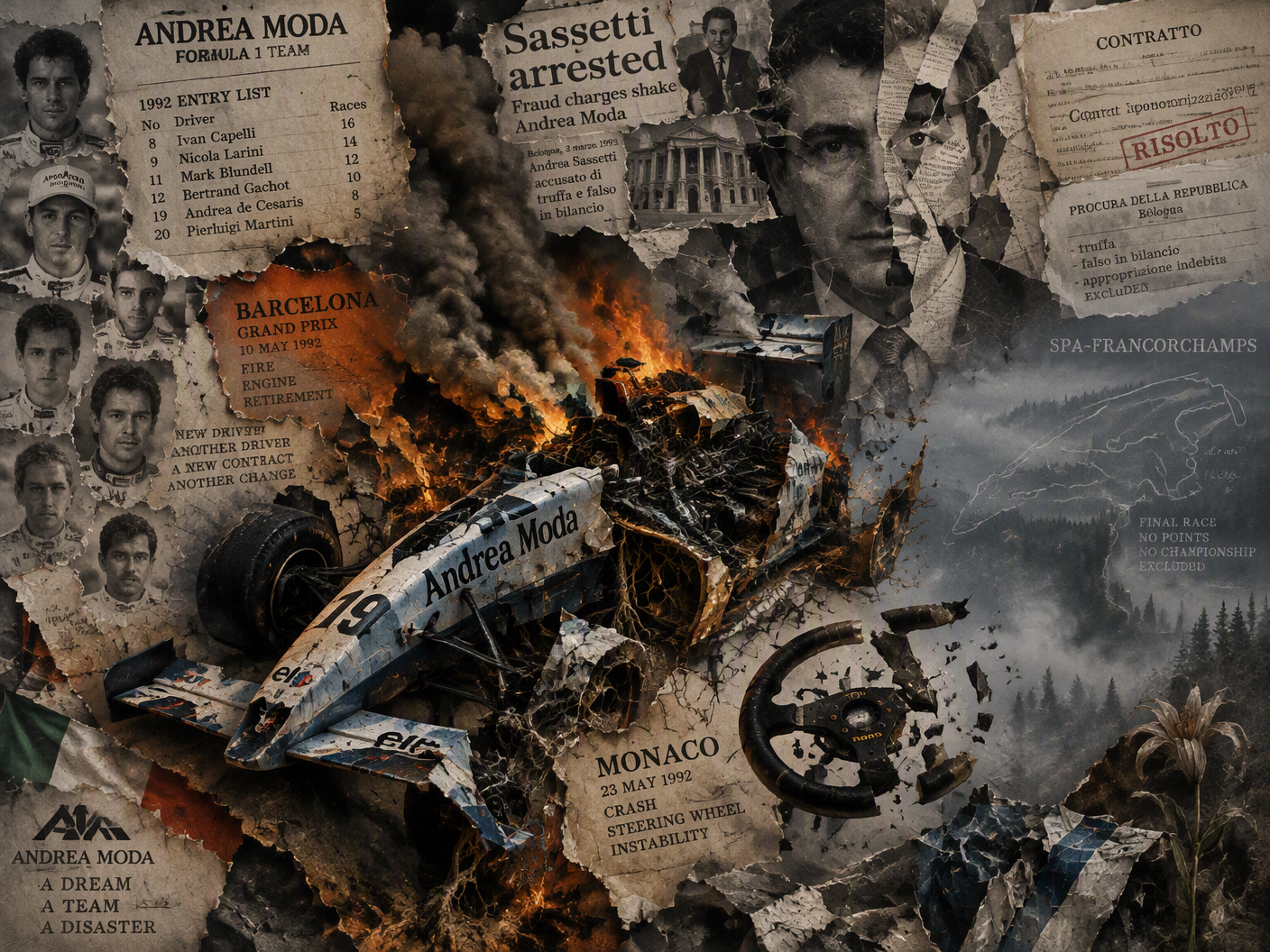
Andrea Sassetti was arrested by Belgian police on fraud charges after the 1992 Belgian Grand Prix at Spa-Francorchamps. The arrest closed Andrea Moda Formula’s season, but it did not produce the team’s final punishment by itself. Formula 1 authorities excluded Andrea Moda from the championship for bringing the sport into disrepute. The team that had entered the season as a functioning constructor disappeared after its last race, leaving behind a short campaign defined by non-qualifications, driver changes, improvised preparation, and an owner facing criminal allegations.
Andrea Moda had been a real Formula 1 entrant in 1992. Sassetti bought the team and oversaw its attempt to operate inside a championship that demanded cars, drivers, money, personnel, and technical reliability at every circuit. Its entry was not ceremonial. The team traveled, presented cars, hired competitors, and entered sixteen races. Yet participation and competition quickly separated. Andrea Moda appeared on the championship’s entry lists while repeatedly failing to put a car into the qualifying field.
The numbers describe the gap. Andrea Moda failed to qualify for three races and failed to pre-qualify for twelve more. Pre-qualifying came first: drivers had to survive an initial session before they could attempt to qualify for the race itself. A failure at that stage ended the weekend before the main qualifying process began. Across the season, the team accumulated twelve such failures, then three additional failures to qualify. Only one entry reached the starting grid, and the calendar ended at Spa.
The first practical setback arrived at the Brazilian Grand Prix, where Andrea Moda made its Formula 1 debut. Perry McCarthy was scheduled to make the team’s first pre-qualifying appearance, but his superlicence had been revoked at the time. He could not take the opportunity assigned to him. Roberto Moreno drove for Andrea Moda as the other principal driver, and the team began its season with one competitor blocked by a licensing problem before the car had established itself on the circuit.
The driver roster did not settle after Brazil. Andrea Moda had already fired Enrico Bertaggia and Alex Caffi earlier in the season, replacing them as the team searched for a workable combination of speed, availability, and credentials. McCarthy and Moreno became the drivers attached to the campaign, but neither received the stable platform normally required to develop a car. The changes were not a side issue. They were part of the operating pattern: personnel shifted while the team continued to enter races it often could not reach through pre-qualifying.
At the Spanish Grand Prix in Barcelona, McCarthy arrived late and climbed into the car at the last moment. He used excessive quick-start spray, and the car caught fire. The engine then failed. The sequence consumed the limited preparation available for the session and converted a difficult entry into another non-qualifying episode. A racing team can lose a weekend through pace alone. Andrea Moda was losing them through the basic acts required to make a car run.
Monaco exposed a different problem. McCarthy said he was held in the pits and later felt the steering move during his lap. The car became unstable beneath him. Moreno was the team’s only driver in the Monaco qualifying account, while McCarthy’s experience ended as another episode in which access to a usable car and control of that car were both uncertain. The distinction mattered to the drivers. A slow car could be measured and improved; a car that arrived late, failed mechanically, or behaved unpredictably narrowed the driver’s control over the result.
McCarthy’s season therefore became a series of operational confrontations rather than a conventional development program. His superlicence prevented the first scheduled appearance. At Barcelona, a rushed start ended in fire and engine failure. At Monaco, he described being held in the pits before encountering steering movement and instability. Moreno remained the other driver through the campaign, but the team’s repeated inability to pass pre-qualifying meant that both men were judged within a program that seldom reached the race itself.
By Spa-Francorchamps, Andrea Moda’s presence had become inseparable from the conduct of its owner and the team’s failures on track. Sassetti controlled the entrant that had made sixteen starts on the calendar, yet the campaign had produced twelve pre-qualifying failures and three failures to qualify. After the Belgian weekend, police arrested him on fraud charges. The arrest placed a criminal allegation beside an already damaged sporting operation, but the two processes remained distinct: Belgian police pursued the charges, while Formula 1 authorities decided the team’s status in the championship.
The governing authorities then excluded Andrea Moda from the 1992 Formula 1 championship for bringing the sport into disrepute. That wording made the sanction administrative and institutional. It did not require the championship to wait for a criminal trial before deciding whether the entrant could remain. The decision ended Andrea Moda’s season at the same venue where Sassetti had been arrested. Spa was both the final race entry and the point at which the sport withdrew its permission for the team to continue.
The public legal consequence attached to Sassetti is the arrest on fraud charges. A conviction, guilty plea, or final disposition is not established by the verified account. The sporting consequence is clearer: Andrea Moda competed in Formula 1 in 1992, entered sixteen races, failed repeatedly before and during qualifying, and was expelled after the Belgian Grand Prix. Its collapse cannot be assigned to one proven cause. The season instead shows several failures operating together—licensing trouble, driver turnover, fire, engine failure, steering instability, and a final institutional sanction.
Investigative Dossier & Evidence
Read the companion investigation notes, verified source claims, and primary documents.
Read the Companion Notes & Evidence Record →