
Tragedy ·
Arrichion’s Last Counter
Ancient accounts say a counter against an opponent’s foot or ankle forced a concession as the Olympic champion died. Arrichion’s body was crowned, but the mechanics of the exchange remain disputed.
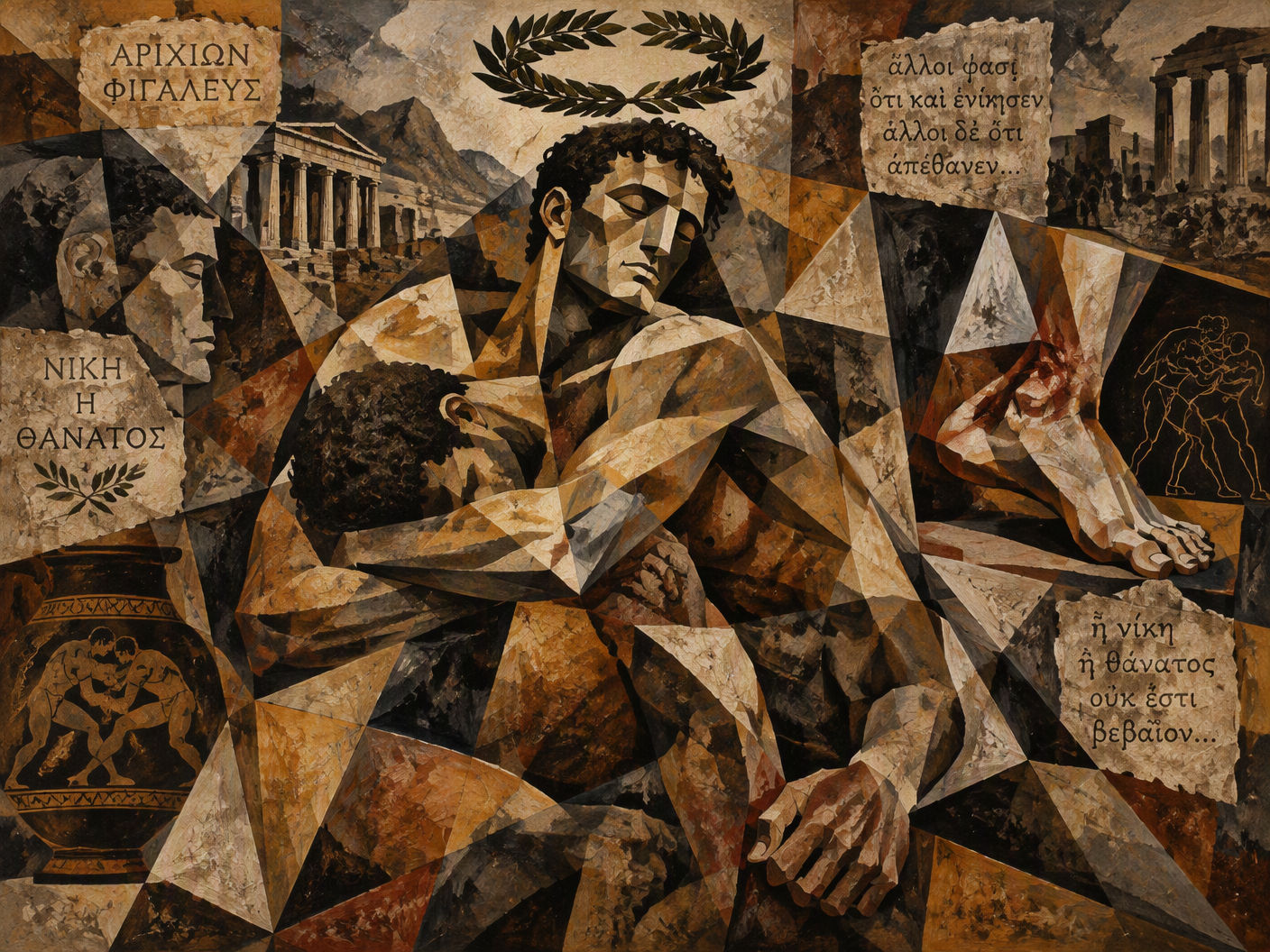
At the Olympic Games of 564 BCE, Arrichion of Phigalia won a pankration crown that was awarded after his death. The two-time champion was caught in an unnamed opponent’s hold from behind when he countered against the man’s foot or ankle. The pain forced the opponent to concede. Arrichion died in the exchange, and his body was crowned victor.
The most detailed ancient telling comes from Philostratus the Lemnian, who flourished around 230 CE—centuries after the contest. His Imagines takes the form of a guided tour through a probably fictional art gallery. Its elaborate description of Arrichion’s struggle is not an eyewitness report from the arena, though it supplies much of the movement through which later writers have tried to understand the fight.
Philostratus describes the opponent wrapping his arms and legs around Arrichion and applying a choke from behind. Translations variously have Arrichion kick a leg free, move or fall to the left, and trap or seize the opponent’s foot. In one reconstruction, the injured man raised a hand to signal defeat.
Beyond those broad actions, the apparent precision dissolves. Translators disagree about whether Arrichion was standing or on his hands and knees. They disagree about which foot was caught, which knee held it and whether he twisted the foot with his hands or injured the joint through the movement of his own leg and body. A description that can sound like a recoverable technique has yielded several substantially different techniques.
The ancient accounts also differ over the injury that made the opponent yield. As classicist Robert H. Brophy III noted in a 1978 study, Pausanias describes a dislocated toe, while Philostratus describes a dislocated ankle. The common ground is narrower but still decisive: Arrichion inflicted a painful injury through a counter against the foot or ankle, and the opponent surrendered.
The cause of Arrichion’s death is not securely established. Nor can the final seconds be placed in a dependable sequence: one translation has him countering as he breathed his last, while Eusebius’ Chronicle says the opponent conceded before the dead champion was crowned. The victory and the death are the stable elements of the tradition, not a precise medical or moment-by-moment reconstruction.
Eusebius gives the reason for the award: the opponent had conceded because of the injury Arrichion inflicted. The man who could still surrender lost; the man who could no longer receive the honor won. The victor’s wreath was placed on Arrichion’s lifeless body.