
Scandals & Feuds · 1990s
The Bad Breed Feud—and the Records That Cannot Yet Verify It
A Wikipedia account describes how ECW turned the reported breakup of Axl Rotten and Ian Rotten into a series of hardcore matches and an award-winning rivalry. The available record can identify the promotion’s public machinery, but it cannot yet authenticate the 1995 chronology or establish who controlled the performers’ working conditions.
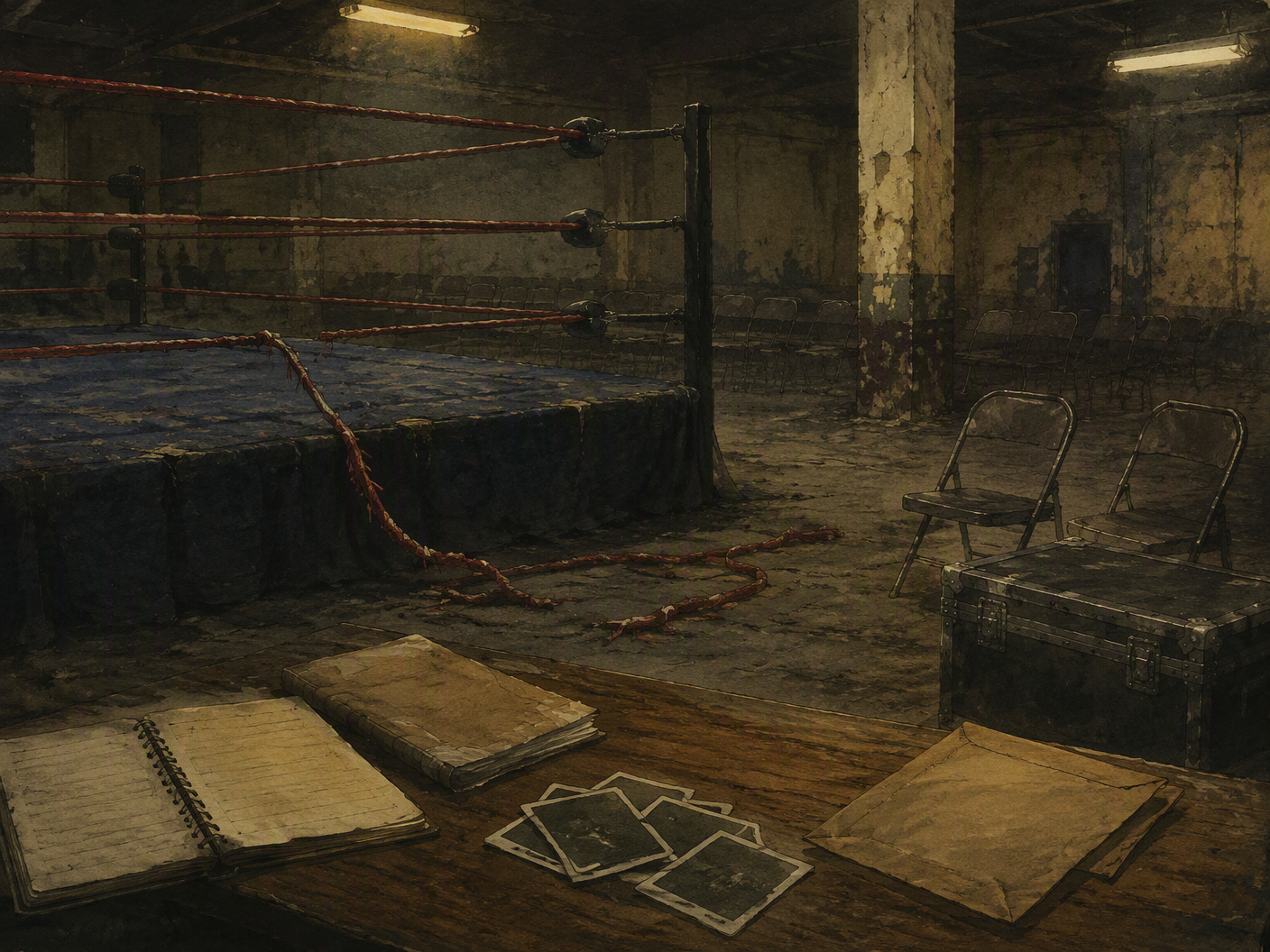
The story begins with a source problem. A Wikipedia account identifies Axl Rotten and Ian Rotten as The Bad Breed, a tag team that performed together in the early 1990s, and places their reported breakup match against The Pitbulls on January 17, 1995. According to that account, the stipulation required the losing team to separate. It further reports that Ian Rotten struck Axl with a chair after the loss and that ECW then presented the former partners in a feud. Those details form the available chronology—not an independently authenticated event record.
Axl Rotten was the ring name of Brian Knighton. The account describes the angle as drawing on real-life ill feelings between the brothers, but that language establishes only how a later reference characterized the promotion’s story. It does not establish what either man privately believed, whether the hostility preceded the angle, or how much of it was written, amplified, or performed for an audience. The record therefore supports a distinction between the angle as described and the private relationship it purported to represent.
What the account does reveal, if its chronology is confirmed, is a compact piece of promotional structure: a rule designed to end a team became the premise for a new conflict. The breakup condition supplied a clear public sequence—partners forced apart, one brother turning on the other, and a rivalry developing afterward. The mechanism is visible in the reported sequence even though the booking records behind it are not.
The reported feud continued through a series of advertised conditions. The Wikipedia account lists a hair-versus-hair match, contests involving barbed-wire baseball bats, a barbed-wire baseball-bat-and-chair match, and a Taipei Deathmatch. These were promoted wrestling stipulations, not proof of unscripted street violence. The record establishes a sequence of named conditions; it does not establish the actual relative danger of one match compared with another.
That escalation also raises the institutional question the surviving account cannot answer. Who proposed the stipulations? Who could modify or stop them? What did the performers receive for accepting the exposure, and what protection existed if an injury ended the work? The available source names the matches but supplies no contracts, compensation records, insurance terms, medical protocols, or contemporaneous decision trail. The physical risk is advertised; the bargaining structure around it remains outside the record captured here.
The rivalry’s afterlife included industry recognition. The same published account reports that Pro Wrestling Illustrated named the Axl Rotten–Ian Rotten feud its 1995 Feud of the Year. That designation documents an industry publication’s judgment as reported by the account. It does not authenticate the breakup match, prove a private family collapse, or certify the safety conditions under which the matches took place. The award is evidence of how the rivalry was described in that publication, not of the working records needed to examine it as an institution.
The gap becomes more consequential when the story is placed beside later reporting about Knighton. In 2016, The Boston Globe reported that forensic pathologist Bennet Omalu publicly announced signs of early-stage chronic traumatic encephalopathy after reviewing and endorsing findings from a postmortem examination conducted by neuropathologist Julia K. Kofler. The report does not say that Omalu performed the examination. That distinction identifies the evidentiary chain: Kofler conducted the examination described, while Omalu publicly announced and endorsed the reported finding.
The Globe also reported that Knighton’s family attributed debilitating physical and mental-health problems to his years as a professional wrestler. That account should be treated as a family attribution, not as a medical or legal finding. It does not isolate the Bad Breed feud from Knighton’s broader career, identify every source of physical exposure, or establish that any particular match caused a later condition. The reported brain finding and the family’s explanation belong to the same biography, but the supplied evidence does not create a proven causal chain between them.
The Globe reported that Knighton died in 2016 from an accidental heroin overdose, and the Wikipedia account reports the same cause of death. Neither source connects the overdose to CTE, the feud, or a particular performance. Nor does the supplied record establish drug use during the 1995 storyline. These facts must remain separate: a reported postmortem finding, a family account of serious health problems, and a reported accidental overdose. Joining them into a single narrative would manufacture a medical and behavioral explanation the sources do not provide.
A 2011 Senate hearing on concussions and traumatic brain injury in contact sports and entertainment supplies broader context, not a case finding. Expert testimony addressed concussion risks and the limits of claims that sports equipment could prevent or reduce those injuries. The hearing did not investigate Knighton, ECW, WWE, The Bad Breed, or any listed match. Its value is to show that questions about repeated exposure and safety assurances were part of a wider public record—not to substitute general testimony for Knighton’s medical files or ECW’s internal practices.
The responsible conclusion is therefore narrower than the familiar legend. A published account describes a team, a breakup stipulation, a chair attack, a series of weapon-based matches, and an industry award. The Boston Globe reports a later CTE announcement, a family attribution about Knighton’s health, and an accidental overdose. None of the supplied material independently verifies the central 1995 sequence, identifies the people who approved its risks, or proves that the feud caused a later illness or death. Before this can be published as verified history, the promotion’s records—and independent contemporaneous accounts—must be found.
Companion notes
A Feud Account Without the Working Files
The captured sources support a carefully bounded account of what was reported about The Bad Breed and what The Boston Globe later reported about Brian Knighton. They do not yet support publication of the 1995 chronology as independently verified history or a conclusion about institutional liability.
The chronology remains a research lead
The central event sequence comes solely from the Wikipedia entry for Axl Rotten. It reports the team’s early-1990s partnership, the January 17, 1995 breakup match with The Pitbulls, the chair attack, the subsequent feud, the named hardcore stipulations, and Pro Wrestling Illustrated’s 1995 Feud of the Year designation. Wikipedia is useful for locating leads, but it is not authority under the evidence standard governing this package. No captured event program, contemporaneous newspaper report, archival footage, booking document, or issue of Pro Wrestling Illustrated independently verifies those details. [S1]
The promotional mechanism is visible; the labor machinery is not
If independently confirmed, the reported sequence would consist of a breakup stipulation followed by a chair attack, a feud, and the listed hair, barbed-wire, chair, and Taipei Deathmatch conditions. But the supplied material does not identify the decision-makers or terms behind that process. There are no contracts, pay records, insurance documents, medical protocols, safety rules, or testimony showing who could approve, change, refuse, or stop a match. The record supports analysis of the advertised mechanism, not a finding of coercion, negligence, or intentional medical neglect. [S1]
The medical record has a defined boundary
The Boston Globe reported that Bennet Omalu announced signs of early-stage CTE after reviewing and endorsing findings from Julia K. Kofler’s postmortem examination. It separately reported the Knighton family’s attribution of debilitating physical and mental-health problems to professional wrestling. The captured article is not the autopsy file, histological record, complete medical history, toxicology report, or formal causation analysis. It therefore supports what was reported, but not a conclusion that the Bad Breed feud caused Knighton’s condition or overdose. [S2]
General concussion testimony is not case evidence
Senate Hearing 112-324 records expert testimony about concussion and traumatic-brain-injury risks in contact sports and entertainment, including limits on claims that equipment could prevent or reduce those injuries. The hearing made no finding about Knighton, ECW, WWE, The Bad Breed, or any specific match. It can frame questions about repeated exposure and safety assurances, but it cannot establish Knighton’s individual medical history or ECW’s actual protocols. [S3]
What must be obtained before publication
A publishable investigation would require independent contemporaneous accounts of the event, programs or booking records, the relevant Pro Wrestling Illustrated issue, contracts, payment and insurance documentation, medical or ringside protocols, and testimony from people with direct knowledge of ECW’s decisions. The medical portion would require the postmortem materials and records necessary to distinguish a reported CTE finding from a conclusion about cause. Until those materials are obtained, the 1995 chronology remains an attributed research lead, while the later medical and death reports remain bounded by The Boston Globe’s account. [S1], [S2], [S3]
Source key
The associated evidence packet contains visible source URLs, source roles and the complete claim ledger.