
Violence & Brawls · 1800s-2010s
Badger Baiting: The Dogs, the Setts, and the Jail Sentences
Badger baiting was outlawed in Britain in 1835 and remains a criminal offence under modern protections covering the animals and their underground setts. Reports from Scotland and Northern Ireland, followed by a Welsh prosecution in 2018, show how the practice moved from old law books into police files, seized kennels, and prison cells.
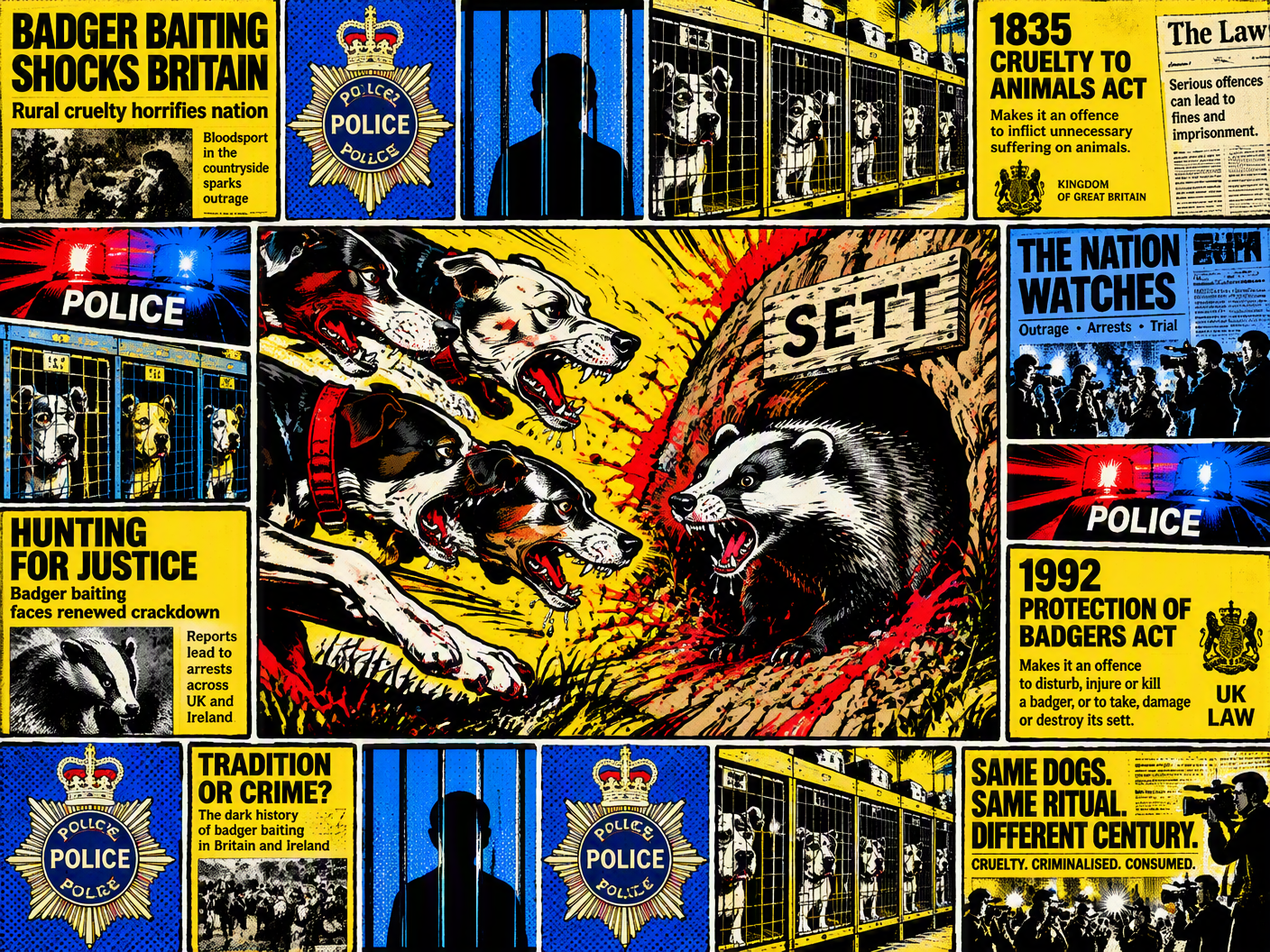
The dogs went at the badgers in a County Down field while an undercover team watched. The operation ran for six months and produced hours of taped evidence, photographs, footage, and pages of transcripts. The scene belonged to Northern Ireland, but the law had already marked the conduct as criminal across the United Kingdom. Badger baiting had been outlawed by the Cruelty to Animals Act 1835. The punishment on paper was old. The appetite behind it had not disappeared.
The sport, if that word is allowed to survive the description, depended on an animal being cornered and dogs being sent against it. The County Down investigation placed that act in a field and placed people behind it. Its evidence was not a stray photograph or a rumor passed along a road. Taped conversations, images, moving footage, and written transcripts accumulated over months. The record put the conduct in the open, even as the people involved operated beyond the reach of ordinary spectators.
Parliament had tried to close the door in 1835. The Protection of Badgers Act 1992 built a newer lock. It made taking, injuring, or killing a badger an offence. It also criminalized interference with a badger sett, the animal's burrowed home beneath the ground. The law dealt in plain verbs: take, injure, kill, interfere. There was no need for a grand theory of cruelty. The prohibited acts were named, and the people who carried them out could be brought before a court.
In Scotland, the warnings arrived in numbers. By June 4, 2009, seventy badger-baiting incidents had been reported so far that year. Scottish Badgers said 2009 could become one of the worst years for crimes against badgers. Pc Craig Brothwick, a Strathclyde Police wildlife officer, described the practice as cruelty and said it was “very much on the rise.” The telephone figures did not tell the whole story. They did establish that wildlife officers and campaigners were dealing with an active criminal concern.
The Scottish reports and the County Down operation occupied different jurisdictions, but the conduct had the same hard center: dogs, badgers, and people arranging the encounter. In County Down, the evidence was gathered from inside the activity. In Scotland, police and wildlife campaigners counted reported incidents and spoke publicly about the pressure on badgers. Neither episode belonged to the distant past. Both showed an illegal practice appearing in modern places, handled by modern investigators, with the old cruelty legislation still behind them.
Nine years after the Scottish tally, the case reached a farm in Wales. RSPCA inspectors attended with police during an undercover badger-baiting investigation. They seized twenty-three dogs at the farm. Eight more were seized at Jordan Houlston's address. The numbers gave the case its physical shape: kennels, animals removed from familiar ground, and officers carrying out the work in the spaces where the conduct had been organized. The farm was no longer private ground. It had become the center of a criminal prosecution.
David Thomas was a huntsman and a defendant in that Welsh case. On February 5, 2018, Llandudno magistrates sentenced him to twenty-two weeks in jail for offences including causing a badger to suffer. The court also ordered him to pay costs and disqualified him from keeping dogs for eight years. That order reached beyond the prison term. It addressed the animals at the center of the case and removed the means by which a similar encounter could be arranged.
Jordan Houlston, tried in the same case, received twenty weeks in jail. The sentences were close in length, but the court dealt with two men and two sets of circumstances inside one prosecution. The seized dogs remained part of the case's human residue. So did the eight-year restriction placed on Thomas. A criminal court had moved from the broad language of animal-protection law to named defendants, named penalties, and the practical question of who could keep dogs afterward.
The law had not changed its subject. In 1835, it outlawed badger baiting. In 1992, Parliament specified the offences around the animal and its sett. In 2009, Scottish authorities counted seventy reported incidents and heard a wildlife officer call the practice both cruel and increasingly common. In Northern Ireland, an undercover investigation assembled recordings and images from a County Down field. In Wales, inspectors and police removed thirty-one dogs and two defendants received jail sentences.
That sequence does not make a single uninterrupted story stretching from the nineteenth century to the present. It makes a narrower one, and the narrower account is sufficient. A practice outlawed in Britain was still reported in Scotland and Northern Ireland in 2009, then prosecuted in Wales in 2018. Campaigners connected persecution to the badger cull, but that causal claim was not settled by the material surrounding these cases. What the court settled was simpler: Thomas went to jail, Houlston went to jail, and the dogs were taken away.
Investigative Dossier & Evidence
Read the companion investigation notes, verified source claims, and primary documents.
Read the Companion Notes & Evidence Record →