
Violence & Brawls · 2000s
Bottlegate: The Fourth-Down Replay Reversal That Stopped Browns-Jaguars
On December 16, 2001, a disputed fourth-down catch was overturned at Cleveland Browns Stadium, prompting some fans to throw debris onto the field. The referee ended the game with 48 seconds remaining, and the NFL commissioner later ordered those seconds played.
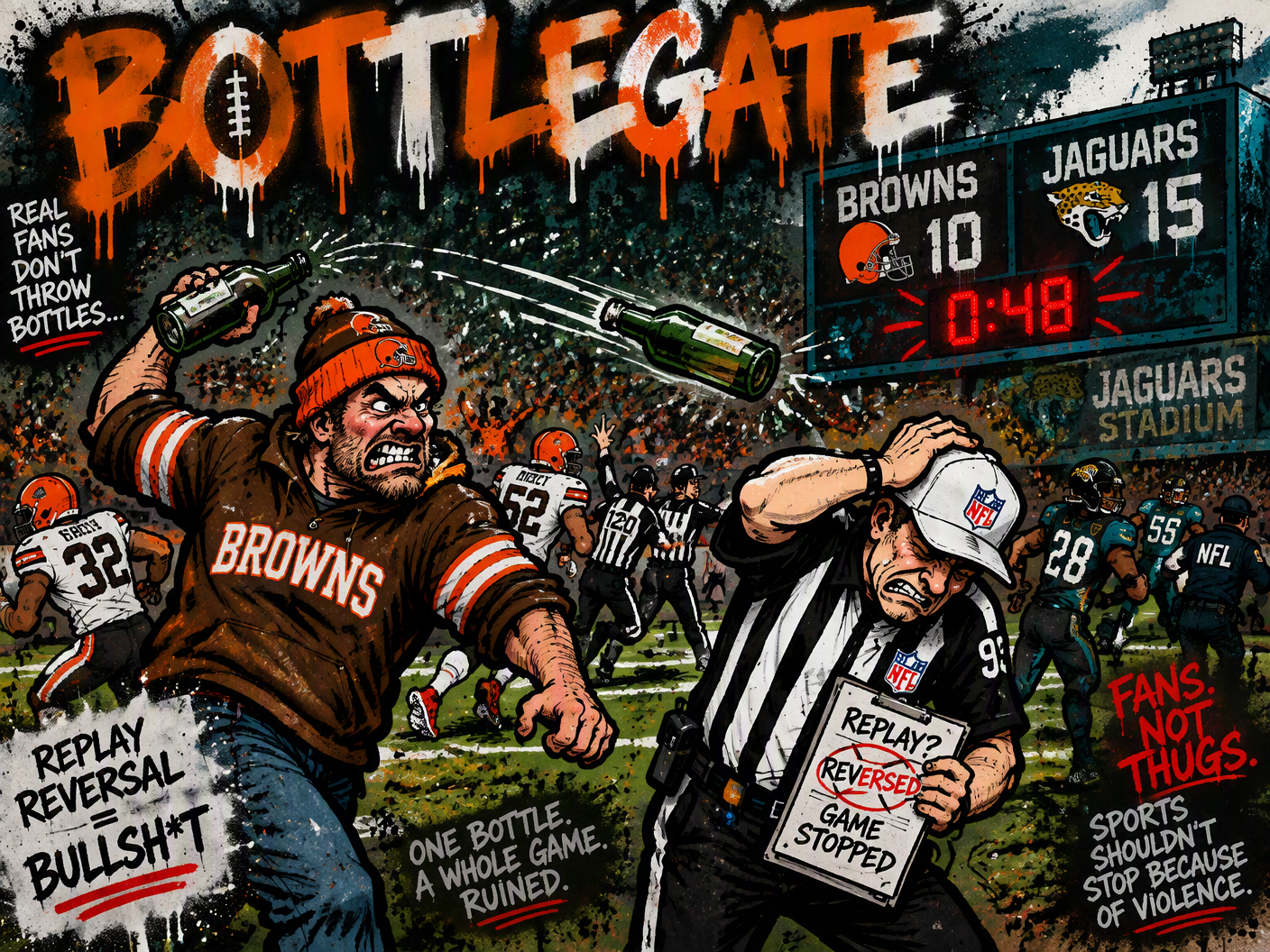
On December 16, 2001, at Cleveland Browns Stadium in Cleveland, the Jacksonville Jaguars were leading the Cleveland Browns 15-10 with 48 seconds left. The Browns faced fourth-and-2 near the Jaguars’ 12-yard line, a final chance to keep the drive alive. Tim Couch threw a short pass toward Quincy Morgan. The officials initially ruled Morgan’s play complete. That signal placed the decision in the Browns’ hands and brought the game to its hinge: one ruling could preserve Cleveland’s possession, while another could end the drive.
Couch spiked the ball after the catch ruling. The spike stopped the immediate action, and the officials halted the game to examine the fourth-down play. Replay review had entered football as a method for correcting certain decisions on the field, but it also gave the officials a second moment in which to decide what the first moment had meant. The Browns had already acted on the completion signal. Now the crew turned back to the pass to Morgan, with the score and the remaining time still fixed above the field.
The review changed the ruling. Morgan’s reception was declared incomplete, removing the completion that had kept Cleveland’s possession alive. The reversal settled the play differently from the way it had first been called, and it came with the Browns still trailing by five points. The officials’ decision did not merely alter a statistic in the game book. It changed which team had the ball, what the Browns could do next, and whether the final 48 seconds would be played as an ordinary closing sequence or become something else.
The response came from the stands. Some Browns fans threw bottles and other debris onto the field after the reversal. The objects crossed into the space occupied by players and officials, turning a disputed call into a safety problem inside the game itself. The disturbance did not describe every person in Cleveland Browns Stadium, but it changed the conditions under which the contest was being administered. The officials now had to decide not only what had happened on fourth down, but whether the field could safely remain in use.
Referee Terry McAulay made the next consequential decision. With 48 seconds still unplayed, he announced that the game was over, citing safety concerns. The announcement gave the afternoon an ending before the clock had reached zero. Jacksonville had the advantage on the scoreboard, and Cleveland’s attempted continuation had been erased by the replay ruling; now the contest itself had been stopped. For the teams and officials on the field, the first ending came not through the expiration of time but through the referee’s declaration.
That declaration did not remain the league’s final administrative answer. The NFL had a commissioner with authority beyond the immediate field decision, and Paul Tagliabue exercised it after the early stoppage. He ordered the officiating crew to return and finish the remaining 48 seconds. The order addressed the unfinished game. It did not restore Morgan’s completion or replace the replay ruling with a new catch decision. The commissioner’s intervention separated two questions that had become entangled in the stadium: what the officials had called, and whether the game had been completed.
The return to the field gave the game a second ending. The Jaguars and Browns were required to play the time that had remained when McAulay stopped the contest. The league’s instruction converted the referee’s first announcement from a conclusion into an interruption. Forty-eight seconds, negligible in a full football game but decisive in this one, became the measure of the dispute. The contest would not stand as an unfinished afternoon at the point where the bottles had landed and the announcement had been made.
The sequence therefore contained two separate reversals. First, the officials changed Morgan’s play from a completion to an incomplete pass. Then the league changed the status of the game from finished to unfinished, requiring the final seconds to be played. The first reversal concerned possession and the Browns’ fourth-down attempt. The second concerned the authority of an on-field ending. Together they produced the event later known as Bottlegate, a name attached not to one isolated gesture but to the collision between replay judgment, public disorder, and league control.
The human consequences were immediate even without assigning the conduct to an entire crowd. Bottles and debris entered the playing area; players and officials had to operate around a field that had become unsafe enough for McAulay to stop the game. No verified account turns that disorder into a record of violence by every spectator, and the established event does not depend on such a claim. The central fact is narrower and more consequential: some fans acted in a way that interrupted an NFL game and forced the officials to abandon the field before the league restored play.
For the Browns, the episode began with a short pass and an initial completion signal. For Morgan, the play became an incomplete reception after review. For Couch, the spike that followed the first ruling preceded the stoppage that erased the drive’s apparent continuation. For McAulay, the decision moved from replay reversal to an announcement that the game had ended. For Tagliabue, the unfinished 48 seconds became an administrative question requiring the officials to return. Each action narrowed the choices available to the next person.
The game’s lasting institutional fact was not simply that a disputed catch had been overturned. It was that an NFL referee stopped a contest with 48 seconds remaining, and the commissioner later ordered the officiating crew back to complete those seconds. The Browns-Jaguars game acquired its durable shape through that sequence: a fourth-down ruling, debris on the field, an early ending, and a league-directed completion. The final authority over the afternoon lay neither entirely in the first signal nor entirely in the stoppage, but in the order that put the remaining time back into play.
Investigative Dossier & Evidence
Read the companion investigation notes, verified source claims, and primary documents.
Read the Companion Notes & Evidence Record →