
Violence & Brawls · 1980s
The Bounty Bowls: Philadelphia, Dallas, and the Price of a Hit
In November and December 1989, the Eagles defeated the Cowboys twice while allegations of player bounties turned a divisional rivalry into an NFL investigation and a public carnival of snowballs, accusations, and security measures. The games established Philadelphia's dominance; they never established an official price list for injuring Dallas players.
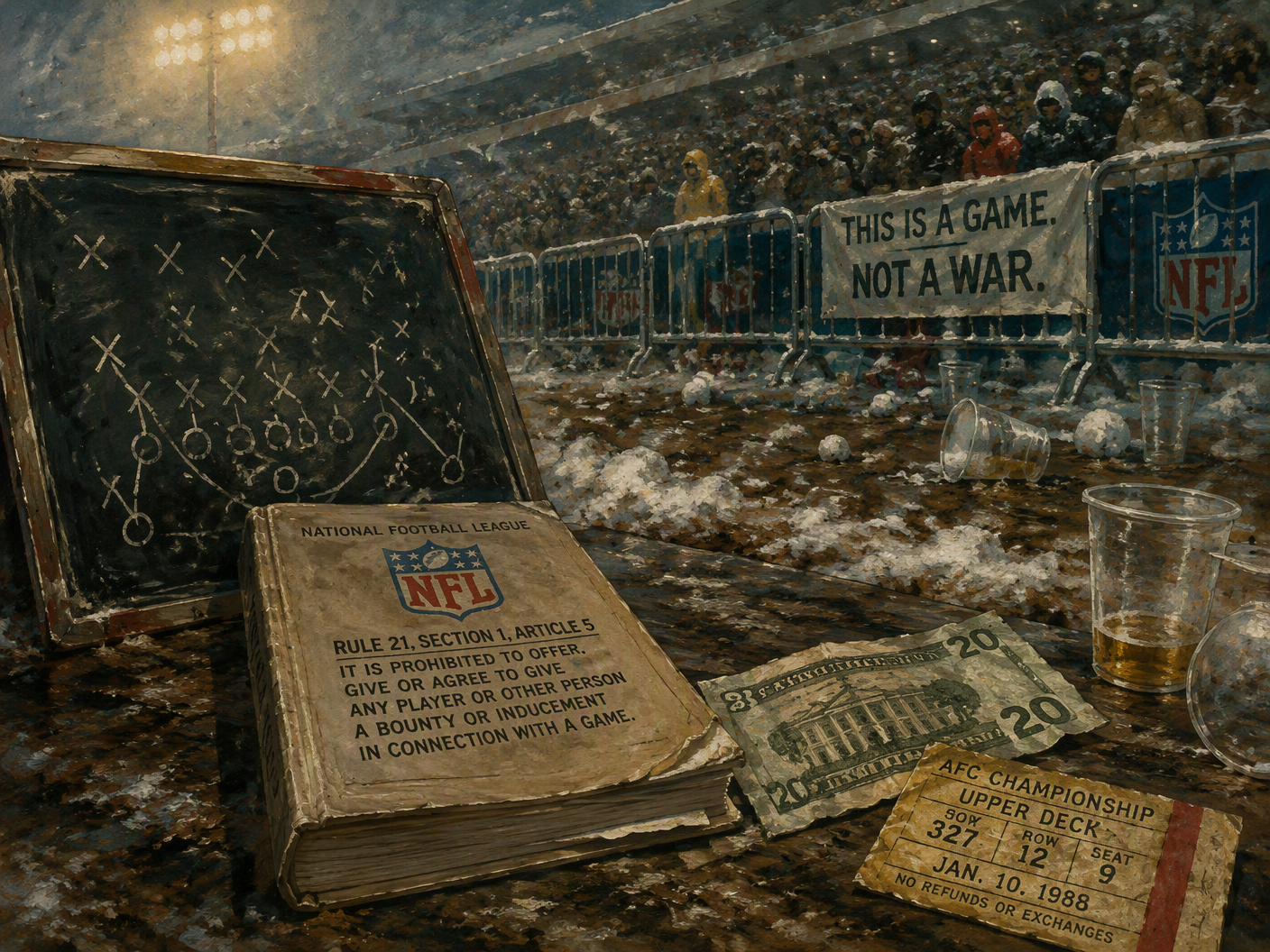
The National Football League prohibited bounties on players, which was a sensible rule in a sport already selling controlled collisions as family entertainment. On Thanksgiving Day, November 23, 1989, the Philadelphia Eagles defeated the Dallas Cowboys 27-0 at Texas Stadium, and the victory arrived carrying an accusation: Philadelphia had put a price on Cowboys kicker Luis Zendejas. The scoreboard offered one kind of accounting. The allegation offered another, more profitable to television, newspapers, and every man who enjoyed discussing ethics while wearing a team jacket.
The game was played in the old professional atmosphere of bad wool coats, aluminum stadium railings, and institutional coffee strong enough to remove paint. Dallas had been beaten without the consolation of a close finish. Philadelphia had not merely won; it had turned the afternoon into a public demonstration of force. Then came the claim that the force had been organized around a target. A kicker, naturally, made an excellent subject: vulnerable, specialized, and already treated by football culture as a decorative civilian until the moment three hundred pounds required him to settle a dispute.
Afterward, reports described Eagles players receiving incentives for delivering big hits. The language was sufficiently elastic to accommodate everything from a formal cash bounty to the locker-room economics of bravado, where a hard tackle could purchase admiration, status, or a coach's approving glance. Buddy Ryan, Philadelphia's head coach, denied that formal bounties existed. His position was clean, categorical, and politically useful. The sport could tolerate mayhem more easily when mayhem remained an undocumented suggestion rather than an entry in somebody's ledger.
The allegations prompted an NFL investigation. Somewhere between the polished conference tables of league administration and the greasy paper plates of the football clubhouse, the question became whether Philadelphia had converted violence into payroll. The league's rules explicitly barred bounty provisions on players, though the regulation had the faintly comic quality of a fire code posted in a fireworks factory. Specific monetary amounts were never officially verified. The rumor possessed a financial shape, but no authenticated price tag emerged to give it the dignity of arithmetic.
Jimmy Johnson, Dallas's coach, did not treat the matter as a seminar in definitional subtlety. He publicly accused Ryan of instigating the physical play that defined the games. The charge sharpened the rivalry because it assigned intention to the violence, and intention is the most combustible substance in professional sports. A collision can be called competition. A collision ordered by a rival coach becomes an insult with shoulder pads. Johnson supplied the insult; Ryan supplied the denial; the league supplied procedures, which are what institutions deploy when anger has become too visible to ignore.
The teams met again at Veterans Stadium in Philadelphia on December 10. By then the rematch had acquired its title: Bounty Bowl II, a name with the polished absurdity of a commemorative plastic trophy. It sounded less like an NFL game than a county-fair attraction sponsored by a pawnshop. The Eagles won 20-10. Philadelphia had now taken both games in the sequence, while the accusation remained attached to every tackle, every whistle, and every expression caught beneath a helmet.
The crowd supplied its own contribution. Snowballs came down onto the field amid violent fan behavior, converting the stadium from a venue for football into a municipal weather event with season tickets. Ed Rendell, then Philadelphia's district attorney and later the city's mayor and Pennsylvania's governor, participated in the episode by betting a fan $20 to throw a snowball onto the field. The gesture had the exact scale of political theater: not a coup, not a riotous manifesto, merely twenty dollars and the temporary suspension of adult supervision.
The snowball incident gave the rivalry a second theater. On the field, coaches argued over the meaning of physical play. In the stands, spectators made ammunition from the weather. The distinction between participant and audience narrowed until the public, having paid to watch sanctioned aggression, began improvising its own version. Rendell's wager made the scene particularly neat. The law's representative was not throwing the snowball himself; he was outsourcing the act at a reasonable market rate, which is how civilization often handles its impulses.
Philadelphia's victory did not end the matter. The Eagles responded to the violent behavior during Bounty Bowl II by adding security and banning beer sales at subsequent home games. This was the institutional remedy: first sell the spectacle, then regulate the spectators when they respond too enthusiastically. The measures acknowledged that the problem was not confined to players or coaches. A rivalry encouraged by hard play, sharpened by accusations, and amplified by a crowd could migrate through the whole building, from the sideline to the cheap seats.
The old allegations of previous Eagles bounties did not become substantiated findings, and the supposed cash amounts never acquired official verification. What remained was more durable than a receipt: two Philadelphia victories, a formal investigation, Ryan's denial, Johnson's accusation, and a stadium full of people behaving as though the game had granted them temporary immunity from ordinary judgment. The NFL had rules against bounties. It also had a product built around making calculated violence look noble under bright lights. The contradiction required no elaborate conspiracy. It needed only a whistle, a target, and an audience eager for the next hit.
Companion notes
The Bounty Bowls: Allegations and Incidents Surrounding the Eagles-Cowboys Rivalry
The official record documents the contentious Bounty Bowl games of 1989, marked by serious allegations and incidents that highlighted the intense rivalry between the Philadelphia Eagles and the Dallas Cowboys.
The Paper Trail & Official Records
On November 23, 1989, the Philadelphia Eagles emerged victorious with a 27-0 win against the Dallas Cowboys, a match overshadowed by allegations of player bounties. These claims were most prominently voiced by Cowboys head coach Jimmy Johnson, who asserted that Eagles players were incentivized to inflict harm, particularly on Cowboys kicker Luis Zendejas. This prompted an NFL investigation focusing on the Eagles' compliance with league rules prohibiting bounty programs, which are designed to protect player safety. Official records such as the NFL's disciplinary rulings and contemporary press dispatches help trace the claims and defenses that followed these incidents. [S2], [S4]
Following the first Bounty Bowl, the NFL scrutinized the Eagles’ practices regarding player incentives for aggressive play. Notably, reports from the time highlighted a culture within the Eagles that encouraged hits, raising serious questions about the ethical boundaries of professional play. Press articles and subsequent NFL investigations provide a foundation for understanding the claims concerning bounties during this period, giving context to the broader implications for player conduct and safety in professional football. Nonetheless, the lack of substantive evidence in support of specific bounty amounts or formal bounty structures leaves much of this narrative unresolved. [S2], [S5]
Forensic Chronology & Turning Points
The timeline of events surrounding the Bounty Bowls clearly illustrates how the conflict escalated between the two teams. The first pivotal incident on November 23, 1989, incurred allegations that tainted the match's reputation due to accusations of the Eagles seeking aggressive hits on pivotal Cowboys players. This tension was compounded during the rematch on December 10, 1989, where not only did the Eagles win 20-10, but the game was marred by significant crowd violence, including instances where Eagles fans threw snowballs onto the field, leading to injuries among players and officials alike. The timeline captures how these incidents fueled an already intense rivalry and had lasting ramifications on fan behavior and team rivalries. [S1], [S4]
The role of key figures such as coaches Buddy Ryan and Jimmy Johnson is crucial in understanding the rivalry dynamics. Ryan’s denial of the allegations contrasted sharply with Johnson's public accusations, which only heightened tensions. These public exchanges contributed to the narrative of both games and served as critical turning points that shaped subsequent interactions between the teams. Moreover, events like the snowball incident associated with Philadelphia District Attorney Ed Rendell showcased the broader cultural context of sportsmanship and rivalry displayed by fans, intertwining personal actions with the broader narrative of aggression within the sport. [S4], [S5]
Evidentiary Boundaries & Negative Findings
The investigation reveals distinct boundaries concerning the established facts and unproven accusations associated with the Bounty Bowls. It is firmly established that the Eagles defeated the Cowboys in both contests, dispelling any notion of competitive disparity resulting from unproven allegations. Moreover, the NFL's rules explicitly condemn bounty systems, highlighting the seriousness with which the league regards player safety and ethical conduct. Yet, no verified instances of specific monetary success tied to player bounties emerged from the investigations, leading to the conclusion that allegations of bounties were largely unsubstantiated despite the notoriety these claims accrued in media narratives at the time. [S1], [S3]
Similarly, previous bounty allegations leveled against the Eagles lack solid proof, underscoring the challenges inherent in substantiating claims of this nature in sports controversies. As such, while the event shaped public perception and ongoing rivalries, the investigative documents fail to establish a definitive case against the Eagles regarding formal bounty practices. In essence, the evidentiary landscape of the Bounty Bowls communicates a wider truth about the rivalry—marked by aggression yet ultimately falling short of proving bounty allegations as a routine practice within the Eagles' operations. [S2], [S5]
Source key
The associated evidence packet contains visible source URLs, source roles and the complete claim ledger.