
Scandals & Feuds · 2010s
Broomgate: The Brush Heads That Forced Curling to Rewrite Its Equipment Rules
New brush materials and directional sweeping changed the balance of curling during the 2015–16 season, prompting a World Curling Federation moratorium, a scientific testing summit, and a one-fabric rule for sanctioned competition. A related dispute over foam inserts resurfaced in 2025.
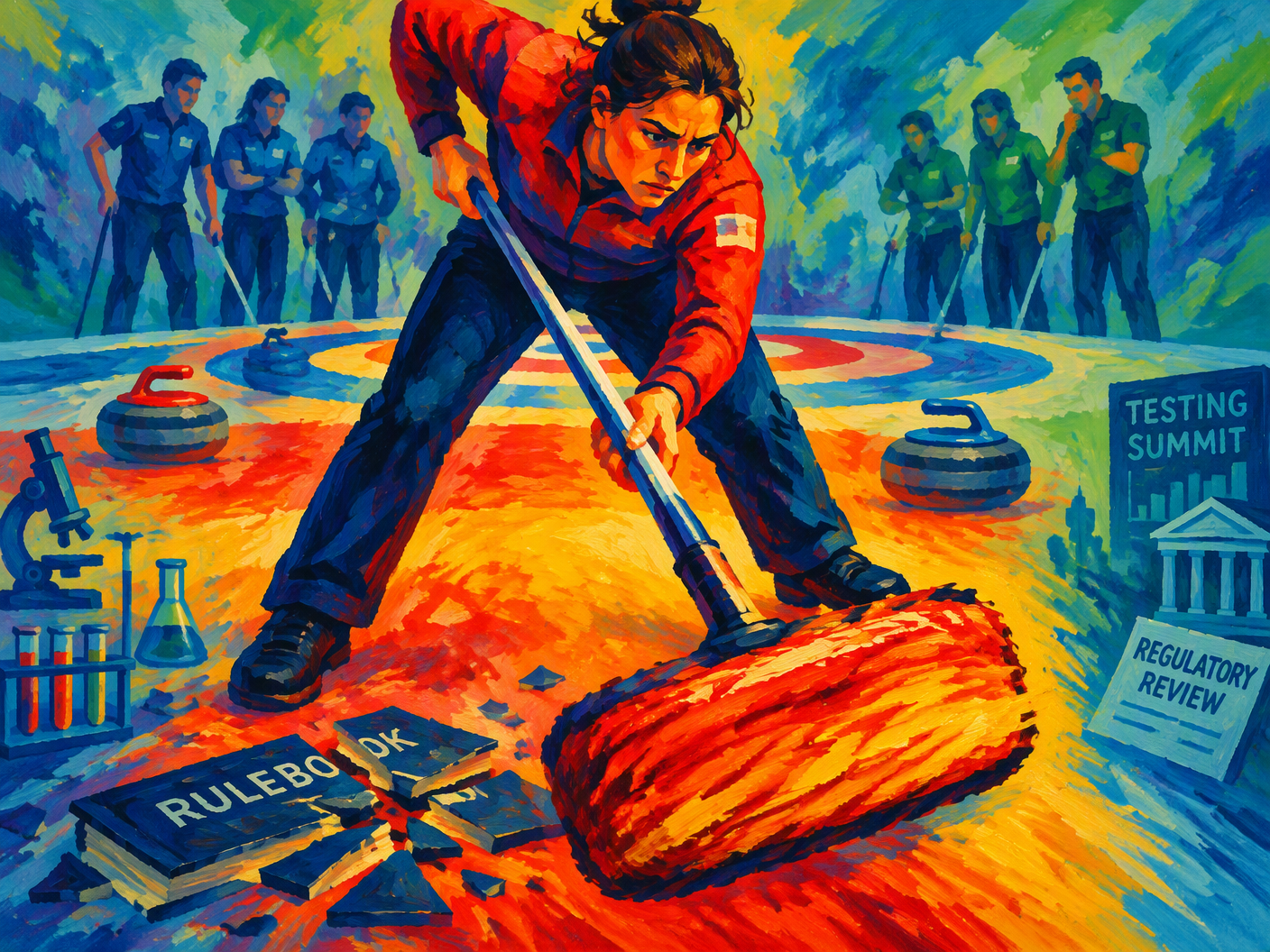
In September 2015, at the GSOC Tour Challenge in Paradise, Newfoundland, Brad Gushue’s team introduced a one-sweeper technique using a new generation of brush heads. Curling had always allowed sweeping to alter a stone’s path and distance, but the new materials gave that familiar act a different force. One player could work the ice with a level of control that drew immediate attention from other elite teams. The issue was no longer only which shot a skip called. It was whether the brush itself had become an instrument capable of changing the terms of the shot.
The materials had entered high-level play gradually. During the 2014–15 World Curling Tour season, leading teams began using new brush-head technology, including Hardline Curling’s icePad. Mike McEwen’s team and Reid Carruthers’s team were among those associated with the early adoption. Curling equipment had usually been treated as an extension of technique: a tool selected for feel, durability, and control. The newer heads made the boundary less settled. Their interaction with prepared ice and sweeping pressure became a competitive question, then an administrative one.
Gushue’s demonstration gave the debate a visible form. A single sweeper working ahead of a stone suggested that the equipment could amplify a player’s contribution beyond the traditional division of labor. Teams did not need a criminal act or an accusation of fraud to recognize a competitive dispute. They needed only to see that different fabrics and brush constructions could produce different results on the same sheet of ice. The controversy acquired the name Broomgate during the 2015–16 season, a label that made a technical disagreement legible to the wider curling public.
Glenn Howard’s team responded through the ordinary channels of elite competition: it called its broom supplier and asked for rival brush heads to be developed. Mike McEwen’s team used Hardline heads while the debate continued. At the 2015 Stu Sells Toronto Tankard, McEwen and Howard met in the final, bringing the equipment dispute into a contest between teams operating at the highest level of the Canadian game. The argument was not abstract. Every head, fabric, and sweeping motion belonged to a team trying to win under rules that had not yet caught up with the technology.
The World Curling Federation intervened in November 2015 by imposing a moratorium on new brush heads. The decision paused the introduction of additional designs while the governing body considered how sweeping and equipment were affecting play. It was an administrative response to a rapidly changing sport, not a criminal proceeding. No police investigation or formal cheating charge defined Broomgate. The central authority in international curling was attempting to hold competition steady while players, suppliers, and national organizations confronted materials that had developed faster than the rulebook.
The pause did not settle the technical question. It moved the dispute from tournaments into testing. In May 2016, curlers and researchers gathered in Kemptville, Ontario, for a Sweeping Summit organized with the National Research Council. More than 50 brush heads and sweeping techniques were tested. The gathering placed elite competitors beside scientific investigators and treated the broom as a measurable piece of equipment rather than a matter of preference or team loyalty. The sport was trying to determine what its players had already learned through competition: that small changes in material could have consequences on the ice.
John Cullen, a semi-professional curler, comedian, and podcast host, later placed himself among the early users of the brush-head fabric at the center of the dispute. His role reflected the wider circulation of the technology: the issue was not confined to a single champion or supplier, but moved through the competitive community as players tested what was available. The summit gave the controversy a common vocabulary. Instead of arguing only over who had gained an advantage, curlers could examine the construction of the head, the fabric’s behavior, and the sweeping method applied to it.
By September 2016, the World Curling Federation had chosen a narrower solution for sanctioned events. Only one standard fabric would be allowed. Curling Canada followed by banning other fabrics in its own sanctioned competitions. The change did not eliminate sweeping, and it did not erase the skill of the players who performed it. It established a common equipment baseline. Teams could still differ in strategy, weight, line, and execution, but the brush head would no longer vary across the field in ways the governing bodies had decided were too difficult to regulate consistently.
The rule also altered the relationship between suppliers and competitors. During Broomgate, manufacturers had helped produce the rival heads that teams used to answer one another. After the federation’s intervention, the legality of a fabric became a condition of entry into sanctioned play. The sequence was unusually clear: new materials spread through top-level events; a visible technique intensified concern; officials imposed a moratorium; researchers and players tested the alternatives; and the governing body standardized the approved fabric before the 2016–17 season. The lasting consequence was regulatory, not judicial.
The question returned on January 15, 2025, at the WFG Masters in Guelph, Ontario. Thirty men’s and women’s teams signed a document sent to World Curling raising concerns about the BalancePlus RS 2.0 Firm and Goldline Pursuer foam products. John Epping was asked not to use a specific foam product and complied. The episode echoed Broomgate without reproducing its full outcome: newer inserts had again made equipment a subject of collective player concern, while the formal status of those products remained a matter for the sport’s authorities.
Broomgate endured in curling’s rules because it changed how the sport understood a brush. It was no longer merely a handle and head carried onto the ice by a sweeper. It was equipment whose fabric, construction, and use could require testing, limits, and a common standard. The 2016 rule left the players’ decisions at the center of the game, but placed a boundary around the tool that helped execute them. In 2025, when teams again signed their names over foam inserts, that boundary was still doing the work created by the earlier dispute.
Investigative Dossier & Evidence
Read the companion investigation notes, verified source claims, and primary documents.
Read the Companion Notes & Evidence Record →