
Scandals & Feuds ·
Di Canio’s Derby Salute and Its Political Fallout
The Lazio striker denied political intent after the January 2005 gesture. Politicians challenged his account, and the league fined both him and his club.
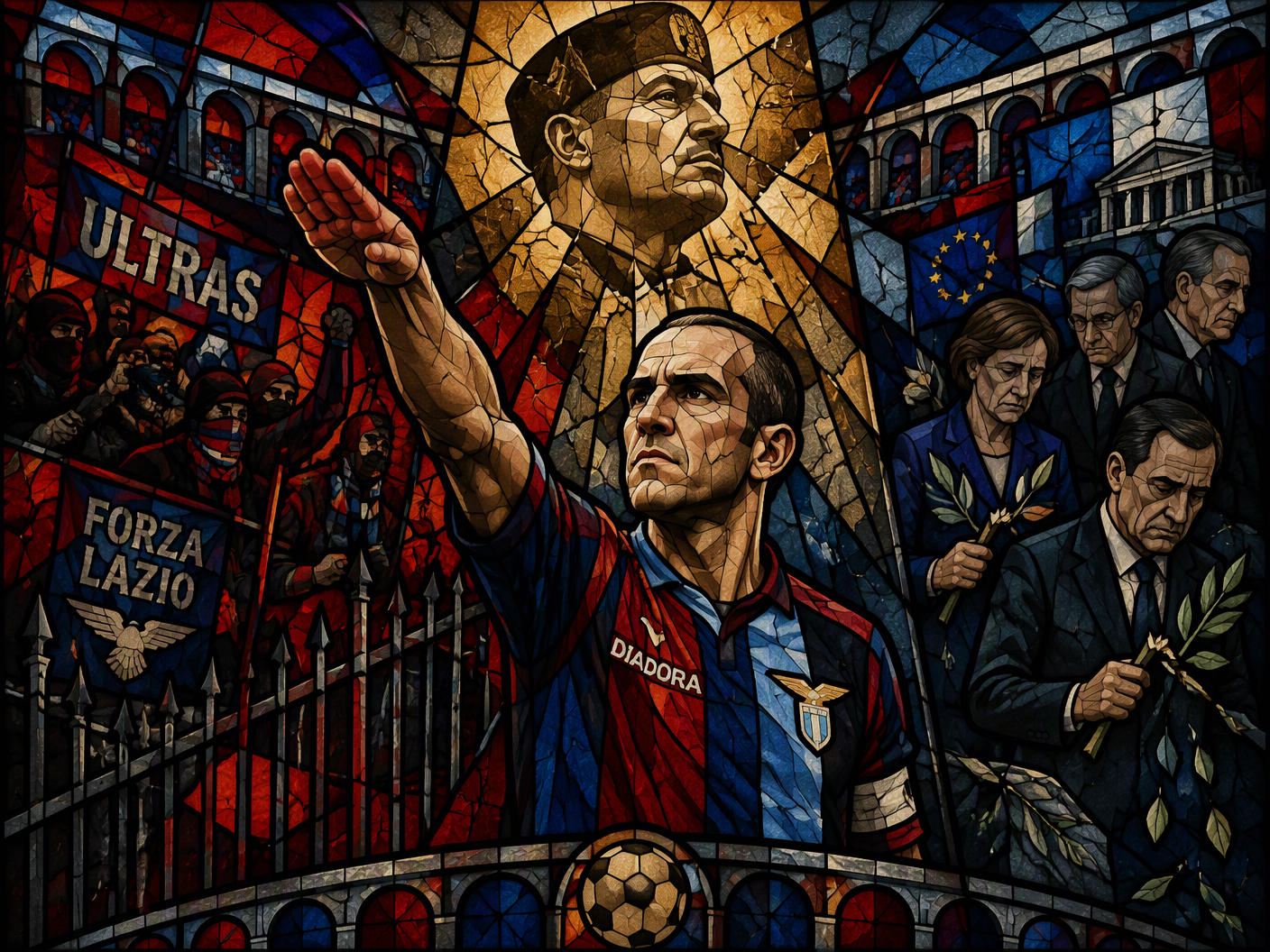
After scoring the opening goal in Lazio’s 3–1 derby victory over Roma in January 2005, Paolo Di Canio ran toward the club’s supporters and raised a stiff arm. Photographs of the celebration prompted an Italian football federation investigation. CNN described the gesture as identical to the “Roman salute” used by followers of Benito Mussolini.
Di Canio denied that the celebration carried a political message. “My celebrations had nothing to do with political behaviour of any kind,” he said, distancing himself in particular from Alessandra Mussolini, the dictator’s granddaughter and a far-right politician. She welcomed the gesture: “How nice that Roman salute was, it delighted me so much,” she said, promising to send him a thank-you note.
The objections were not confined to politicians on the left. Rocco Buttiglione, Italy’s conservative minister for EU affairs, said the salute brought back painful memories. “Sport should bring people together but the symbols of that terrible civil war can only divide,” he said. Centre-left politician Enzo Foschi said he respected Di Canio as a footballer but regarded the gesture as giving legitimacy to fascism.
Di Canio’s history gave those responses a context beyond the photographs. He had been a hardcore Lazio “ultra” in his youth before joining the club as a player. In his autobiography, he described himself as “fascinated” by Mussolini and called the dictator “deeply misunderstood” and “basically a very principled, ethical individual.” His account of the derby celebration nevertheless denied political intent.
On March 10, 2005, the Italian Football League fined Di Canio €10,000 and imposed an equal fine on Lazio. By then, according to the BBC, he had also claimed that the gesture was a misrepresentation by the cameraman. The league’s disciplinary commission ruled that it had “immediately and unequivocally recalled a precise political ideology.” It said players should not make gestures indicating political ideologies that could potentially provoke a violent reaction from fans.
The derby was not the last dispute over his raised arm. Later that year, the Telegraph reported that Di Canio had made the salute for the third time within a year. Italian football authorities imposed a one-game ban and a fine of almost £7,000 for the latest incident. FIFA president Sepp Blatter suggested that a lifetime ban might be more appropriate, but the supplied reporting does not say such a ban was imposed.
In that later episode, Di Canio gave an explanation markedly different from his initial denial of political content. “I am a fascist, not a racist,” he told the Italian news agency Ansa. He described the gesture as a salute from a “camerata” to “camerati,” terms for members of Mussolini’s fascist movement. “The salute is aimed at my people,” he said. “With the straight arm I don’t want to incite violence and certainly not racial hatred.”