
Bizarre & Myths · 1800s–2020s
The Record Behind “Redskin”
An 1863 newspaper line, a translated 1769 speech, and a disputed 1699 letter trace the documented history of the word while a reference source rejects its scalp-or-dye origin story.
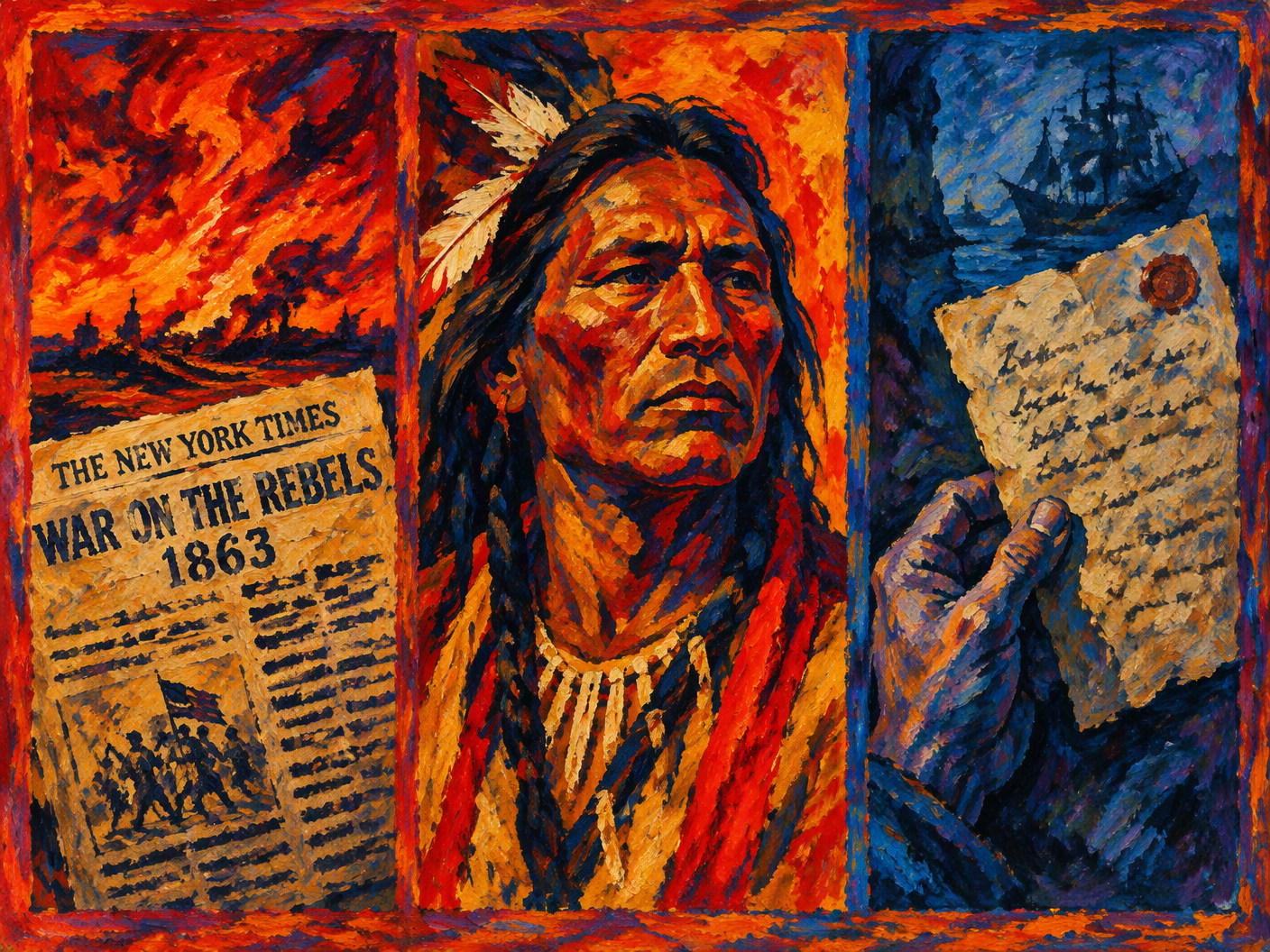
The University of Minnesota’s Center for Holocaust & Genocide Studies guide reproduces an 1863 newspaper line wishing “every red-skin sent to Purgatory.” The guide presents the sentence in a war-history resource, where the term appears in language directed against Native people. The quotation stands in the record after the 1769 occurrence identified by Ives Goddard and before the disputed 1699 letter is examined.
WordOrigins says claims that “redskin” came from scalping or red dye are false. Goddard’s documented conclusion places the first documented occurrence instead in a 26 August 1769 speech by Chief Maringouin, as translated by William Johnson. The source tradition is a translated and later-reported account, not the original-language text.
History News Network says Johnson was a British lieutenant colonel translating an Indian chief’s letter. Its timeline quotes Maringouin’s message as promising safe passage if the officer visited the tribe. WordOrigins likewise says the term was first recorded in a transcript and translation of Maringouin’s speech.
The earlier Samuel Smith letter, quoted in standard references, is the evidence Goddard disputes. He argues that the 1699 letter is not authentic evidence for “redskin” and describes the published version as a later fabrication based on Helen Evertson Smith’s materials. Goddard notes that the letter was printed in a 1900 book rather than preserved as an original. In Smith’s notebook, the wording was “if the Indians were treated”; the published version read, “iff ye Red Skins was treated.”
The University of Minnesota guide places the 1863 quotation in the history of a conflict in which hundreds of Dakota women, children, and elderly people were interned on Pike Island below Fort Snelling.
Investigative Dossier & Evidence
Read the companion investigation notes, verified source claims, and primary documents.
Read the Companion Notes & Evidence Record →