
Bizarre & Myths · 2010s
Dikembe Mutombo’s Tweet Before the 2016 NBA Draft Lottery
Dikembe Mutombo congratulated the Philadelphia 76ers on securing the first pick before the NBA conducted its 2016 draft lottery. The league’s procedure later produced the result his message had announced.
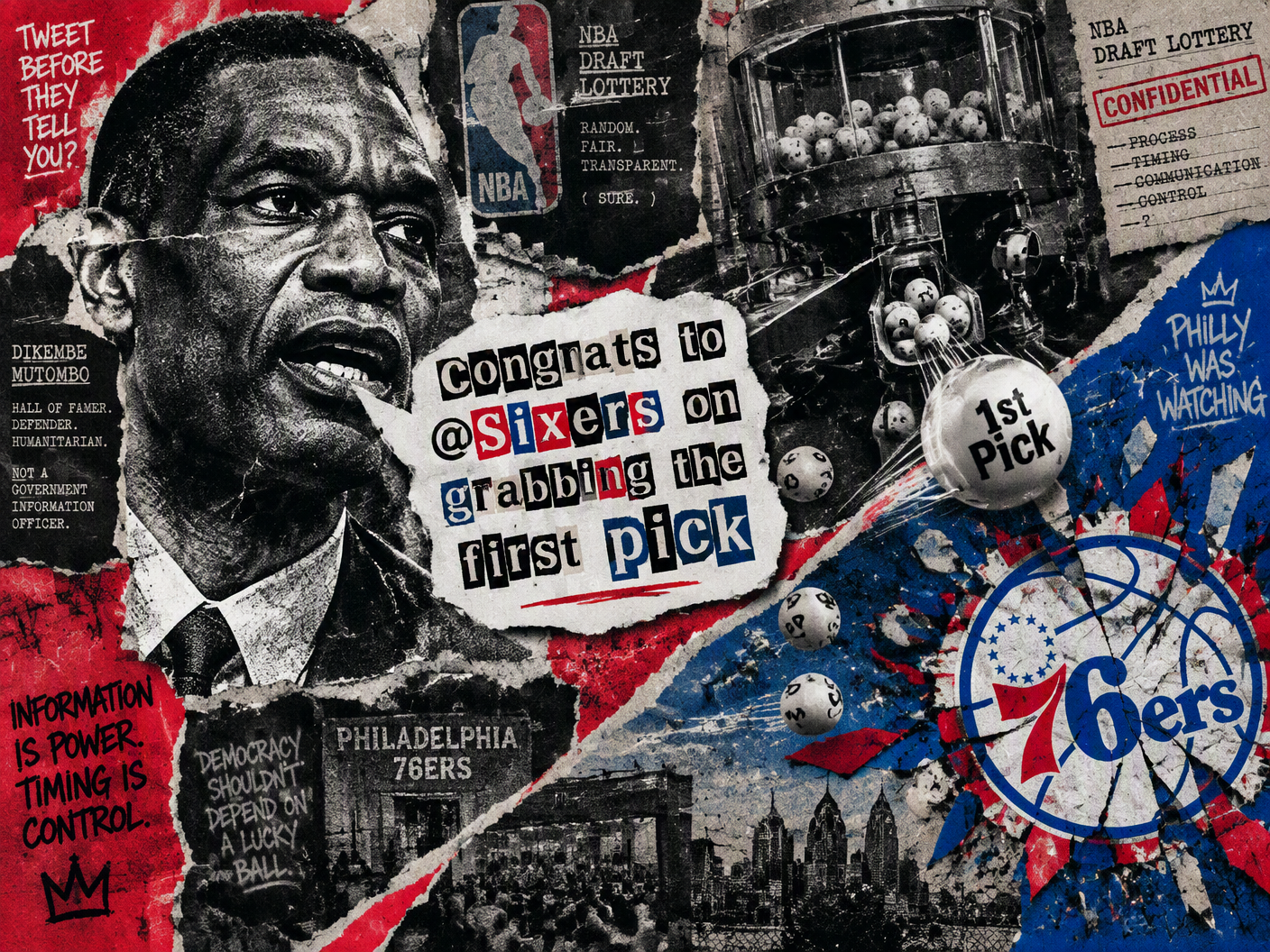
On May 17, 2016, before the NBA had conducted its draft lottery, Dikembe Mutombo published a result. “Congrats to @Sixers on grabbing the first pick in the #NBADraft,” the former player wrote on Twitter. The sentence was brief, declarative and premature. Philadelphia had not yet been awarded anything. The league procedure that would determine the first selection still lay ahead, leaving Mutombo’s congratulations suspended between prediction and apparent disclosure. Once posted, however, the message could not be confined to whatever intention had produced it. It named the team, named the prize and presented an unsettled question as a completed event.
The timing gave the tweet its significance. A congratulatory message issued after the lottery would have been routine; the same words sent beforehand reordered the event. An official process was supposed to produce a result, after which players, executives and spectators could respond. Mutombo had reversed that sequence. He responded first. The lottery remained to be conducted, yet his wording allowed no room for uncertainty: the 76ers had “grabbed” the first pick. The message contained no visible hesitation and no explanation. Its meaning depended on what happened next, under the authority of the league rather than the confidence of the person who had posted it.
The draft lottery had been part of the NBA’s allocation system for decades, though its format changed over time. In 1987, it determined the order in which the league’s seven worst teams would select in the draft. That arrangement placed a league-administered drawing between poor performance and access to incoming talent. A losing record could secure entry into the process, but it did not by itself settle the order. The lottery did that. Its function made the timing of any advance claim especially sensitive: the procedure existed precisely because the final selection order remained undecided until the NBA completed it.
By 2016, the details were different from those of 1987, but the essential institutional division remained. Teams entered the lottery under rules established by the NBA; the league conducted the process; the outcome assigned the first pick. Public anticipation rested on that order of operations. Mutombo’s tweet possessed no formal authority within it. He could not award Philadelphia the selection, amend the draft order or substitute a social-media post for the league’s result. Yet the specificity of his message made it difficult to dismiss as generic encouragement. He had identified one club and the most valuable position before the authorized process had supplied either.
For the moment, the tweet and the lottery occupied separate categories. One was a public statement by a former NBA player. The other was the league’s method of determining draft order. They became entangled because Mutombo did not write that he hoped Philadelphia would win, believed it would win or wished the franchise good luck. He congratulated the 76ers for having won. The completed tense transformed an ordinary expression of support into an apparent announcement. Readers encountering it before the lottery had to decide whether they had seen a mistaken prediction, an accidentally early message or something that carried knowledge unavailable to them.
Then the NBA conducted the lottery. The Philadelphia 76ers received the first overall pick. The official outcome matched Mutombo’s premature congratulations exactly where it mattered: the team and the position. His post had not influenced the league’s determination, but the determination changed the public meaning of the post. Had another team received the selection, the message could have been set aside as an error. Philadelphia’s victory preserved the timing problem instead. What had first appeared to be an unsupported declaration now looked, in retrospect, like an accurate announcement issued before the institution authorized to decide the matter had done so.
That alignment added another layer of intrigue to the lottery. The curiosity did not arise from complicated language or an ambiguous reference. Mutombo had named the 76ers, specified the first pick and posted before the drawing. The 76ers then won it. Each component was easy to understand, which made the episode unusually portable: a screenshot, a timestamp and a final result could condense the entire sequence. Social media favored precisely that compression. The interval between statement and outcome disappeared, while the apparent foresight remained. A premature message became a compact object onto which suspicions about a closed league procedure could be placed.
The chronology, restored in full, was less expansive than the speculation it invited. Mutombo posted first. The NBA conducted the lottery second. Philadelphia received the first selection third. Those events established an extraordinary coincidence of timing and outcome, not an account of how Mutombo composed the message or why he sent it when he did. The tweet itself offered congratulations and nothing further. It did not describe the lottery process, identify a source or explain how the result had supposedly become known. The official proceeding supplied the result; the earlier post supplied the enduring question around it.
The episode exposed a modern vulnerability in an old institutional ritual. The league’s authority depended on procedure, while public confidence could be unsettled by a few words released ahead of schedule. Once the eventual result matched those words, the official chronology had to compete with the simpler chronology suggested by the tweet: Mutombo announced it, and then it happened. Simplicity gave that version force, but not proof. A correct statement made before an event can be evidence of luck, assumption, error or knowledge; accuracy alone cannot determine which. In this case, the message established its own timing, while the lottery established Philadelphia’s draft position.
Philadelphia’s first overall pick entered the NBA’s formal draft order. Mutombo’s sentence entered the event’s afterlife. The two remained joined because the official result confirmed the premature wording without explaining its origin. What endured was not a demonstrated scheme, but a sequence precise enough to resist easy dismissal: a former player congratulated the 76ers before the league acted, and the league later awarded them exactly what he had named. The lottery retained its institutional result. The tweet retained its timestamp. Together they left a small, durable conflict between what the NBA had not yet decided publicly and what Mutombo had already declared.
Investigative Dossier & Evidence
Read the companion investigation notes, verified source claims, and primary documents.
Read the Companion Notes & Evidence Record →