
Scandals & Feuds · 1990s
Doug Gilbert’s Live Shoot Interview and the Lawler Family Wrestling Line
On October 23, 1999, Doug Gilbert used a live Power Pro Wrestling broadcast to challenge the invented boundaries that made professional wrestling believable. His claims about Jerry Lawler and Brian Christopher triggered backstage retaliation, a demand for the interview tape, and pressure that followed the promotion toward closure.
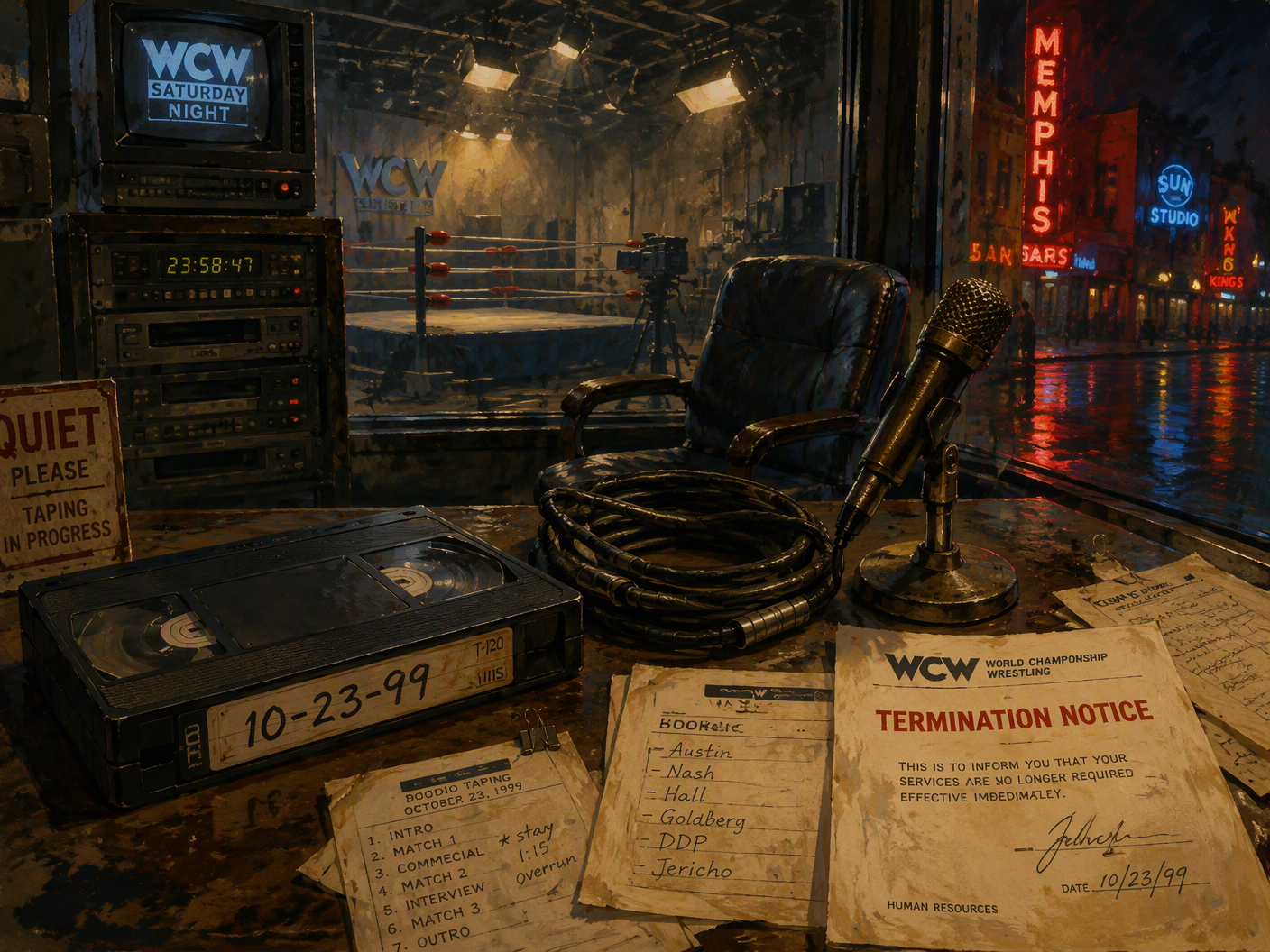
The television lights burned white over Memphis on October 23, 1999. Doug Gilbert sat in the broadcast space with the wrestling business laid out before him: leather bodies, painted rivalries, family names, and the old agreement that nobody would turn the machinery inside out. Then he did. Gilbert delivered a live shoot interview—a wrestling conversation stripped of the usual scripted guardrails—and aimed it at Jerry Lawler. The words were personal. They were combustible. By the time the segment ended, the room had lost its clean division between performance and fact.
The target was not only Lawler. Gilbert pulled Brian Christopher into the light and attacked the story built around his career. Christopher was Lawler’s son, and Gilbert claimed that bloodline had carried him farther than the public version of professional merit allowed. In wrestling, that distinction was the product. A feud needed villains and heroes. A rising wrestler needed a ladder, not a father holding the roof above him. Gilbert’s accusation struck at the ladder itself. It told viewers that the family connection behind the curtain mattered more than the contest presented in front of it.
For decades, the business had survived on a peculiar discipline. The punches could be staged; the consequences were not. Wrestlers protected the fiction because the fiction paid them. Fans entered through the bright door and agreed to leave their skepticism outside. Gilbert walked that skepticism back into the room. His interview exposed personal information about Lawler while challenging the promotion’s accepted narrative about Christopher. The broadcast became more than an argument between wrestlers. It became a public breach in the wall separating the character from the man, the son from the résumé, the show from the business that sold it.
The reaction moved quickly through Power Pro Wrestling. Backstage tension followed the broadcast, and Gilbert was fired from the promotion shortly afterward. The dismissal carried its own message. A wrestler could threaten an opponent with violence inside the story and remain useful. A wrestler who threatened the story itself became a liability. Gilbert’s punishment was professional before it was philosophical: no more place in the operation, no more regular access to its television platform. The same medium that had carried his words became the door through which he was pushed.
Jerry Lawler sought a tape of the interview. That choice gave the episode weight beyond ordinary locker-room friction. A tape preserves the voice, the phrasing, the pauses—the things a denial cannot easily sand away. Gilbert’s claims had moved from a hot microphone into a physical object that could be replayed, copied, circulated, and used as a weapon. The demand for the recording placed the old wrestling fear in plain view: not the fear of an opponent’s punch, but the fear that a forbidden sentence might survive the night.
Lawler occupied a special position in Memphis wrestling. He was a performer and a promoter, a man who understood both sides of the camera. Brian Christopher stood within that same orbit as wrestler and son. Gilbert’s interview forced those roles into the same frame. A father’s influence could no longer remain safely disguised as professional opportunity. A son’s success could be discussed not as a sequence of matches, but as the product of access, protection, and inherited power. The accusation did not merely insult a family. It challenged who had been allowed to define achievement.
That was the dangerous arithmetic of a shoot interview. In the ring, every blow could be folded into the program. Outside it, a claim about favoritism attached itself to contracts, bookings, television time, and the invisible chain of favors that keeps a small wrestling territory alive. Gilbert’s words gave the audience a glimpse of that chain. They also gave the people inside the operation a reason to cut him loose. The business needed conflict, but only the kind it could package. Gilbert supplied conflict without permission.
Power Pro Wrestling then faced operational problems that carried the promotion toward its eventual closure. The interview did not stand alone as a single lever that can be cleanly pulled to explain everything that followed. It became part of the pressure surrounding an already fragile operation. Television required organization. Wrestling required trust, money, talent, and control of the message. Once those pieces began grinding against one another, the promotion had less room for a public rupture between its performers and its power structure.
The implications reached past one broadcast. Gilbert had shown how quickly the invented world of wrestling could be undermined by a performer who knew where the bodies were buried—not literal bodies, but the private arrangements behind public victories. The audience did not need a contract in its hands to understand the threat. If Christopher’s rise could be explained through his father, then the promotion’s claims about merit became vulnerable. If Lawler could be named inside the show, then authority was no longer protected by the bell.
Memphis wrestling had always traded in intimacy. The stars were not distant figures in a sealed arena; they were local royalty, familiar names moving through a business built on loyalty and repetition. That closeness made Gilbert’s interview sharper. He did not attack an abstract institution from a safe distance. He aimed at people whose professional lives were bound together by family, promotion, and television. The personal and the commercial occupied the same narrow room. One sentence could damage a relationship, a reputation, and a company’s operating floor.
What remained after the lights went out was not a clean victory for one side. Gilbert lost his position with Power Pro Wrestling. Lawler and Christopher faced the public force of claims that reached into their family and professional standing. The promotion continued under pressure before its eventual closure. The interview endured because it exposed the bargain at the center of the spectacle: wrestling depended on audiences believing the fiction, while wrestlers depended on one another not to reveal how the fiction was made.
On that October night, Doug Gilbert did not break the ring. He broke the glass around it. The old story said the performance was the truth for two hours and nothing more. Gilbert answered with the harder proposition—that the business had its own bloodlines, gatekeepers, and punishments, and that the man who named them could be removed before the tape stopped turning. The broadcast became a fault line in Memphis wrestling: a moment when the secret machinery showed through, and the show could not quite cover it again.
Investigative Dossier & Evidence
Read the companion investigation notes, verified source claims, and primary documents.
Read the Companion Notes & Evidence Record →