
Tragedy · 1950s
Ed Sanders, Willie James, and the Boston Garden Fight That Ended in Death
Ed Sanders carried an Olympic heavyweight gold medal from Helsinki into professional boxing, then entered Boston Garden on December 11, 1954, for the New England heavyweight title. Willie James knocked him out in the eleventh round; Sanders was carried from the ring, never regained consciousness, and died the next day.
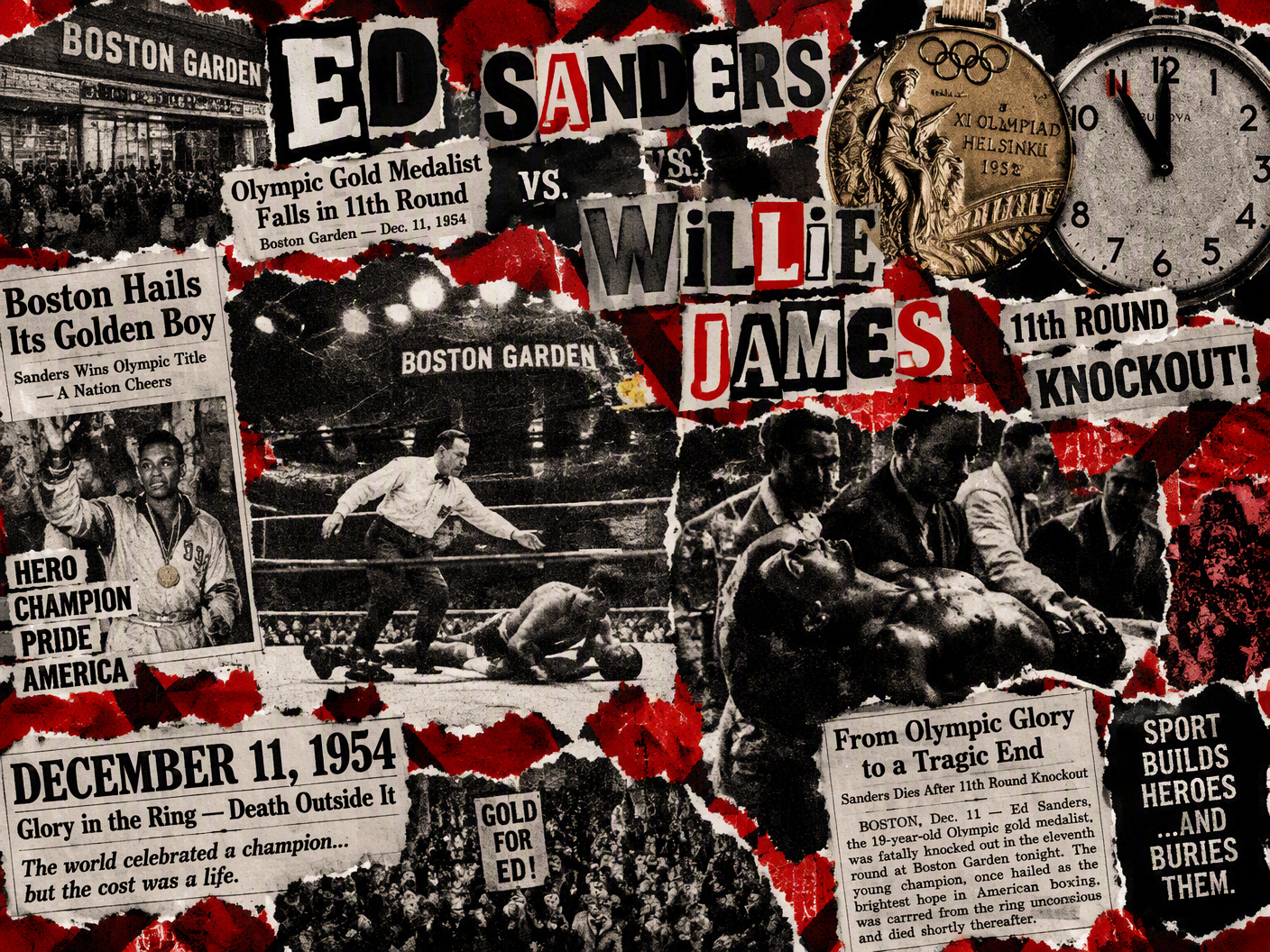
On December 11, 1954, Ed Sanders entered Boston Garden to fight Willie James for the New England heavyweight title. It was a professional contest held more than two years after Sanders had become an Olympic champion, and it carried the ordinary visible terms of a title bout: two heavyweights, a ring, an eleventh round still to be completed. That round changed the course of Sanders’ life. James knocked him out. Ring personnel carried Sanders away after the fight, and he did not return to consciousness.
Sanders died in Boston on December 12, 1954, eighteen hours after the bout. He was twenty-four years old. The interval between the knockout and his death gave the event a terrible finality: the evening had begun as a regional championship contest and ended with a young heavyweight removed from the ring, unconscious, while the next day brought news of his death. The Olympic gold medal remained part of his name, but it could not alter the sequence that had unfolded in Boston.
Ed Sanders had been born in Los Angeles, California, on March 24, 1930. His ascent in boxing reached its clearest public milestone in Helsinki during the summer of 1952. From July 29 through August 2, he boxed in the Olympic men’s heavyweight tournament, the division that placed the largest men in amateur boxing under the scrutiny of national teams and international officials. Sanders emerged from that competition with the gold medal for the United States.
The final brought Sanders together with Sweden’s Ingemar Johansson. Johansson was disqualified for lack of aggressiveness, and Sanders received the Olympic heavyweight championship. The result made Sanders an Olympic gold medalist at an age when a boxer’s career still appeared to be opening rather than closing. Olympic success could confer a durable public identity, particularly in heavyweight boxing. For Sanders, Helsinki became the achievement by which his career would continue to be introduced, even after Boston gave that career its final date.
Between Helsinki and Boston lay the shift from amateur competition to the professional ring. The two settings placed different demands on a boxer, but Sanders’ Olympic standing followed him into that later work. By December 1954, the decisive contest was no longer an international tournament match but a fight for the New England heavyweight title. Willie James stood across the ring from him at Boston Garden, a venue built for public contests in a city where boxing had long occupied a regular place on the sporting calendar.
The fight lasted into the eleventh round. That detail matters because Sanders was not merely defeated on a scorecard or stopped in an early exchange; the bout continued through ten completed rounds before James knocked him out in the eleventh. A title fight can be remembered by its winner, its belt, or its place in a local boxing schedule. This one became fixed instead by the condition in which Sanders left the ring. He had to be carried away.
From that point, there was no recovery into the ordinary aftermath of a fight: no later public appearance, no return to training, no further contest. Sanders never regained consciousness after the knockout. The fact joined the fight and the next day in a single, unbroken passage of time. Eighteen hours after the Boston Garden bout, he was dead in Boston. His death placed an irrevocable human cost beside a professional title contest that had begun as another step in a heavyweight career.
Sanders’ story is often compressed into two images: the Olympic medal in Helsinki and the knockout in Boston. The compression is accurate as far as it goes, but its force comes from the short distance between the two events. In 1952, Sanders stood at the summit of amateur heavyweight boxing. In 1954, he fought for a regional professional championship. The same athlete whose name had been attached to an Olympic victory was carried from a ring after an eleventh-round knockout and died the following day.
Willie James’ role in the final bout is equally plain. He was Sanders’ opponent for the New England heavyweight title, and he delivered the eleventh-round knockout. Boxing records often preserve a bout in the compact language of opponent, round, and result. Here those terms cannot be separated from what followed. James’ name remains attached to Sanders’ last fight because the contest’s outcome was followed by Sanders’ removal from the ring, his continuing unconsciousness, and his death eighteen hours later.
What endured was a narrow, grave chronology. Ed Sanders, born in Los Angeles in 1930, won Olympic heavyweight gold in Helsinki in 1952. On December 11, 1954, he fought Willie James for the New England title at Boston Garden and was knocked out in the eleventh round. He was carried from the ring and never regained consciousness. His death in Boston on December 12 placed his Olympic triumph and his final fight together in the permanent outline of his career.
Investigative Dossier & Evidence
Read the companion investigation notes, verified source claims, and primary documents.
Read the Companion Notes & Evidence Record →