
Point Shaving & Fixes · 2000s
The Bribed Referees and Brazil's Replayed Championship
In 2005, referees Edílson Pereira de Carvalho and Paulo José Danelon accepted bribes to manipulate matches in Brazil's national championship. The sporting tribunal annulled eleven matches, ordered them replayed, banned both officials for life, and left the Brazilian federation to crown Corinthians while clubs were still contesting the wreckage.
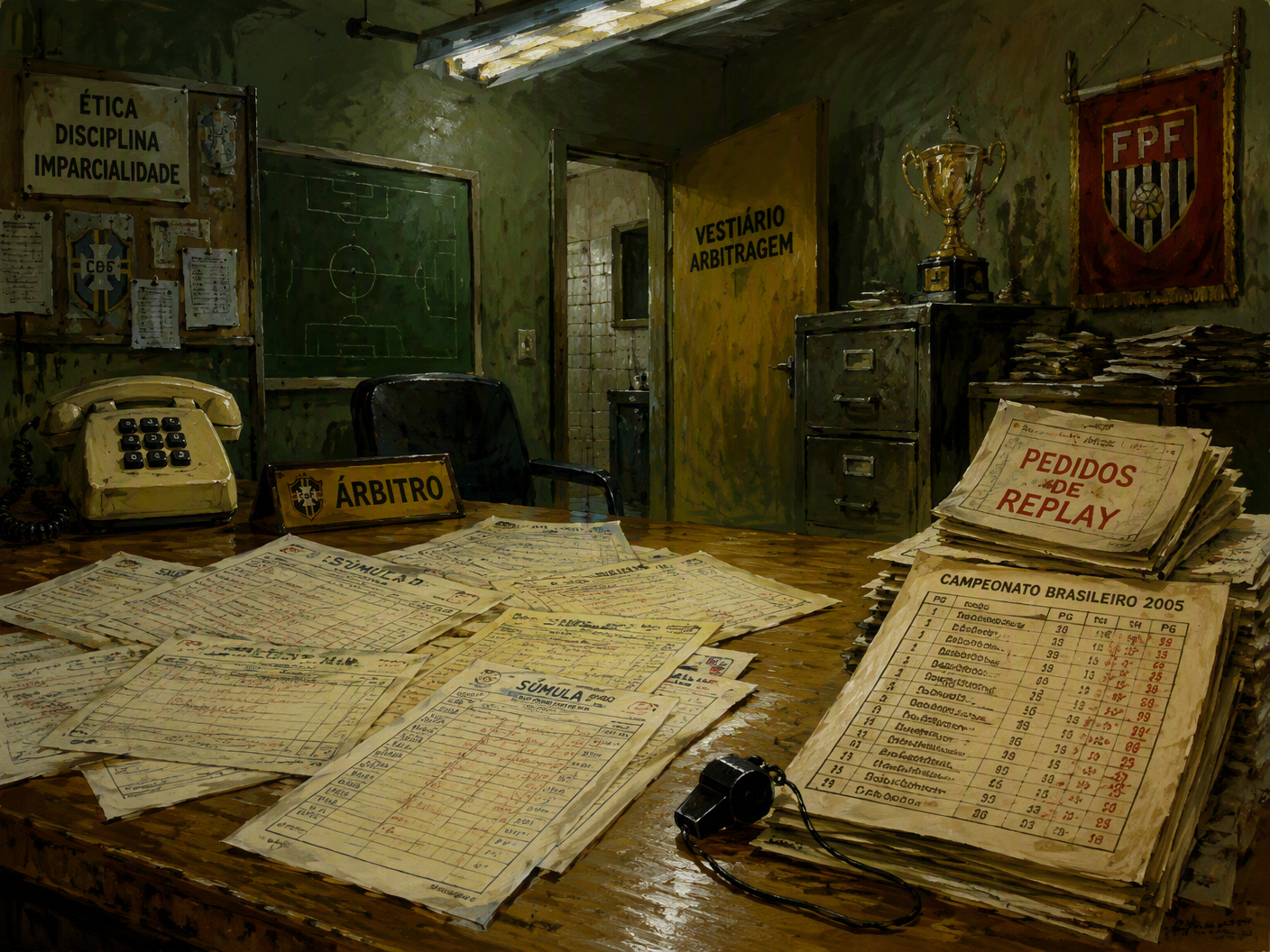
Brazilian football had spent decades presenting its championship as a national ritual, complete with sacred colors, municipal loyalties, and enough solemn speeches to furnish a ministry. Then, on September 23, 2005, the ritual acquired a less ceremonial accessory: a match-fixing scandal. The names were Edílson Pereira de Carvalho and Paulo José Danelon, two referees who had accepted bribes to influence matches in the Campeonato Brasileiro. The game’s guardians had promised fair competition. The paperwork, as usual, had other plans.
The scandal entered public life through Veja, which reported the arrangement on that September day. What emerged was not a dispute over one doubtful penalty or a referee’s bad evening under the lights. Carvalho and Danelon had been involved in fixing matches during the 2005 national championship, converting the referee’s whistle from an instrument of judgment into a small, portable business office. The sums may have been less grand than the stadiums around them, but corruption has never required a magnificent budget. A bribe fits comfortably in a pocket.
Carvalho became the central figure in the collapse because eleven matches he had refereed were subsequently annulled. Eleven is an awkward number for anyone selling the idea of an isolated mishap. It is too large for a clerical error and too small to flatter an institution that had permitted the machinery to operate. Each match carried its own result, table position, celebration, complaint, and collection of men in bad suits explaining that everything remained under control. The control, it turned out, was mostly decorative.
The Supreme Court of Sporting Justice, known by the crisp bureaucratic initials STJD, ordered all eleven matches to be replayed. A championship built over months was thus disassembled and sent back onto the field like faulty merchandise. The clubs affected did what clubs do when an institution revises reality after the fact: they appealed. Their objections moved through the tribunal’s machinery while officials contemplated the unusual spectacle of a competition whose finished games had become provisional.
The STJD upheld the decision despite appeals from several clubs. The ruling did not merely punish two referees; it altered the competitive landscape for every team that had earned, lost, or built strategy around the annulled results. Players trained again for matches they had already survived. Supporters were asked to invest emotional capital twice. Administrators reached for the language of integrity, the favorite currency of institutions forced to admit that integrity had required a replay button.
For Carvalho and Danelon, the sporting tribunal imposed the permanent sentence available within Brazilian refereeing: both were banned for life. The punishment removed them from the profession and fixed their names to the scandal’s central mechanism. They had not merely made mistakes in judgment. They had accepted money to manipulate the contest whose legitimacy depended on their decisions being independent. The official uniform, once associated with authority, now looked like a very expensive way to identify the subcontractors.
The annulments created a second crisis, less theatrical but more consequential. A league table is a machine for turning uncertain athletic events into a public hierarchy. Once eleven results were withdrawn, the machine had to be restarted while everyone argued over who had been damaged by the original settings. Clubs appealed because standings affect titles, revenue, prestige, and the ordinary institutional appetite for claiming that yesterday’s money was earned fairly. The replay order made the corruption visible in the most practical language possible: fixtures, points, travel, expense, and resentment.
By late autumn, the championship had become a dispute conducted beneath the formal surface of competition. Matches were replayed; appeals continued; officials defended the tribunal’s intervention while clubs examined the consequences with the tender suspicion of creditors inspecting a bankrupt debtor’s accounts. Nobody needed a metaphor. The tournament itself had been forced to testify. Its amended results carried the fingerprints of the scandal, even as the administrators tried to restore the clean geometry of a completed season.
On December 6, the Brazilian football federation announced Corinthians as champion of the 2005 Campeonato Brasileiro. The declaration arrived while disputes over the annulled matches were still alive, which gave the ceremony the atmosphere of a ribbon-cutting at a building site. Corinthians received the title through the federation’s official conclusion, but the route to that conclusion ran through bribed officials, erased fixtures, replayed games, and clubs still contesting the tribunal’s decision. A trophy can be polished. It cannot polish the calendar.
The implications extended beyond Carvalho, Danelon, and the eleven matches. The scandal prompted calls for reform and stronger oversight in Brazilian football, exposing weaknesses in the league’s operational structure. Oversight had failed where it was supposed to be most mundane: in the supervision of officials, the protection of results, and the detection of incentives that made manipulation profitable. The grand language of sporting purity had met the small machinery of access, discretion, and cash. The machinery had won until someone opened the file.
That is the peculiar afterlife of match-fixing: the whistle may be silenced, the referees expelled, and the fixtures replayed, but the competition does not return to its previous condition. Every disputed decision acquires a shadow. Every table invites arithmetic. Every official assurance must pass through the memory of a championship that had to manufacture its own past again. Brazilian football kept its champion, its governing bodies, and its language of integrity. It also kept the more durable fact that two referees had made the sacred game available for purchase.
Investigative Dossier & Evidence
Read the companion investigation notes, verified source claims, and primary documents.
Read the Companion Notes & Evidence Record →