
Tragedy · 1930s
The Primo Carnera Knockout and the Medical Dispute Over Ernie Schaaf’s Death
Ernie Schaaf was knocked out by Primo Carnera at Madison Square Garden on February 10, 1933, and died in New York four days later. The medical findings—meningitis and swelling of the brain—made the final bout central to the story, but the autopsy left the cause of the meningitis uncertain and pointed to a recent influenza attack as a reasonable probability.
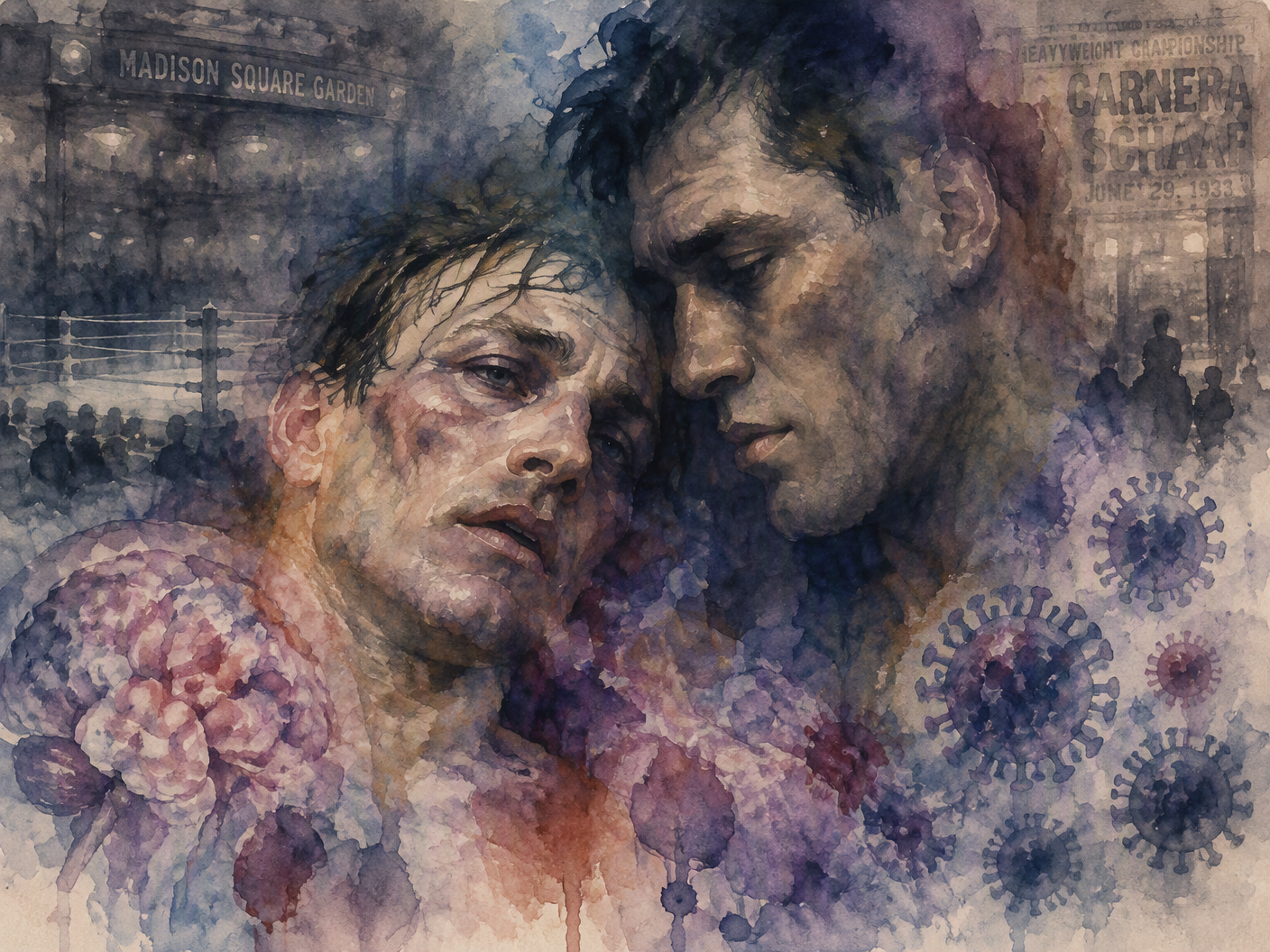
On February 14, 1933, in New York City, Ernie Schaaf died four days after Primo Carnera had knocked him out at Madison Square Garden. The interval gave the death its enduring shape: a heavyweight entered the ring on February 10, was stopped in the thirteenth round, and did not live to leave the episode behind. An autopsy found meningitis and swelling of the brain. Those findings identified the condition inside Schaaf’s body, but the medical explanation extended beyond the simple fact of a knockout. His death became a question of sequence—what belonged to the last fight, what belonged to the months before it, and what illness may have intervened.
At Madison Square Garden, Schaaf and Carnera fought through twelve rounds before the bout ended in the thirteenth. Carnera knocked Schaaf out, fixing the contest in the public record as a defeat rather than a decision or a stoppage on the scorecards. Four days later, Schaaf was dead. The closeness of those dates made the fight impossible to separate from the medical aftermath. Carnera was the last man to face him in competition, and the Garden was the last sporting venue connected to Schaaf’s life.
The four days between the knockout and death carried a different weight from the months that preceded them. A decision could be debated through scores and rounds; a knockout placed the body itself at the center of the event. Schaaf did not die at the instant the referee ended the contest, but his death followed before the episode had receded into ordinary boxing chronology. The final fight therefore became the natural hinge of the case, not because its meaning was simple, but because it was the last contest before the illness described by the autopsy.
The earlier chapter began on August 31, 1932, at Chicago Stadium. Schaaf fought Max Baer and lost by majority decision. The result placed Baer in the chain of events later attached to Schaaf’s death, but the form of the defeat mattered: Chicago ended with a decision, not the thirteenth-round knockout that closed the February bout. Five months and ten days separated the two fights. Schaaf’s last season was consequently remembered through two opponents, two cities, and two very different endings.
Chicago and New York were later joined in the explanation of what happened to Schaaf. Baer’s victory supplied an earlier point of reference; Carnera’s knockout supplied the immediate one. The chronology permitted both fights to remain in the same account without making them equal events. Schaaf had been defeated by Baer in August, then returned to the ring against Carnera in February. When death followed the second bout, the first fight acquired a significance it had not possessed on the night it was fought.
The claim that Max Baer had definitively killed Schaaf in the ring offered a clean answer to a complicated sequence. The documented contests provided a less convenient structure. Baer had beaten Schaaf by decision at Chicago Stadium; Carnera had knocked him out at Madison Square Garden. One bout preceded the other by more than five months, and only the second was followed immediately by death. The distinction did not remove Baer from the story, but it prevented the earlier decision from being treated as the final event in a chain that ended elsewhere.
The autopsy shifted the account from the language of rounds and opponents to the language of disease. It found meningitis and swelling of the brain. Those findings described serious conditions within Schaaf’s head, but they did not reduce the death to a single phrase such as knockout or ring injury. The medical examination supplied the physical facts that followed the fight: inflammation, swelling, and a death occurring four days after the contest. It also left room for a cause that could not be assigned solely by identifying the last man who struck him.
The uncertainty in the autopsy report was specific. It could not determine with certainty what had caused the meningitis, and it identified a recent attack of influenza as a reasonable probability. That possibility placed illness beside the February knockout in the explanation of Schaaf’s condition. The report did not turn the fight into an irrelevant detail; the short interval kept the bout at the center of attention. But the medical language resisted a single-origin narrative, preserving a distinction between the event that preceded death and the disease found after it.
Lucy Schaaf carried that distinction into her own response to Carnera. She told him that she did not consider him responsible for her son’s death. Her statement did not alter the dates, the knockout, or the autopsy findings. It placed a family judgment beside the public argument over the fight and its consequences. Carnera remained the opponent who had knocked Schaaf out four days before Schaaf died, while Lucy’s words rejected the conclusion that this sequence alone assigned him blame.
What endured was not one settled culprit but a tightly bounded sequence with an unresolved medical explanation. Schaaf lost to Baer by decision in Chicago, fought Carnera at Madison Square Garden, was knocked out in the thirteenth round, and died in New York four days later. Meningitis and swelling of the brain entered the medical record; a recent influenza attack remained a reasonable probability. The final fight could not be removed from Schaaf’s death, but neither could the death be assigned to it with the certainty that the calendar seemed to invite.
Investigative Dossier & Evidence
Read the companion investigation notes, verified source claims, and primary documents.
Read the Companion Notes & Evidence Record →