
Scandals & Feuds · 1930s-1960s
The NFL Color Line That Kept Black Quarterbacks Outside
Fritz Pollard became the NFL’s first Black quarterback in 1923, yet George Preston Marshall helped convert racial exclusion into league policy. The NFL lifted its informal color barrier in 1946; the quarterback position remained largely segregated until the late 1960s, and the consequences outlasted the ban.
In 1923, Fritz Pollard took the position the young NFL had not prepared to see a Black man occupy. He became the league’s first Black quarterback. Pollard also became the NFL’s first Black head coach, making him more than an exception on a depth chart: he directed the offense and the people running it. His achievement demonstrated that Black athletes could handle the ball, read the field, and command a team before the league built a structure willing to make that opportunity repeatable.
Nine years later, George Preston Marshall founded the Boston Braves. The franchise later became known as the Washington Redskins. Marshall controlled the club and helped turn his racial preferences into league machinery. He brokered an NFL-wide ban on Black players, and that barrier lasted until after World War II. The decision did more than remove names from rosters. It narrowed the league’s idea of who belonged on the field and who could hold authority over it.
The system needed no single sign above every locker. Ownership decisions, recruitment practices, roster construction, and coaching judgments could deliver the same result without repeating the policy aloud. A Black athlete might appear in the stands while the league denied him a uniform. A Black quarterback confronted an additional judgment: that leadership, intelligence, and command belonged elsewhere. Marshall’s franchise gave exclusion a public address; the league’s habits carried it from one personnel decision to the next.
Pollard’s breakthrough remained real, but it offered no protection to the players who followed. The league could celebrate a pioneer in retrospect while closing the position to other Black quarterbacks in practice. That contradiction produced a distinctive psychological burden. Each prospect had to prove individual competence against a racial assumption that treated one mistake as confirmation and one success as an exception. The quarterback could not simply perform; he had to argue, play by play, for the legitimacy of his authority.
In 1946, the NFL lifted its informal color barrier and allowed Black players to join the league again. The change reopened rosters, but it did not erase the hierarchy that assigned positions. In 1949, George Taliaferro became the first Black player drafted into the NFL. He played quarterback as well as multiple other positions, giving coaches a versatile talent while also revealing the limits of a system that often valued Black athletic ability more readily than Black direction.
The quarterback room stayed different from the rest of the roster. Black players entered the league, but the quarterback position remained largely segregated until the late 1960s. The distinction carried operational power. The quarterback handled the snap, called signals, read the defense, and absorbed blame when an offense failed. Integration allowed Black players onto the machine while withholding its controls. It also taught coaches and teammates to scrutinize a Black quarterback’s judgment more severely than his physical skill.
That scrutiny could shape an athlete’s entire working life. A quarterback who moved, improvised, or relied on athleticism risked classification as gifted but undisciplined. One who played cautiously risked a different accusation: insufficient command. The narrow corridor left little room for ordinary development. White quarterbacks could accumulate experience while the league treated Black quarterbacks as tests of a theory. The pressure did not reside only in the huddle; it followed players into evaluations, depth charts, and the public language surrounding every decision.
The formal barrier and the positional barrier therefore moved on different clocks. The NFL removed its broad exclusion in 1946, yet the quarterback position continued to resist Black leadership. The distinction matters because institutional change often arrives first in language and policy, while personnel habits preserve the old boundary. A team could call itself integrated and still decide that a Black player belonged at another position. The league’s public rule changed before its deepest assumptions did.
Doug Williams confronted that history in 1988, when he became the first Black quarterback to start in the Super Bowl. He did not merely occupy the position for a ceremonial moment. He led Washington in Super Bowl XXII, placing a Black quarterback at the center of the sport’s largest stage for the first time. His start carried the accumulated force of Pollard’s pioneering season and Taliaferro’s draft selection, but it also exposed the distance between those milestones.
Williams’ achievement changed what the league could plausibly deny without removing every old judgment. One Super Bowl start could establish access; it could not restore the seasons lost to exclusion or eliminate the pressure placed on the next Black quarterback. The psychological inheritance remained complicated: success could create opportunity for others while making the successful player carry the expectations of a group the institution had spent decades marginalizing. Visibility opened doors, but it also intensified the demand to justify them.
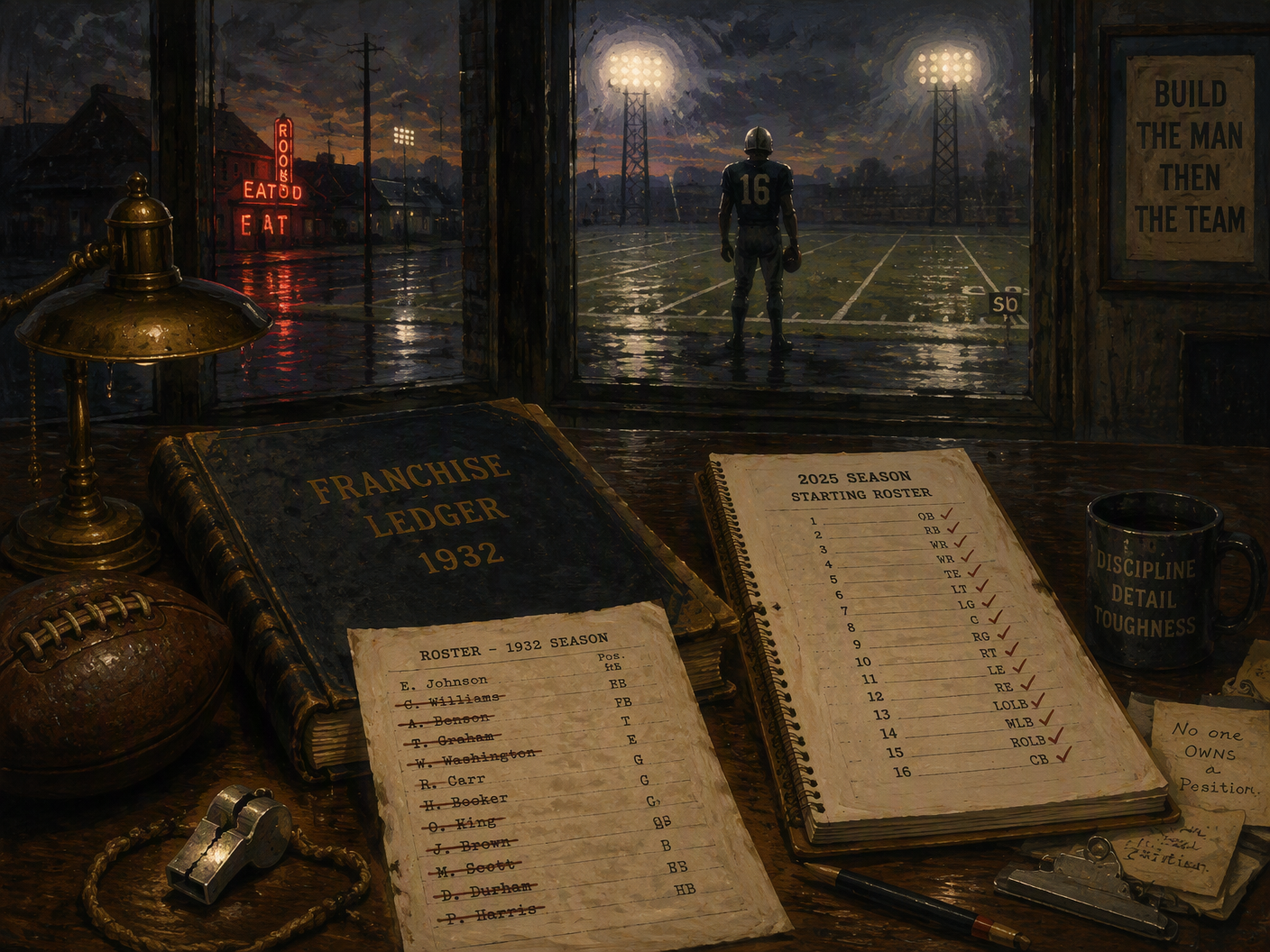
By the start of the 2025 season, the NFL expected a record 16 Black quarterbacks to start. That number marks a substantial change in access and perception. It does not make the earlier decisions harmless or turn a long institutional delay into a simple story of progress. Pollard broke the quarterback barrier in 1923. Marshall helped enforce the exclusion that followed. Taliaferro entered through the draft in 1949. Williams reached the Super Bowl in 1988. The sixteen projected starters show how far the league moved—and how long it took to move.
Investigative Dossier & Evidence
Read the companion investigation notes, verified source claims, and primary documents.
Read the Companion Notes & Evidence Record →