
Violence & Brawls · 2010s
The Saints Bounty Sanctions and the Appeals That Lifted Four Player Suspensions
In 2012, NFL Commissioner Roger Goodell punished the New Orleans Saints, its coaches, general manager, and four players over an alleged bounty system tied to rewards for injuring opponents. Within months, a collective-bargaining appeals panel lifted all four player suspensions, while Sean Payton returned only after Goodell reinstated him in January 2013.
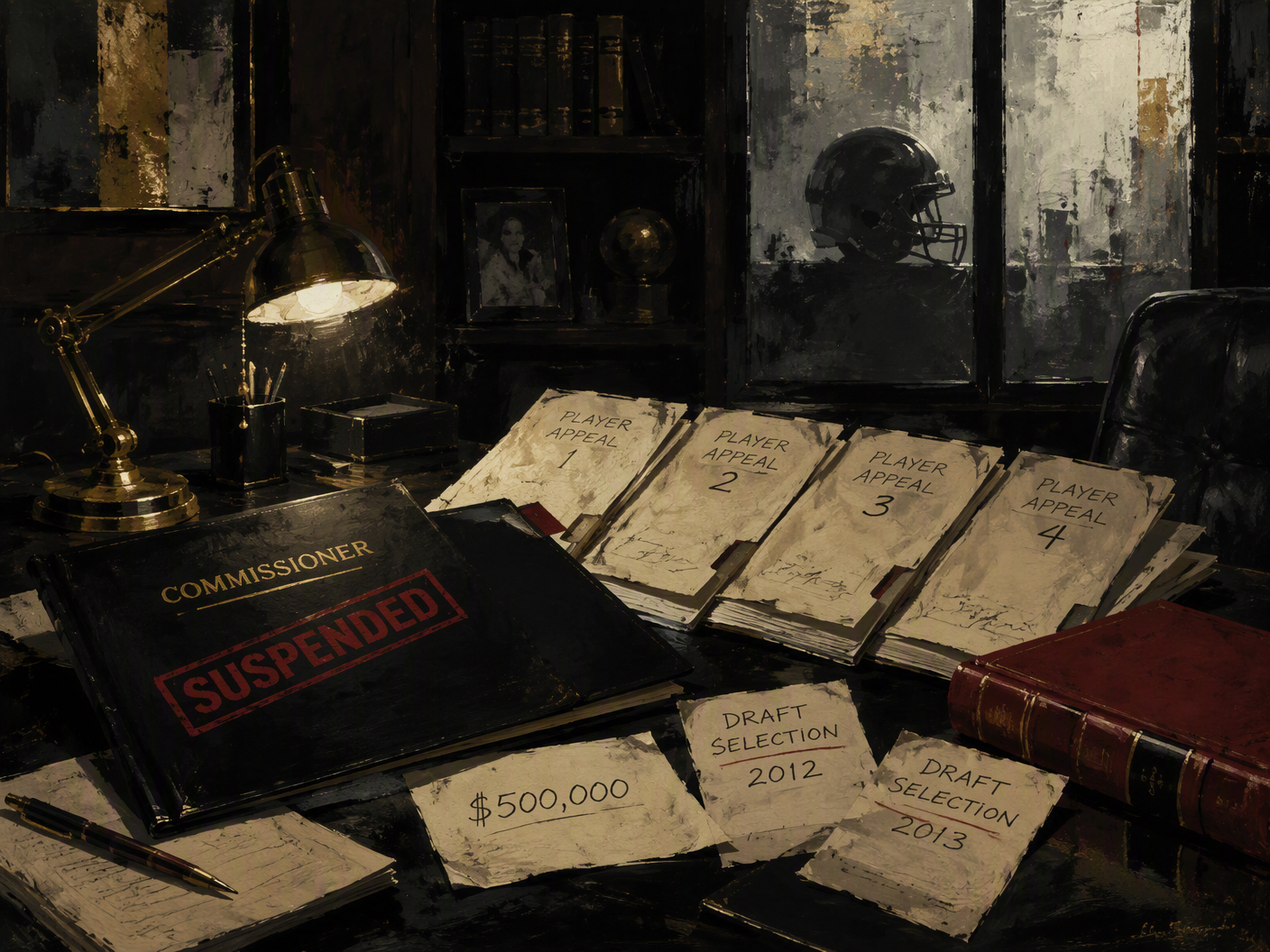
The punishment arrived before the season, when the NFL turned the New Orleans Saints' internal football culture into a league-wide disciplinary case. Head coach Sean Payton was suspended for the entire 2012 season. Defensive coordinator Gregg Williams was suspended indefinitely. General manager Mickey Loomis received an eight-game suspension, and assistant head coach Joe Vitt received six games. The league also fined the Saints $500,000 and stripped the franchise of two second-round draft selections. The sanctions reached from the sideline to the front office, treating the alleged bounty system as an organizational failure rather than a players-only offense.
The machinery behind the case began with information supplied by Mike Cerullo, a former Saints defensive assistant. He contacted the league and alleged that New Orleans had operated a bounty system. The accusation described a private economy beneath the public game: money attached not merely to making a tackle, but to removing an opponent from the contest. Cerullo's account became part of the NFL's case, while Saints representatives attacked his credibility and characterized him as a fired employee carrying a grudge. The same allegation therefore entered the record as both evidence and a dispute over the person who supplied it.
At the center of the league's account stood Jonathan Vilma, one of the Saints' defensive leaders. The NFL alleged that Vilma offered $10,000 to a teammate who knocked Brett Favre out of a playoff game. The alleged target was not an abstract name from another roster; Favre was a prominent quarterback whose body and availability could determine the course of a postseason game. Vilma denied contributing to or creating a bounty pool intended to injure players. The case placed a specific dollar figure against a specific collision, then left the public to watch the league and the players fight over what that figure meant.
The league's response extended beyond Vilma. It suspended three other players—Will Smith, Scott Fujita, and Anthony Hargrove—for alleged roles in the bounty system. The four suspensions did not place four identical careers on hold: Vilma and Smith were active Saints players confronting lost games, while Fujita and Hargrove were former players when the league announced the discipline. The sanctions therefore operated differently from the fine imposed on the franchise. A draft pick could be replaced through future personnel decisions; a player suspension directly removed an athlete from the work, visibility, and place on the field that the season provided.
Goodell's authority made the sanctions unusually broad. The commissioner punished the head coach for the season, the coordinator indefinitely, the general manager and assistant coach for defined portions of the schedule, and the franchise itself through money and draft capital. The arrangement placed accountability on several levels at once. It also made the league's interpretation the immediate operating reality. Before any appeal could sort through the competing accounts, the NFL had already decided that the Saints' alleged conduct justified penalties reaching the people who ran the team, the players who defended it, and the franchise as a separate disciplinary subject.
For the players, the calendar narrowed the dispute to a practical question: would they be allowed to play? The four suspensions were challenged through the collective-bargaining process, shifting the conflict from the commissioner's office to an appeals panel. The language of discipline now met the language of labor procedure. A league decision that had threatened the opening of the season was no longer final. The question was not whether the Saints' defensive culture looked aggressive on film or in memory, but whether the punishments imposed through the NFL's authority could survive the appeal mechanism negotiated between the league and its players.
In September 2012, a three-person collective-bargaining appeals panel vacated or lifted all four player suspensions. Jonathan Vilma and Will Smith's suspensions were unanimously overturned. Scott Fujita and Anthony Hargrove's suspensions were separately reported as lifted. All four players were permitted to return for Week 1. The ruling did not produce one clean verdict on every disputed fact. It changed the immediate consequence. The players who had been removed from the season were back in uniform, while the league's original disciplinary judgment had been weakened by the process designed to review it.
The reversal exposed the difference between league power and permanent resolution. The NFL had announced a punishment large enough to alter a franchise's season and draft future. The appeals panel then returned the four players to the field, with unanimity specifically reported for Vilma and Smith rather than for all four suspensions. The players' return did not erase the allegations, and the lifted suspensions did not transform the dispute into a criminal case. It showed instead how quickly a disciplinary narrative can change when authority moves from the commissioner to the labor process.
Gregg Williams' indefinite suspension also did not remain permanent. The league's original action had placed the defensive coordinator outside the normal boundaries of a game schedule, without a defined return date. Roughly a year later, that suspension was overturned or reversed. The distinction mattered inside a system that had imposed different forms of control on different people: fixed games for Loomis and Vitt, a season for Payton, an indefinite exile for Williams, and lost playing time for the four defenders. The player appeal addressed those suspensions; the franchise fine and draft-pick penalties were separate sanctions, handled through separate later actions.
Payton's absence lasted through the 2012 season, leaving the Saints without the coach who had led the team from the head of its football operation. On January 22, 2013, Goodell met with Payton and reinstated him. The decision ended the coach's league suspension and restored him to the Saints, but it did not come from a court or jury deciding the underlying bounty allegations. The commissioner who had imposed the punishment also controlled the moment of return. In that arrangement, discipline and reinstatement remained within the same institutional orbit.
The Saints case endured because it contained two competing truths about power. The NFL could identify an alleged bounty system, punish an entire organization, and attach a dollar amount to a reported offer involving Brett Favre. In March 2012 it suspended the coach, coordinator, executives, and franchise officials; in May, it announced the player suspensions. Yet the players' appeals demonstrated that league punishment was not the same as an unchangeable finding. Vilma's denial remained part of the story; Cerullo's account remained contested; the penalties changed at different speeds. What the public finally saw was not a single clean resolution, but a system disciplining itself in stages.
Companion notes
How the NFL's Saints Sanctions Changed on Appeal
The public record supports the existence and scale of the NFL's 2012 disciplinary actions, but it presents the bounty allegations through league findings and contemporary reporting rather than a criminal verdict or judicial determination.
The league's original sanctions
The account assembled in the New Orleans Saints bounty scandal reference record and later reporting identifies the NFL's March 2012 actions: Commissioner Roger Goodell suspended Sean Payton for the 2012 season and Gregg Williams indefinitely, while Mickey Loomis received eight games and Joe Vitt six. The Saints were fined $500,000 and forfeited second-round selections in the 2012 and 2013 drafts. These are established as league penalties. The cited material does not present them as criminal or civil sanctions imposed by a court. [S1], [S4]
The source of the allegation
The same reporting identifies former Saints defensive assistant Mike Cerullo as a person who contacted the NFL and supplied information alleging that New Orleans operated a bounty system. Saints representatives disputed his credibility and characterized him as a dismissed employee with a grievance. That conflict is central to the evidentiary boundary: the sources establish that Cerullo provided information and that the league acted on its investigation, but they do not independently adjudicate the reliability of every part of his account. [S1], [S4]
The player suspensions and appeal
The league suspended Jonathan Vilma, Will Smith, Scott Fujita, and Anthony Hargrove for alleged roles in the bounty system. USA Today reported that a three-person collective-bargaining appeals panel acted in September 2012, allowing all four to play in Week 1. The report specified unanimous overturning for Vilma and Smith, while describing the Fujita and Hargrove suspensions as lifted. The available sources therefore do not support saying that the panel unanimously overturned all four suspensions. [S4], [S6]
The NFL's allegation that Vilma offered $10,000 to a teammate who knocked Brett Favre out of the NFC Championship Game is recorded alongside Vilma's denial that he contributed to or created a pool intended to pay for injuring players. Neither the cited reports supplies a criminal verdict or an independent judicial finding resolving that factual dispute. The appeals result altered the players' punishment; it did not, by itself, establish a complete factual account of the alleged pool. [S1], [S6]
Payton's reinstatement and the limits of the record
The Washington Post reported on January 22, 2013, that Goodell reinstated Payton after meeting with him. That action ended the NFL suspension and restored Payton's eligibility, but it was an administrative decision by the commissioner, not a judicial determination concerning the bounty allegations. The reference record and Bleacher Report reporting also indicate that Williams's indefinite suspension was later overturned or reversed after approximately a year. The sources establish changing league discipline, not a criminal prosecution or court judgment against the suspended coaches or players. [S1], [S3], [S4]
Source key
The associated evidence packet contains visible source URLs, source roles and the complete claim ledger.