
Violence & Brawls · 1980s
The Hamilton Pitch Invasion and the Plane Report That Ended the Match
On 25 July 1981, a large protest at Rugby Park became a police operation, then an abandoned rugby match, after reports that a stolen light plane was approaching the stadium. The episode belonged to a wider history of protest and security around Springbok fixtures, including an earlier attempt to cut broadcast cables above Wellington.
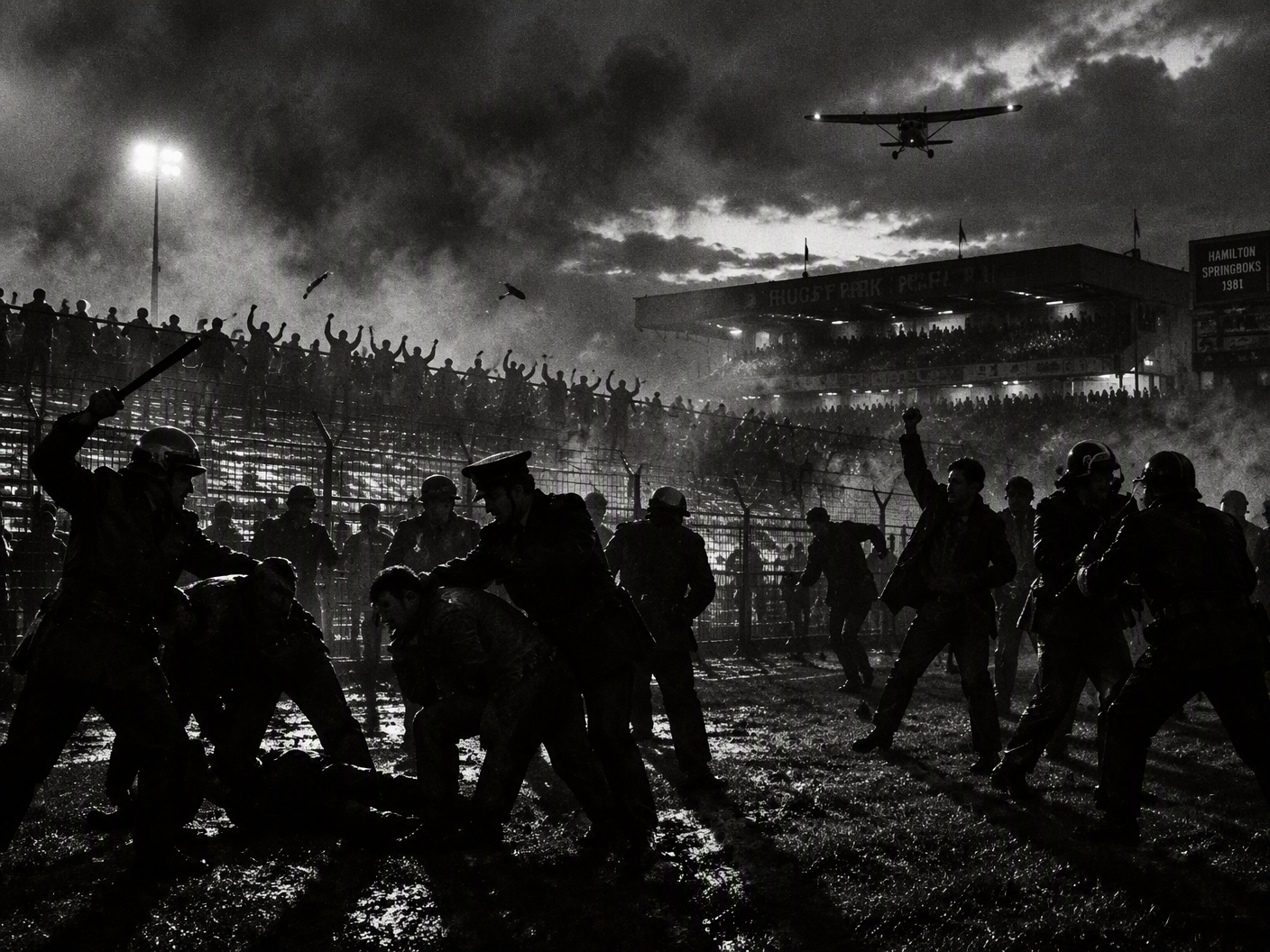
On 25 July 1981, at Rugby Park in Hamilton, the match stopped being a contest. About 350 protesters entered the pitch, putting the players, officials, and police inside a disorder that continued for roughly an hour. The fixture had been scheduled as part of the Springbok tour, but the ground could no longer function as a controlled sporting space. Police arrested about 50 people. Then came a further report: a stolen light plane, piloted by Pat McQuarrie, was approaching the stadium. Police cancelled the match rather than attempt to resume it.
The invasion transformed the field into the central site of the confrontation. Protesters crossed onto the playing surface in numbers that made ordinary interruptions impossible. Police moved through the ground making arrests while the match remained suspended. The scale of the action mattered operationally: this was not a single trespasser being removed from a touchline, but a mass entry that occupied the space where the game was supposed to proceed. For the people inside Rugby Park, the intended sequence of kickoff, play, and conclusion had been replaced by containment.
The response did not come only from the authorities. Rugby spectators threw bottles and other objects at protesters, adding a second danger to the disorder already unfolding on the pitch. The ground therefore contained competing forms of intervention: protesters disrupting the match, police attempting to restore control, and spectators using whatever objects were available against those on the field. Arrests continued over the hour. The event was no longer governed by the rules of rugby or by the ordinary authority of match officials.
The decisive reversal came through information from outside the playing area. Police received reports that a stolen light plane was approaching Rugby Park, with Pat McQuarrie identified as its pilot. The report introduced the possibility of an aerial threat into an already unstable public gathering. Police did not wait for play to restart or for the disturbance to settle. They cancelled the fixture. The plane report became the final operational reason for ending the Hamilton match, and the scheduled game never resumed.
That decision altered the meaning of the afternoon. A pitch invasion could be treated as a disruption to be cleared; arrests could be made and the field theoretically returned to the players. A reported aircraft approaching the stadium presented a different problem, one that belonged to police judgment rather than the referee's authority. The match schedule eventually recorded Hamilton as cancelled. Its entry was brief, but it preserved the outcome of the layered crisis: protest, arrests, objects thrown from the stands, and a police cancellation after the aircraft report.
Hamilton was not the first time a Springbok fixture had drawn disruption beyond the field. On 26 July 1976, before an All Black–Springbok test telecast, an attempt was made to sabotage the microwave repeater station above Wellington. The station stood at Makara Hill, where the transmission route carried the match toward viewers beyond the ground. The target was not a player or referee. It was part of the communications infrastructure that allowed the event to exist simultaneously inside the stadium and in homes across New Zealand.
At Makara Hill, cables were partly cut through with a hacksaw. The physical damage was discovered before the telecast, and engineers and Post Office personnel examined the station's condition and its ability to continue operating. The cut cables gave the incident a tangible form: an attempt to interfere with the transmission had reached the equipment itself. Yet the station's damaged cables and the later loss of television coverage belonged to separate parts of the sequence.
The final 10 minutes of the All Black–Springbok match were blacked out when the transmission failed. K. C. Sharp, the Broadcasting and Post Office engineer responsible for operational standards and services, explained that the Makara damage was not the reason for the breakdown. The blackout came from a separate microwave fault. That distinction fixed the limits of what the Wellington episode could show: cables had been partly cut, and the broadcast had been interrupted, but the technical failure was not attributed to the sabotage attempt.
Trevor Richards, chairman of H.A.R.T., addressed the sabotage attempt from the position of an organization associated with opposition to the tour. He stated that H.A.R.T. Did not condone the act and said the organization had known nothing about it. His statement placed distance between the group's public protest and the physical damage at Makara Hill. The distinction would matter in later retellings, because protest movements, individual acts, and technical failures could easily be compressed into one story even when the events had different actors and different outcomes.
The two episodes were separated by five years and by their immediate targets. At Makara Hill, someone tried to interfere with a broadcast before the match appeared on television; at Rugby Park, hundreds entered the field during the event itself. The first incident involved partly cut cables and a separate microwave fault. The second involved arrests, thrown bottles and other objects, and a police decision made after an approaching aircraft was reported. Together they show how a rugby tour could draw conflict into communications systems, public grounds, and the decisions of authorities.
What endured from Hamilton was not a completed match but an administrative fact: the fixture was cancelled. The schedule reduced a prolonged confrontation to a single word, yet that word carried the consequence of the afternoon's successive failures of control. Protesters had occupied the pitch, police had arrested about 50 people, spectators had thrown objects, and a report of a stolen plane had changed the police assessment of what could safely follow. The game ended before the players could reclaim the field, and the cancelled entry remained the tour's permanent account of Hamilton.
Investigative Dossier & Evidence
Read the companion investigation notes, verified source claims, and primary documents.
Read the Companion Notes & Evidence Record →