
Violence & Brawls · 1942
Jack Adams, the Referee, and the Suspension That Removed Detroit from Its Own Collapse
At the end of Game 4 of the 1942 Stanley Cup Final, Detroit coach Jack Adams struck referee Mel Harwood in the face during a physical confrontation. NHL President Frank Calder suspended Adams indefinitely, removing him from the final three games as Toronto completed the only reverse sweep in Stanley Cup Final history.
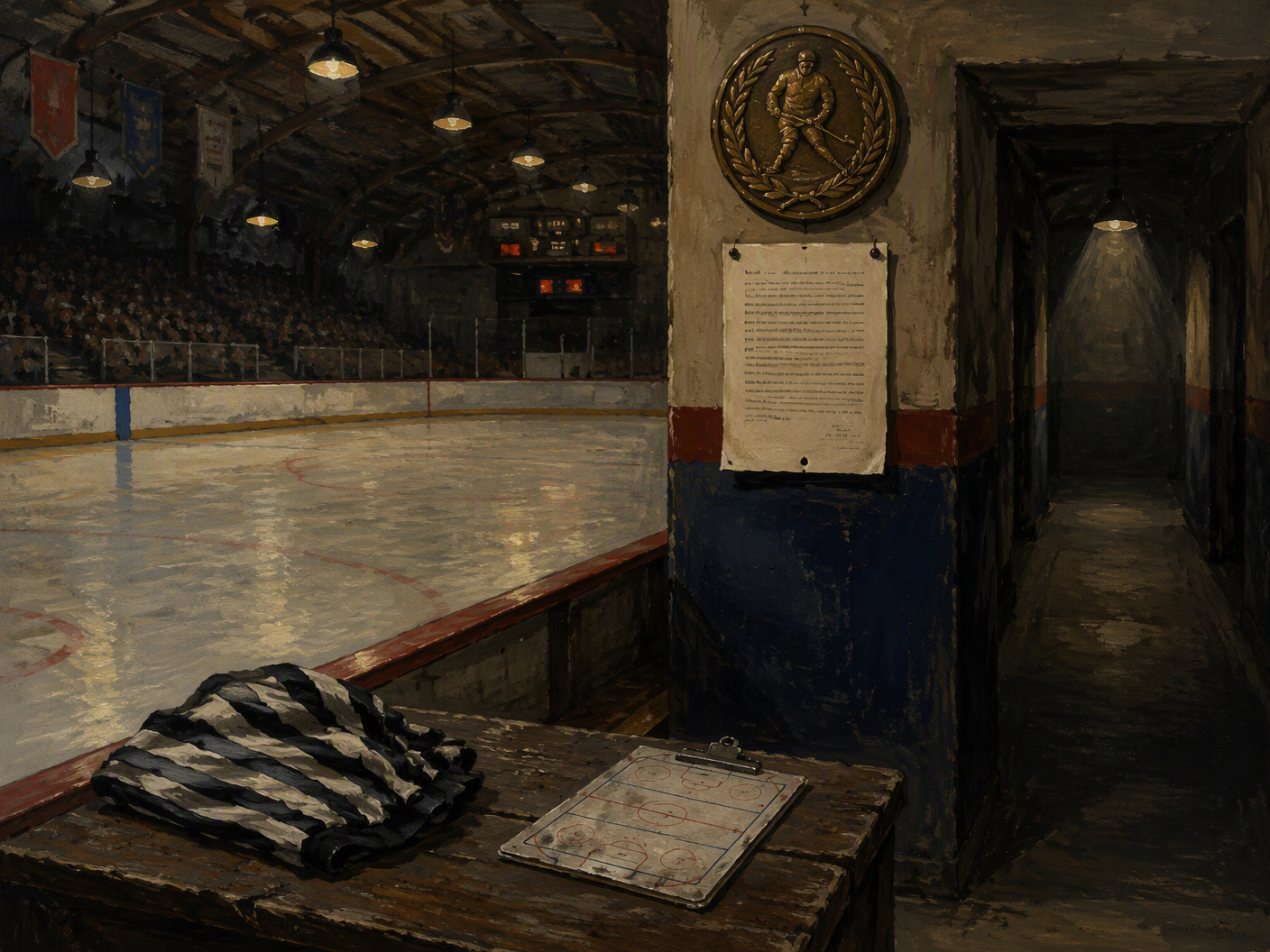
The final buzzer had barely finished cutting through Detroit's Olympia Stadium when Jack Adams confronted Mel Harwood. Adams was not a player chasing a loose puck or a spectator lost in the crush behind the boards. He was Detroit's head coach, still carrying the authority and fury of a series that had begun with his team winning three straight games. At the end of Game 4, that fury became physical. Adams struck the referee in the face, an act later described as a fistfight. The Stanley Cup Final had acquired a second combatant.
Olympia Stadium was built for noise: skates cutting the ice, sticks knocking against the boards, thousands of voices pressing upward into the cold air beneath the roof. On April 12, 1942, the Toronto Maple Leafs and Detroit Red Wings were playing inside that pressure, with the war abroad giving the season its wider, unsettled atmosphere. Detroit had controlled the opening shape of the Final, moving three games ahead. The surviving accounts describe booing and disputes over officiating during Game 4, but they do not establish how those reactions changed the mood inside the building. At the final buzzer, the dispute moved from the game to the officials' vicinity.
Adams had been Detroit's coach throughout the 1941–42 season and remained in that role during the Final. The position placed him beside the contest rather than within its formal boundaries, but it also put him close to every decision that could alter a game. Detroit had won the first three games, and Game 4 offered Toronto a chance to keep the series alive. By the final minute, the documented complaints over officiating had reached a physical end point: Adams confronted Harwood, and the coach's dispute with an official became part of the series record.
Toronto battled back to win the fourth game, keeping the Final alive and changing the meaning of the next hour. The Red Wings had entered the night one victory from the championship and left it with their advantage cut to two. The defeat was not yet the collapse later remembered; it was one loss in a best-of-seven series. But the confrontation at the buzzer gave the defeat a human face. Adams crossed the boundary between protest and a physical attack, turning an argument over the game into an incident the NHL answered by disciplining him. NHL President Frank Calder suspended Adams indefinitely, and the coach did not return to the Final.
Harwood stood on the receiving end of that crossing. The surviving series account describes Adams as attacking him and punching him in the face; the NHL retrospective characterizes the incident plainly as a fistfight. The language matters because it strips away the protective vocabulary of competitive anger. This was not merely a coach objecting to a call, nor a shouted exchange that ended when the players left the ice. At the final buzzer, the official and the coach became participants in a physical confrontation, with the referee bearing the immediate human consequence.
Frank Calder, the NHL president, responded quickly. He suspended Adams indefinitely, barring the Detroit coach from the remaining games of the Final. The discipline did not wait for the series to reach a quieter administrative moment. It arrived while Toronto and Detroit were still fighting for the championship, and it altered Detroit's bench before the players returned to the ice. Calder's action established the league's machinery in its bluntest form: the institution could remove a coach from the contest even when the team remained close to the Cup.
Ebbie Goodfellow took over Detroit's coaching duties for Game 5. The change was not a ceremonial substitution. A team that had built its position under Adams now had to receive instructions from another man, while the coach who had led it through the season and the first four games no longer participated in the series. Players still had their systems, their habits, and the memory of a three-game lead. They also had a new fact to absorb: Adams's confrontation with an official had removed him from the most important stretch of their season.
Adams did not participate in the final three games. Toronto won each of them, completing a 4–3 championship victory over Detroit. The sequence is simple in the standings and difficult to separate from the atmosphere around it: a team that had led three games to none lost the fourth, lost its coach, and then lost the three games that followed. The record does not turn that sequence into a proven causal equation. It does preserve the institutional fact that Detroit's bench changed immediately after Adams's physical confrontation with Harwood.
Toronto's championship became the first Stanley Cup Final reverse sweep: a team trailing three games to none winning four straight to take the title. It remains the only Stanley Cup Final in which that sequence has occurred. The distinction gives the 1942 series its peculiar afterlife. Its defining image is not only Toronto lifting the Cup or Detroit surrendering a lead. It is also the empty space where Adams should have been, created by a punch at the end of a game and enforced by a president who removed him from the rest of the series.
The episode survives because the machinery of sport did not treat the boundary violation as background noise. A coach had confronted an official, the confrontation had become a fistfight, and the league answered by taking the coach away from his team. Everything afterward became part of the same historical frame: Goodfellow behind the bench, Toronto winning three consecutive games, and a 3–0 lead disappearing into a 4–3 defeat. The Final's mythology grew around the comeback, but the mechanism was more concrete. The institution recorded the attack and made sure Adams could not participate again.
Companion notes
What the NHL Record Shows About the Adams–Harwood Fight
The surviving record establishes the confrontation, the league suspension, Adams's absence, and Toronto's historic comeback. It does not supply a contemporaneous police file, the original disciplinary notice, or proof that the suspension caused Detroit's defeat.
The Series and Its Result
The NHL's archived all-time playoff results identify the 1942 Stanley Cup Final as a best-of-seven series between the Toronto Maple Leafs and Detroit Red Wings. The NHL's retrospective on three-games-to-none comebacks gives the same matchup and records Toronto's 4–3 series victory. The 1942 Final account provides the detailed sequence: Detroit won the first three games, Toronto won the next four, and Toronto won the championship. These sources establish the competition and result, not any broader judgment about the quality of officiating. [S1], [S3], [S4]
What Happened at the Buzzer
The 1942 Stanley Cup Final account states that Detroit coach Jack Adams attacked referee Mel Harwood at the end of Game 4 and punched him in the face. The NHL retrospective independently describes Adams and Harwood as engaging in a fistfight. Together, those accounts support the central event as a physical confrontation rather than a verbal dispute. The cited records set does not include a contemporaneous police blotter, court filing, witness deposition, or medical record, so the details of the exchange beyond the reported attack remain outside the documented boundary. [S1], [S4]
The League's Response
The available NHL accounts report that President Frank Calder immediately suspended Adams indefinitely after the incident. They also establish the practical consequence: Adams did not participate in the final three games, and Ebbie Goodfellow assumed Detroit's coaching duties for Game 5. The sources do not reproduce Calder's original suspension notice or provide a detailed disciplinary rationale, including whether the league considered additional facts beyond the confrontation itself. The discipline is therefore established as an institutional action, while its full internal process is not recoverable from the supplied record. [S1], [S4]
Adams's Role and Source Hierarchy
The Final account and NHL retrospective identify Adams as Detroit's coach during the series. A biographical entry records him as Detroit's head coach from 1927 through 1947 and places him in that role during the 1941–42 season. That biography is useful corroboration but is not the sole basis for the incident or the suspension; those points rest on the NHL accounts. The source set is therefore mixed: institutional NHL material supplies the principal historical narrative, while the biographical reference supports the coaching chronology. [S1], [S2], [S4]
The Comeback and the Causal Limit
The NHL's historical materials call Toronto's victory the first Stanley Cup Final reverse sweep and state that it remains the only one. That establishes the rarity of the 3–0-to-4–3 sequence. It does not establish that Adams's suspension caused Detroit to lose the final three games. The record places the suspension immediately before those games and documents the coaching change, but it contains no controlled comparison, player testimony sufficient to prove causation, or contemporary institutional analysis demonstrating how the absence affected performance. The historical connection is documented; the causal conclusion remains unproven. [S1], [S3], [S4]
Source key
The associated evidence packet contains visible source URLs, source roles and the complete claim ledger.