
Scandals & Feuds · 1980s
Jimmy Snyder’s Slavery Remarks, the CBS Firing, and the Judgment for the Network
Jimmy Snyder said Black athletes had been “bred” to outperform white athletes and traced that claim to slavery. CBS fired him the next day, then defeated the civil lawsuit through which he challenged the network’s decision.
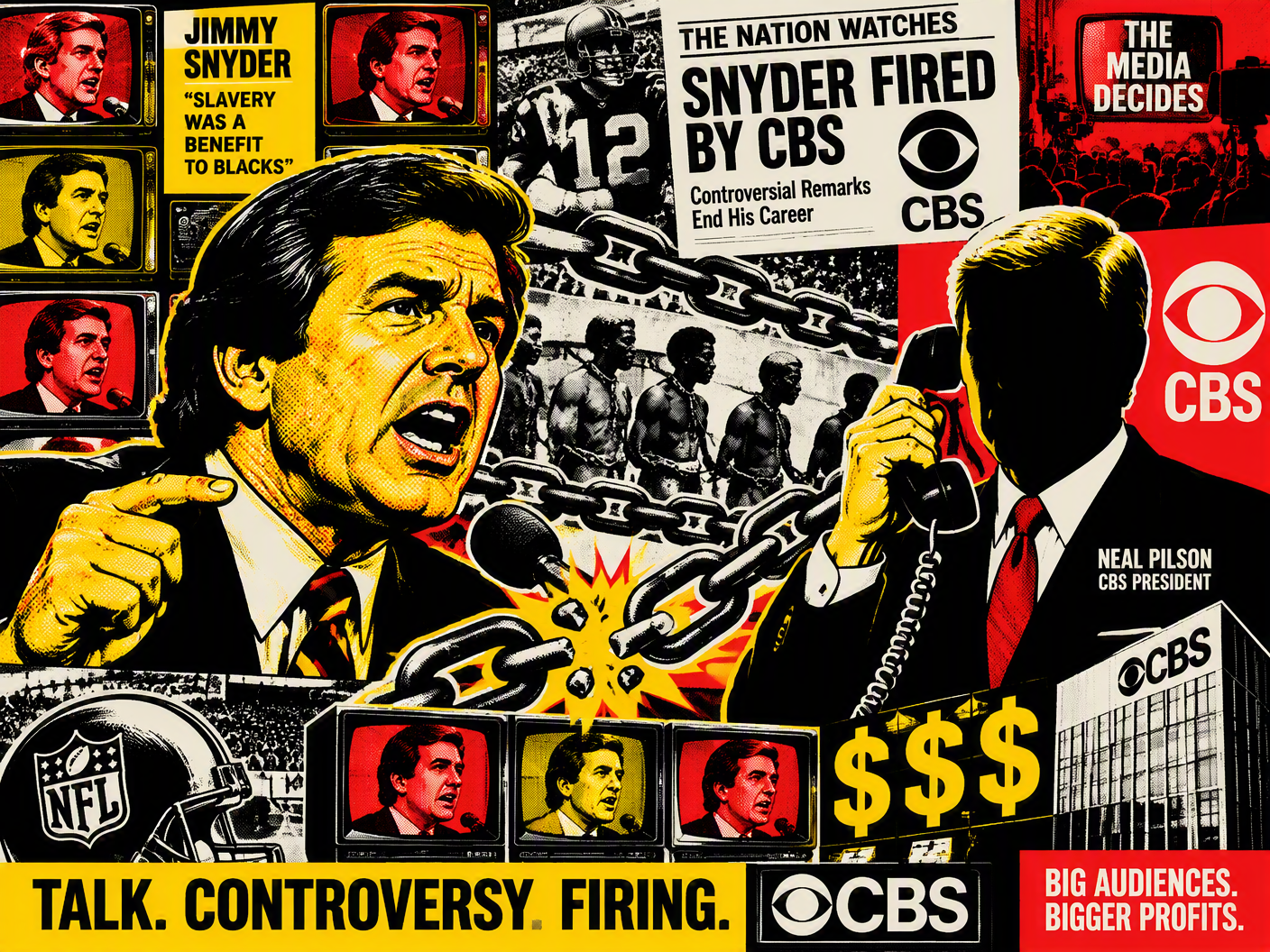
On January 15, 1988, Jimmy Snyder sat for an interview at Duke Zeibert’s restaurant in Washington, D.C., and offered a racial explanation for athletic performance. Snyder told Ed Hotaling, a producer-reporter for WRC-TV, that Black athletes had been “bred” to be better athletes than white athletes. He traced the idea to slavery. The remarks reduced generations of enslavement to a theory of physical selection and presented that theory as an explanation for achievement in modern sports. By the following day, Snyder’s position at CBS Sports was over.
Snyder was not speaking as an anonymous spectator. He was a sports commentator and a contributor to CBS’s NFL Today, a national television program built around professional football. His public value rested on his voice: its certainty, its familiarity and its ability to turn a prediction into entertainment. At Duke Zeibert’s, that same certainty carried him into a claim about race, inherited physical ability and slavery. The interview gave CBS a direct personnel problem involving one of the figures it placed before viewers.
Hotaling’s question produced a statement with two connected parts. Snyder first asserted that Black athletes possessed a physical advantage because they had been “bred” for it. He then located that supposed process in slavery, when human beings were bought, sold and forced to labor under hereditary bondage. The formulation treated racial identity as biological destiny. It also made the violence of slavery serve as an explanatory device for contemporary athletic success, shifting attention from individual achievement to a racial theory Snyder presented in a restaurant interview.
Neal Pilson, the president of CBS Sports, acted on January 16. Pilson called Snyder and communicated that CBS was terminating its relationship with him. The network also drew an institutional boundary around the comments, stating that Snyder’s remarks did not reflect the views of CBS Sports. The response did not depend on a criminal proceeding, league sanction or outside regulator. Pilson possessed the authority to decide who represented the sports division, and CBS used that authority one day after Snyder made the remarks.
The compressed sequence defined the dispute. Snyder spoke on January 15; CBS removed him on January 16. The network treated the interview itself as sufficient grounds to end the relationship rather than opening a prolonged disciplinary process. Its statement addressed institutional identity, not the historical validity of Snyder’s theory. CBS rejected the idea that he had spoken for the division and separated its brand from his words. The measurable consequence was immediate: Snyder lost his place at the network and the national platform that came with it.
Snyder responded by raising the possibility of litigation. After CBS fired him, he said he might sue the network. At that stage, the threat expressed his intention to contest what Pilson had done; it was not yet a filed civil action. Three years passed before Snyder brought the dispute into a New York court. The delay changed the forum but not the event at its center. His claims arose from the network relationship that ended immediately after the interview at Duke Zeibert’s.
In 1991, Snyder sued CBS on three grounds: age discrimination, defamation and breach of contract. Each theory attacked a different part of the rupture. The discrimination claim challenged CBS’s treatment of him as an older commentator. The defamation claim concerned reputational injury. The contract claim challenged the network’s compliance with its obligations when it ended the relationship. Snyder had moved from saying he might sue to asking a court to impose civil liability on CBS for the decision made after his Washington interview.
The lawsuit did not reverse the allocation of power between Snyder and CBS. The network obtained summary judgment, a ruling that disposed of the claims without sending them to a full trial. Snyder appealed. The dispute then reached the Appellate Division of the Supreme Court of the State of New York, First Department. By that point, the question before the court was not whether CBS regretted its decision or whether Snyder could restore his television role. It was whether his civil claims could survive the judgment entered for the network.
On May 31, 1994, the Appellate Division affirmed summary judgment for CBS. Snyder’s allegations of age discrimination, defamation and breach of contract therefore failed to produce a judgment against the company. The ruling left CBS’s legal victory intact and closed the appellate stage captured by the case. It also preserved the separation between Snyder’s public argument and the dispute the judges resolved: the litigation tested his claims against CBS, while producing no judicial validation of his assertion that slavery had “bred” Black people into superior athletes.
The final institutional decision came more than six years after the restaurant interview. CBS had needed one day to remove Snyder and state that he did not speak for its sports division. Snyder needed three years to file his case and three more to reach the appellate ruling. On May 31, 1994, the court left the judgment for CBS in place. The telephone call Pilson made on January 16 remained effective, and the network retained both the personnel decision and the civil judgment that followed it.
Investigative Dossier & Evidence
Read the companion investigation notes, verified source claims, and primary documents.
Read the Companion Notes & Evidence Record →