
Scandals & Feuds ·
LIV Golf’s Costly Challenge to the PGA Tour
Saudi funding helped the new league recruit prominent players in 2022. More than $5 billion in investment later, its backer withdrew support, leaving LIV’s future uncertain.
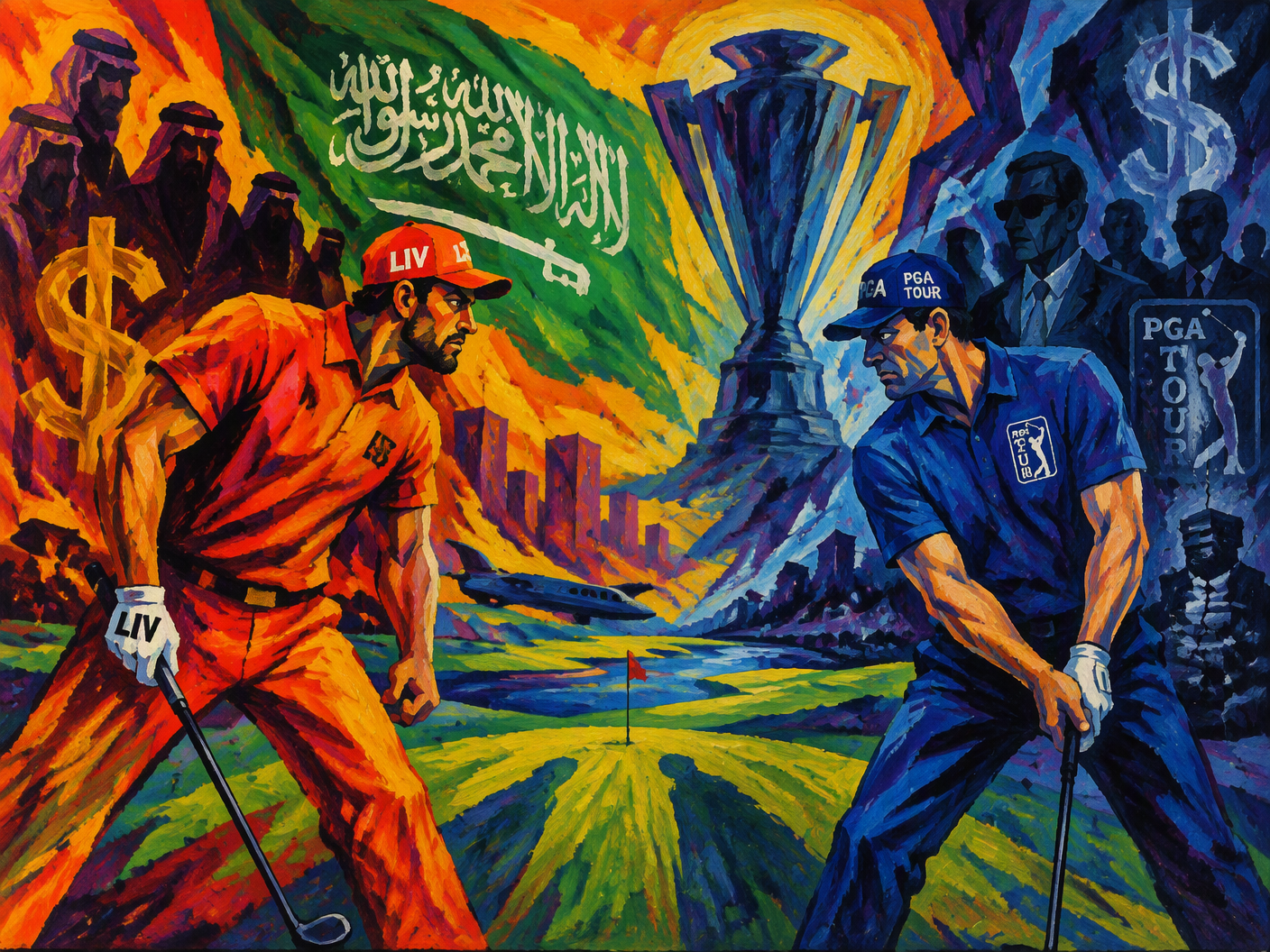
When LIV Golf launched in 2022, it offered PGA Tour players another place to compete—and large sums of money to go there. Backed by Saudi Arabia’s Public Investment Fund, the new circuit recruited Dustin Johnson and Phil Mickelson for its first event near London. The PGA Tour had already refused its members permission to play. LIV’s commercial challenge began with players choosing between an established tour and a well-financed rival.
The opening schedule promised eight events, individual and team competition, and combined prize money of up to $255 million. Each of the first seven tournaments would carry a $20 million purse, with another $5 million divided among the top three teams. Johnson, a former U.S. Open and Masters champion, headlined the initial field. Mickelson joined days before the June 9 opening, after LIV announced that it would stream the tournament because it had no television deal.
Mickelson described the move as a fresh start after 32 years. In a statement, he praised the format and said it would give him more balance in his life. “I am incredibly grateful for what this game and the PGA Tour has given me,” he wrote. “I would like to think that I have given back as well but now I’m excited about this new opportunity.”
The Tour’s response was not simply to compete for those players. In denying permission for the London event, executive vice president Tyler Dennis wrote that the decision was “in the best interest of the PGA Tour and its players.” Greg Norman, LIV’s commissioner, accused the Tour of perpetuating an “illegal monopoly”—an allegation, not an established finding. The Tour suspended members who joined LIV. Lawsuits followed, and the Justice Department investigated whether the Tour had engaged in anticompetitive behavior.
LIV also offered a different atmosphere. “It had loud music and concerts and cheering at holes,” Alicia Jessop, a sports-law professor at Pepperdine University, told Marketplace. But the Saudi backing carried scrutiny beyond golf. The league faced accusations of sportswashing from the start. Economist Victor Matheson suggested that the investment could direct attention toward golf and away from matters such as the 2018 assassination of journalist Jamal Khashoggi at a Saudi consulate.
In June 2023, the rivals announced a framework agreement intended to combine their commercial businesses, along with those of the DP World Tour, in a new for-profit entity supported by the Saudi fund. It was not a completed merger. The proposed arrangement remained unfinished as LIV continued operating and recruiting players. The league secured a broadcast deal with the CW, but a television outlet did not settle the larger question of whether its spending could build a durable audience and business.
By August 2026, Marketplace reported that LIV had struggled to attract television deals, sponsors and fans despite drawing prominent golfers away from the PGA Tour. Citing Reuters, it put the fund’s investment at more than $5 billion—not a launch budget, but spending on the venture over time.
The fund stopped supporting LIV at the end of its 2026 season, Marketplace reported, leaving the league’s future in doubt. The money had brought players across. After billions in investment, LIV still had to find a way to continue without the backer that had made its challenge possible.