
Violence & Brawls · 1870s
The Run-Out That Broke Open Lord Harris’s Sydney Match
A disputed decision against Billy Murdoch turned a February 1879 cricket match into a pitch invasion in which Lord Harris was struck and an English batsman removed an assailant. The match resumed two days later, and Lord Harris’s XI won by an innings and 41 runs.
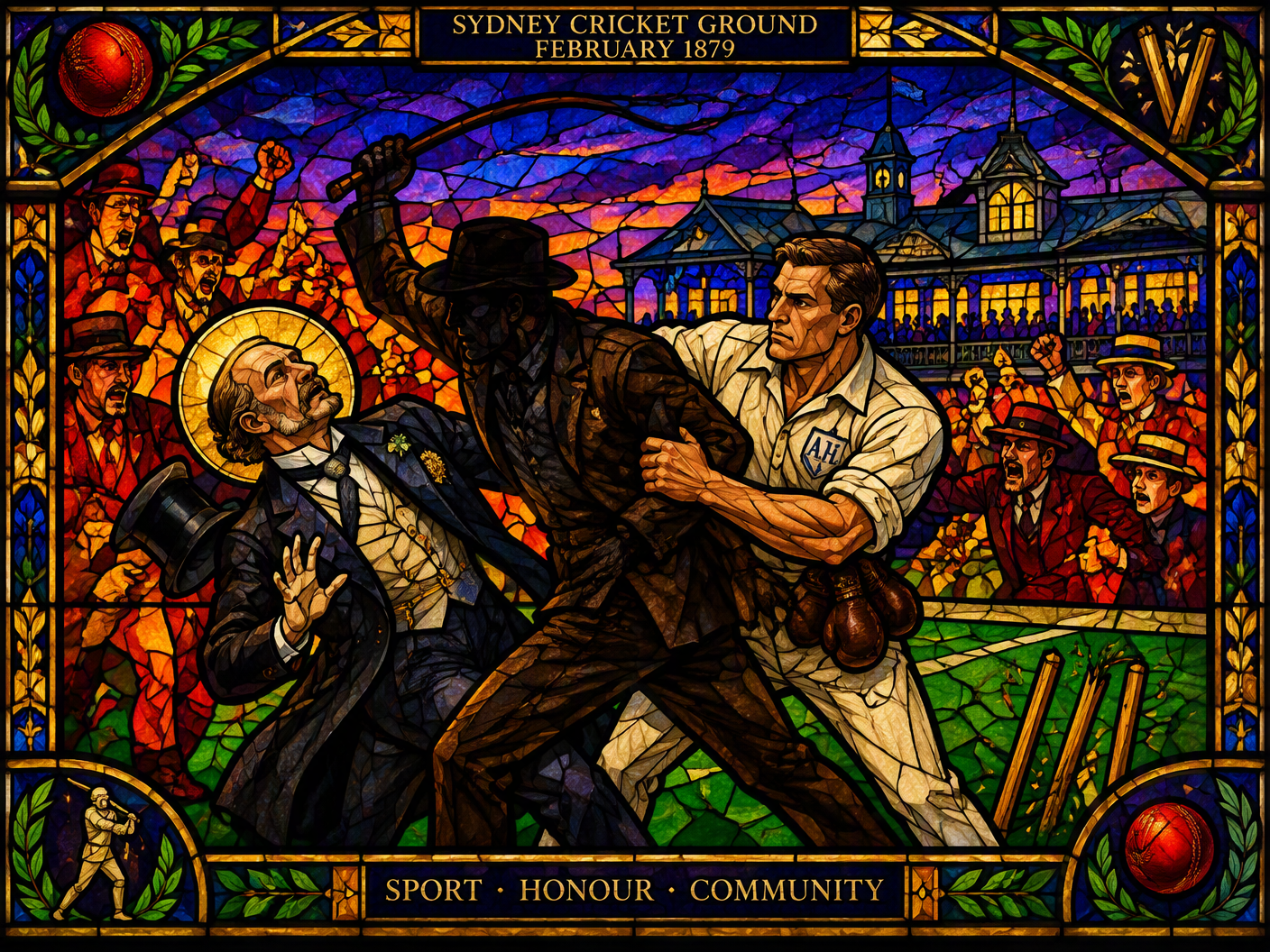
George Coulthard gave Billy Murdoch out, and the match came apart. Murdoch had been run out in New South Wales’s second innings at the Sydney Cricket Ground on 8 February 1879. The decision brought objections from the crowd, then people onto the pitch, then a disorder that moved around the players and officials. Lord Harris, captain of the visiting English side, was struck by a whip or stick. A.N. Hornby, an English batsman and amateur boxer, seized the man responsible and escorted him toward the pavilion. The score had become a public confrontation.
The fixture had begun the day before at the ground then commonly called the Association Ground. New South Wales was playing Lord Harris’s XI, a touring English team led by Harris, and the match was scheduled as serious cricket rather than a loose exhibition. E. Barton stood for New South Wales. Coulthard stood for the English side. Their appointments placed two men at the center of every appeal, edge, and doubtful run. On the second day, Coulthard’s ruling would give the crowd a single object for its anger.
Murdoch was not a minor figure waiting for a chance. He kept wicket for New South Wales and opened the batting. In the first innings he made 82 not out, a long stay at the crease that fixed him in the match before the trouble began. His second innings lasted only ten runs. The contrast was sharp: the local batsman who had carried the first innings was now leaving the ground after Coulthard’s finger went up. Between those two scores, the argument over the match changed from cricket to authority.
An umpire’s decision was supposed to end the matter. Coulthard’s decision did the opposite. Murdoch’s dismissal was contested by the people around the pitch, and the objection became movement: spectators entered the playing area, players and officials faced the crowd, and the boundary between match and disturbance disappeared. The decision itself remained the hinge of the episode. Edmund Barton later stated that Coulthard had been correct. That judgment did not settle the crowd, and it did not prevent the violence that followed Harris across the ground.
Harris remained on the ground while people cleared. He had won the toss and batted for his side during the match; now he was one of the men exposed to the disorder. The blow from the whip or stick made the dispute physical. Hornby answered with an act that required no appeal and no committee: he grabbed the assailant and took him toward the pavilion. The movement carried the immediate danger away from Harris, but it also showed how little stood between a player and a spectator when the crowd crossed the pitch.
The English party had arrived with the usual privileges of a touring side and the usual vulnerability of visitors. Their captain was an aristocrat playing before a local crowd. Murdoch was the local wicket-keeper and batsman whose dismissal had become the grievance. Coulthard was the foreign-nominated umpire who had made the call. Barton, the New South Wales nominee, later backed it. The conflict gathered around those roles. Nobody needed to invent a larger conspiracy to explain the first movement onto the pitch. A disputed run-out was enough to begin it.
Afterward, the story acquired additions. Bookmakers were blamed for starting the riot, and later retellings attached a rumor to Coulthard—that he had wagered on an English victory. Neither claim belongs in the firm center of the match. The event that can be followed is narrower and harder: Murdoch was given out, the crowd objected, the pitch was invaded, Harris was struck, and Hornby removed an assailant. The rest belongs to the loose talk that gathers around a public rupture, where motive is often supplied after the fact.
The match did not end when the crowd surged across the playing area. Enough order returned for the fixture to continue. On 10 February, players came back to the Sydney Cricket Ground and resumed the contest. Harris’s XI completed the match. The interruption had been serious, but it had not erased the score, the innings already played, or the officials’ authority to finish the work. The same ground that had held the confrontation held the closing overs two days later.
Lord Harris’s XI won by an innings and 41 runs. The margin gave the match a formal ending that the riot had nearly denied it. New South Wales had not merely lost a session or surrendered a disputed passage; the visitors completed an innings victory. Murdoch’s 82 not out remained in the scorebook beside his second-innings dismissal for 10. Coulthard’s decision remained part of the route to the disorder, while Barton’s later view preserved the official disagreement with the crowd’s response.
What remained at Sydney was not a clean sporting anecdote about bad temper. It was a match in which a ruling carried a crowd onto the pitch, a visiting captain took a blow, and a player had to escort an assailant toward the pavilion before play could be restored. The fixture began on 7 February and finished on 10 February. In between stood Murdoch’s run-out, Coulthard’s decision, Barton’s support, and the hard arithmetic of the final score: an innings and 41 runs, written after the bodies had cleared the ground.
Investigative Dossier & Evidence
Read the companion investigation notes, verified source claims, and primary documents.
Read the Companion Notes & Evidence Record →