
Scandals & Feuds · 2000s
The Interrupted Count That Preserved Lucian Bute’s Title
With five seconds left in their October 24, 2008 IBF super middleweight title fight, Librado Andrade knocked Lucian Bute down. Bute rose at six, continued before the ten count, and retained the belt by unanimous decision after referee Marlon Wright’s interrupted count became the decisive procedural dispute.
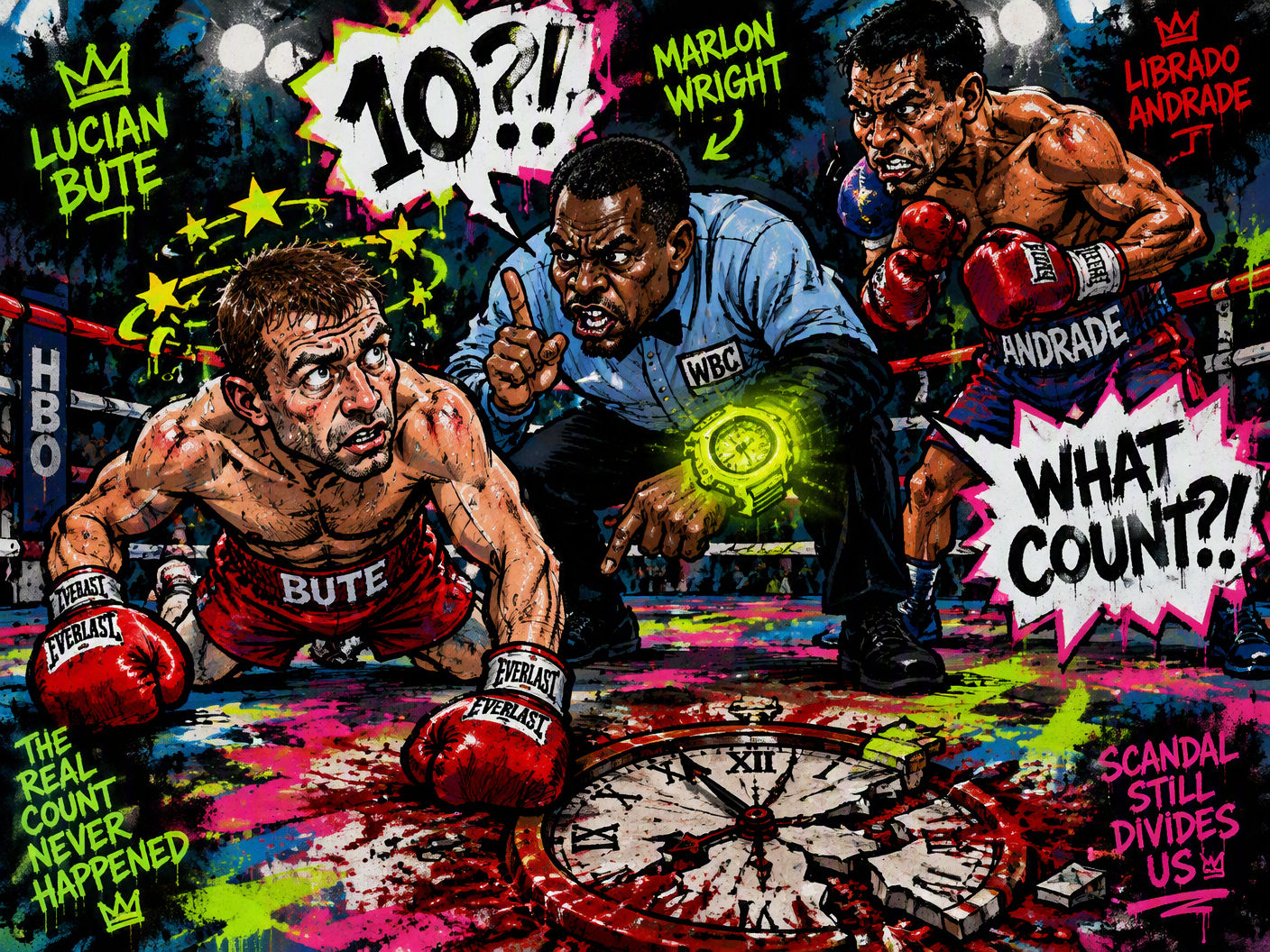
Five seconds remained in the scheduled fight when Librado Andrade put Lucian Bute on the canvas in Quebec. Bute had entered the ring as the undefeated IBF super middleweight champion; Andrade had spent the bout trying to take the belt from him. The knockdown changed the contest’s final question. It was no longer simply whether Bute had outboxed the challenger across the scheduled rounds. It was whether the champion could recover in time—and whether the referee’s count would give that recovery a lawful measure.
Bute rose at the count of six. He was not counted out, and he continued fighting before referee Marlon Wright completed the official ten count. That distinction governed the result. Andrade had landed the most consequential blow of the night, but a knockdown did not end the bout by itself. The champion’s recovery kept him eligible to continue, leaving the judges with a completed contest rather than a knockout to score.
The controversy centered on the count’s administration. A referee’s count is supposed to impose a fixed limit on a fallen fighter’s recovery. In this case, Wright’s count was interrupted as Bute got back to his feet, and the interruption gave the champion additional time before the count was completed. The dispute was therefore not about whether Andrade had dropped Bute. It was about whether the procedure used to determine Bute’s readiness gave him more time than the contest’s rules permitted.
Timing made the issue unusually consequential. The knockdown came with almost no fight left, leaving Andrade little opportunity to test Bute’s condition through another exchange. The referee controlled the space, Bute recovered, and the bout moved toward its scheduled conclusion. A moment that might have produced a sustained attack in an earlier round instead became an administrative decision compressed into seconds: the challenger’s advantage had to pass through the referee’s count before it could become a change of champion.
Two facts consequently stood together. Andrade had knocked the champion down, and Bute had risen before ten. The first gave Andrade a concrete achievement at the end of the fight; the second preserved Bute’s right to remain in it. Neither erased the other. The count functioned as the hinge between physical damage and official eligibility, and the interruption made that hinge visible to everyone watching the final seconds.
The bout ended without another decisive exchange. The judges awarded Bute a unanimous decision, and he retained the IBF super middleweight title. The ruling did not remove Andrade’s knockdown from the fight, nor did it treat the final sequence as a knockout. It recorded a championship defense in which Bute survived the count and completed the contest. The belt stayed with the champion because the official process treated his recovery as sufficient to continue.
For Andrade’s corner, the issue was the officiating rather than an abstract complaint about losing. The team objected to the interrupted count and the recovery time it created for Bute. Their dissatisfaction reflected the practical consequence of the sequence: had the count been administered without interruption, Bute’s status at the end of the fight might have been different. The team considered filing a protest, which would have moved the dispute from the ring into the sport’s administrative machinery.
That protest was never filed. The objection therefore remained a post-fight challenge rather than a formal proceeding that could compel a commission or sanctioning body to review the count. No new ruling displaced the judges’ decision, and no administrative process changed the title’s ownership. The absence of a protest did not settle the fairness question; it left the existing result as the only operative championship decision.
The fight’s institutional lesson lies in the narrow authority granted to a referee at the point where a championship can turn. Andrade supplied the knockdown. Bute supplied the recovery. Wright’s handling of the count determined how much time that recovery occupied, and the judges then converted the completed bout into a unanimous decision. The process did not require anyone to deny what had happened on the canvas. It required the officials to decide whether the champion had remained legally able to continue.
Bute left the ring with the IBF belt, while Andrade’s team left with a specific objection that never reached a formal review. The final five seconds did not overturn the scorecards, but they exposed how a contest’s meaning can depend on procedure as much as impact. A knockdown can alter a fight without producing a knockout; a recovery can preserve a title without removing the dispute over how it was measured. In Bute–Andrade, the championship remained intact because the count, interrupted and completed, allowed the official result to stand.
Investigative Dossier & Evidence
Read the companion investigation notes, verified source claims, and primary documents.
Read the Companion Notes & Evidence Record →