
Scandals & Feuds · 2000s
The Six-Minute Palace Station Robbery Case That Sent O. J. Simpson to Prison
On September 13, 2007, O. J. Simpson entered a Las Vegas hotel room with armed associates during a confrontation over sports memorabilia. The encounter produced a 12-count conviction, a 33-year sentence, and a later retrial effort centered on the performance of his former lawyer.
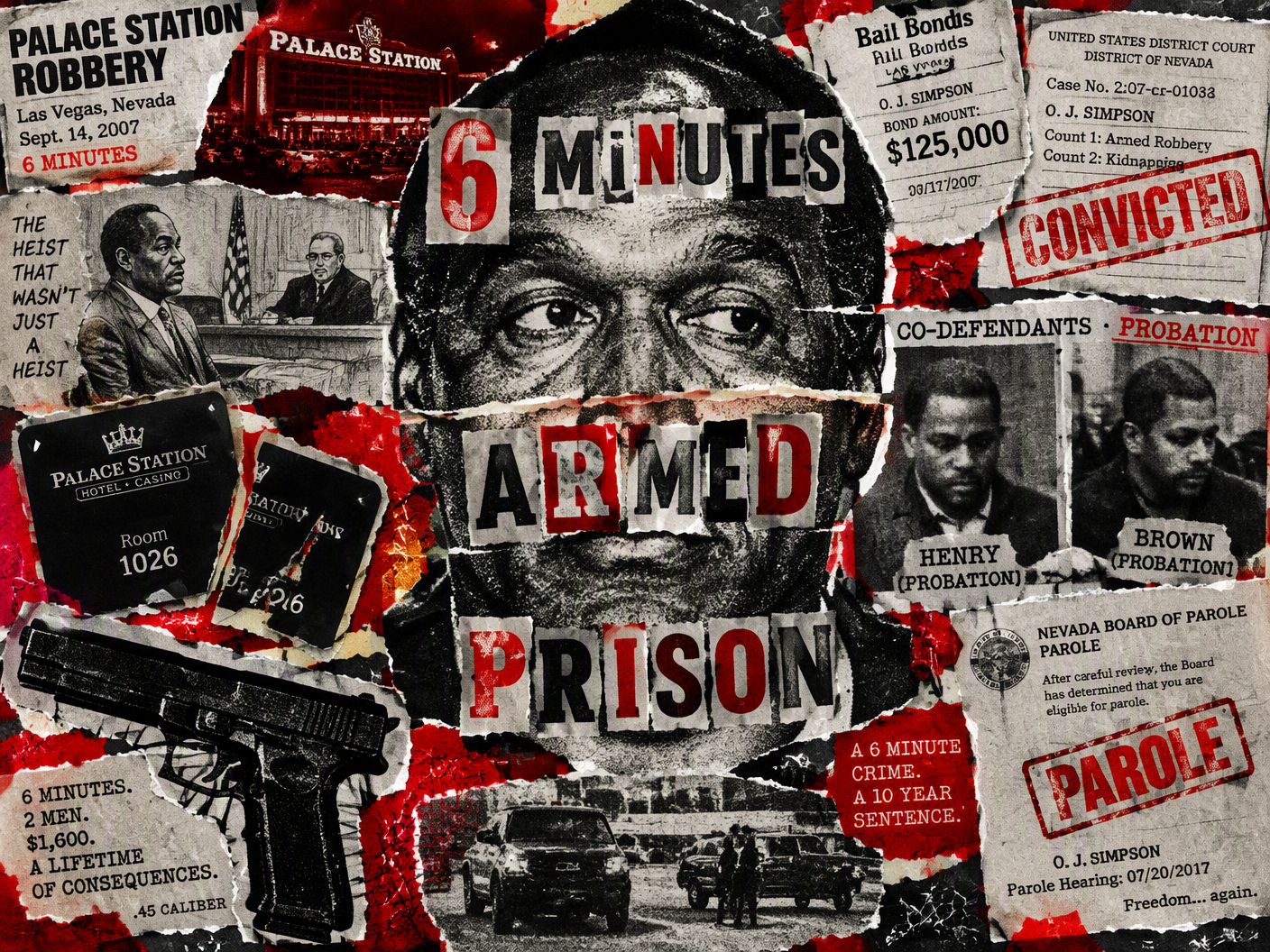
On September 13, 2007, O. J. Simpson and a group of men entered room 1203 at the Palace Station hotel in Las Vegas. Bruce Fromong and Alfred Beardsley, memorabilia dealers, were inside. Michael McClinton carried a .45-caliber Ruger into the room. The confrontation lasted about six minutes. That short interval became the fixed center of a robbery and kidnapping prosecution: a hotel-room encounter that began over sports memorabilia and ended with Simpson facing the most consequential criminal case of his life. The participants left the room, but the legal sequence moved quickly. (C1, C2, C3, C4)
The dispute concerned sports memorabilia, but the state treated the conduct as a coordinated criminal episode rather than a private argument over ownership. The defense later advanced the position that Simpson had been retrieving property he believed belonged to him. That assertion never became the legal basis of the verdict. The central question for the prosecution was what happened when Simpson and the other men entered the room, confronted the dealers, and removed items while armed participants were present. The six-minute duration gave the case a compressed operational shape: entry, confrontation, removal, departure. (C1, C2, C3, C4)
Three days later, on September 16, authorities arrested Simpson in Clark County. On September 19, he appeared in court before Judge Joe M. Bonaventure Jr., who granted bail of $125,000. The amount placed Simpson back outside custody while prosecutors prepared a case built around the Palace Station room and the people who had occupied it. His public status remained inseparable from the proceeding, but the court handled him through ordinary mechanisms: arrest, appearance, bail, and the gradual setting of a trial date. The hotel room had become a criminal docket. (C1)
The case did not reach a jury immediately. On March 9, 2008, a judge postponed the trial until September 8, extending the period in which the prosecution and defense would test their accounts of the confrontation. By then, Judge Jackie Glass would preside over the trial and the later sentencing. The delay changed neither the location of the alleged offense nor the identities of the principal participants. It lengthened the interval between the six-minute encounter and the verdict, allowing the disputed ownership claim and the armed entry to compete in court. (C1, C2, C3, C4)
The case also divided the men who had entered the room. McClinton was identified as the participant who brought the .45-caliber Ruger. Walter Alexander was another armed codefendant. Both later testified for the prosecution and received probation sentences. Their outcomes differed sharply from Simpson’s, creating separate legal consequences within the same episode. The state’s case therefore did not end with a single defendant’s account. It included participants whose cooperation carried its own terms and whose sentences demonstrated how prosecutors and courts treated their roles differently. (C3, C8)
On October 3, 2008, a Clark County jury found Simpson guilty on all 12 charges. The verdict converted the hotel-room confrontation from a contested narrative into a criminal judgment against the former NFL player. The charges arose from the entry into room 1203, the confrontation with Fromong and Beardsley, and the armed presence of men accompanying Simpson. The jury rejected the defense outcome Simpson sought. It did not resolve every argument about ownership or motive in the abstract; it imposed criminal liability for the conduct charged by the state. (C1, C2, C3, C6)
Judge Jackie Glass sentenced Simpson on December 5, 2008. The term was 33 years in prison, with eligibility for parole after nine years. The sentence supplied the measurable consequence of the verdict: not a fine, suspension, or civil settlement, but a state prison term tied to convictions on all 12 counts. Alexander and McClinton received probation in the case, while other codefendants received separate sentences or probation. The same room produced different punishments because the court assigned different legal consequences to the people who entered it. (C6, C7, C8)
Simpson’s later challenge moved the conflict from the hotel room to the conduct of his defense. In May 2013, he sought a new trial in Clark County District Court. The motion focused on Yale Galanter, Simpson’s former lawyer, and argued that Galanter had been incompetent. Galanter testified during the hearing. Simpson also testified in support of the motion, placing his own account of the representation before Judge Glass. The proceeding did not retry the Palace Station confrontation; it examined whether the original trial had been conducted with constitutionally adequate legal assistance. (C9)
The retrial hearing ran from May 13 through May 17, 2013, with Gabriel Grasso also involved in the proceedings. Simpson’s argument attempted to shift the decisive failure away from the six minutes in room 1203 and toward the lawyer who had represented him. That strategy faced the weight of what had already occurred: the jury’s October 2008 verdict, the December sentence, and the separate probationary outcomes for Alexander and McClinton. A postconviction claim could challenge the trial’s integrity, but it could not erase the sequence that produced the convictions. (C6, C7, C8, C9)
The case retained a narrow factual core beneath the celebrity surrounding it. Simpson entered the Palace Station room with a group of men. Fromong and Beardsley were present as dealers. McClinton brought a handgun. The confrontation lasted about six minutes. An arrest followed three days later, then bail, postponement, trial, conviction, sentencing, and a retrial request directed at counsel. Each stage transferred the dispute into a different form of authority: police custody, judicial supervision, jury judgment, prison, and postconviction review. None changed where the sequence began. (C1, C2, C3, C4, C6, C7, C9)
By May 17, 2013, Simpson’s legal position rested on a conviction, a 33-year sentence with parole eligibility after nine years, and an unresolved effort to obtain a new trial based on Yale Galanter’s performance. Alexander and McClinton had already received probation, underscoring the uneven consequences of a single coordinated entry. The final documented stage in this account was not a return to the memorabilia market or the football field. It was a hearing about whether the lawyer’s conduct could reopen a case that had begun and ended with six minutes in a Las Vegas hotel room. (C7, C8, C9)
Investigative Dossier & Evidence
Read the companion investigation notes, verified source claims, and primary documents.
Read the Companion Notes & Evidence Record →