
Violence & Brawls · 2000s–2020s
The Bears That Never Reached Shah Jewiena
On 18 May 2005, wildlife officials stopped a planned bear-baiting festival in Punjab before the animals reached the arena. The intervention followed years of official pressure, but it ended one event rather than the practice across Pakistan.
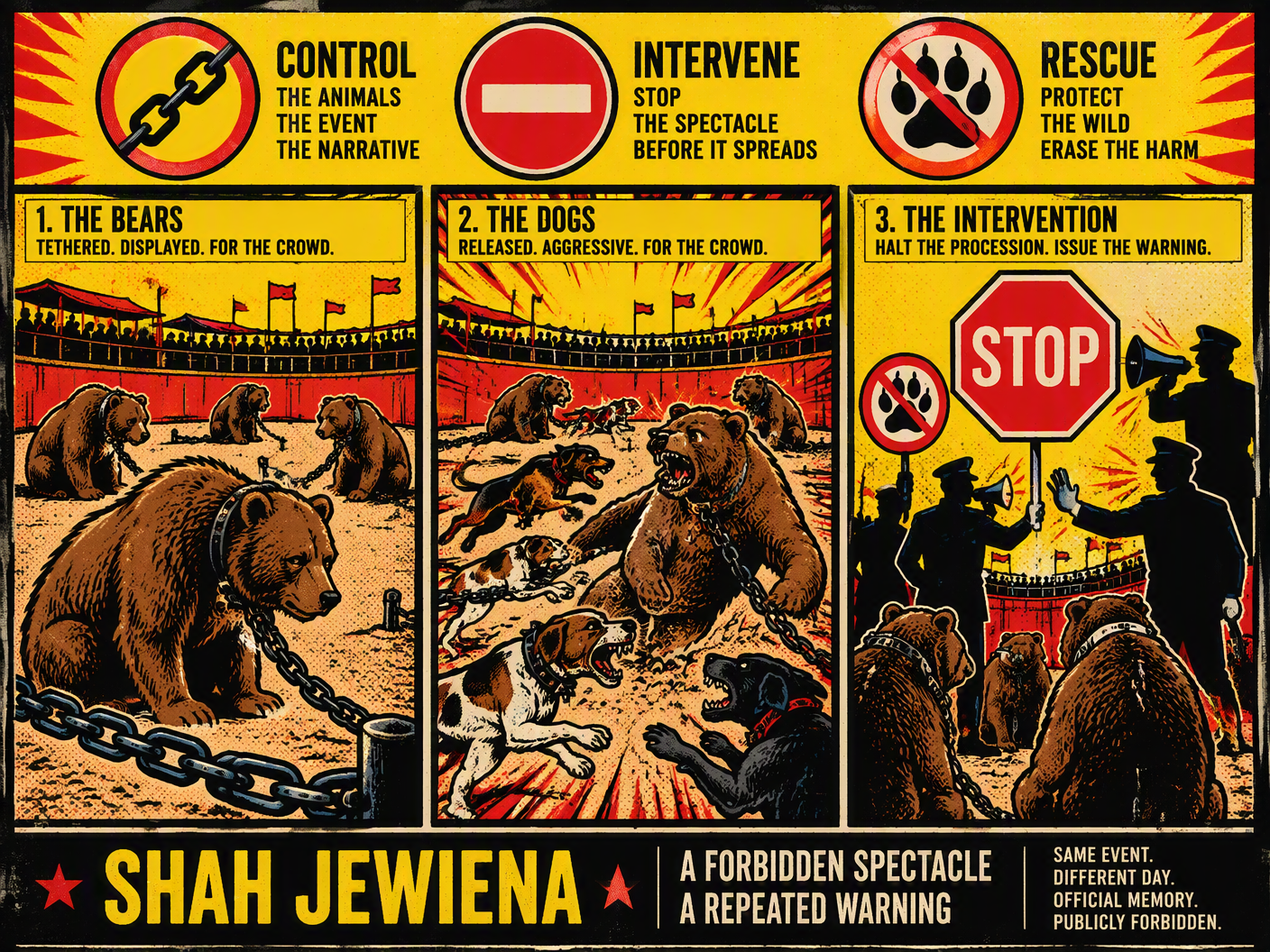
The bears were stopped before they reached the festival ground. On 18 May 2005, wildlife officials moved against a planned bear-baiting event in Shah Jewiena, in Jhang district, Punjab. The warning had come from animal-welfare staff. The numbers waiting behind the warning were large: 20 fights, 30 bears, and 100 dogs. The officials did not arrive to break up a completed contest. They prevented the animals from being brought into the area at all.
The event belonged to an old form of animal fighting. A bear was tethered by a rope in the center of an arena. Dogs were turned loose against it. The bear could not run, and the dogs could not be blamed for choosing the fight. People arranged the distance, the restraint, and the contestants, then gathered around the result.
In Punjab and Sindh, these gatherings had continued since at least 2004. Local gangsters and owners of fighting dogs stood on one side of the arrangement. Bears stood on the other, held in place for an encounter they had not chosen. The event at Shah Jewiena showed how quickly a local spectacle could become a scheduled production, with enough animals for twenty separate fights.
The practice had already survived its original home by centuries. Bear-baiting largely died out in the eighteenth century and was formally outlawed in Britain in 1835. The old arrangement was simple: chain the bear to a post and set dogs upon it. In Pakistan, the same basic contest remained a living practice long after the law and public language had turned against it.
Pakistan's president had taken a public position before the Shah Jewiena intervention. In 2001, Pervez Musharraf issued a decree calling for enforcement of the existing ban on bear baiting. The order gave the prohibition an official voice, but a decree still required people in the field to find the animals, reach the organizers, and stop the gathering before the dogs were released.
Musharraf also directed that confiscated bears be moved to a sanctuary built by the World Society for the Protection of Animals at Kund Park, in Pakistan's North-West Frontier Province. The order dealt with the animals after seizure. It placed a second responsibility on the state: not merely to interrupt the contest, but to decide what became of the bear once the crowd, the ropes, and the dogs were gone.
At Shah Jewiena, the intervention began with a tip-off from the same welfare world that had helped build the sanctuary. Staff connected to the World Society for the Protection of Animals passed the warning to the authorities. Wildlife officials and local authorities then acted together. The planned bears never entered the festival area, and the dogs never met them there.
Victor Watkins, a representative of the World Society for the Protection of Animals, called the halted event a victory and thanked Pakistan's government for its action. His words belonged to the narrow hour: a planned gathering had been stopped, and a state office had responded to information supplied by animal-welfare workers. The congratulations were for prevention, not for a clean map of every village, arena, or dog owner involved in the practice.
That distinction mattered in Punjab and Sindh, where bear-baiting had continued despite the decree issued four years earlier. The official response had two faces. One was the presidential order, printed as policy and attached to a sanctuary at Kund Park. The other was the telephone warning, the local official, and the decision to block animals from a particular festival ground. The second face was slower, closer to the dirt, and dependent on someone speaking before the event began.
The animals at the center of the contest carried the cost of the arrangement. A rope fixed the bear to the arena's center. A post or tether narrowed its world to the reach of the chain. Dogs were set upon the restrained animal while people watched. The language of sport could not change those physical facts. The fight was organized by humans, and the restraint made the encounter possible.
On 18 May, the authorities broke the sequence before it reached its appointed end. No procession of bears entered Shah Jewiena for the twenty planned fights. No tally of winners followed the hundred dogs into the arena. The action was not a speech about cruelty. It was a refusal at the point where transport became spectacle, and where a scheduled event could still be stopped by people who chose to intervene.
The sanctuary at Kund Park and the halted festival belonged to the same struggle, but they were not the same act. One gave confiscated bears a destination after enforcement. The other kept thirty bears from being brought to a Punjab gathering in the first place. Between them stood Musharraf's decree, the welfare workers' warning, and the wildlife officials who acted on it. The rope, the arena, and the dogs remained the plainest description of what those actions were meant to prevent.
Investigative Dossier & Evidence
Read the companion investigation notes, verified source claims, and primary documents.
Read the Companion Notes & Evidence Record →