
Violence & Brawls · 2000s
The 2004 Tunnel Fracas After Arsenal’s Unbeaten Run Ended
Manchester United’s 2-0 victory over Arsenal at Old Trafford on 24 October 2004 ended Arsenal’s 49-match unbeaten league run and was followed by a tunnel disturbance in which pizza was thrown at Sir Alex Ferguson. The Football Association later punished Arsène Wenger for his comments and Ruud van Nistelrooy for an on-field challenge, while Cesc Fàbregas admitted throwing the pizza.
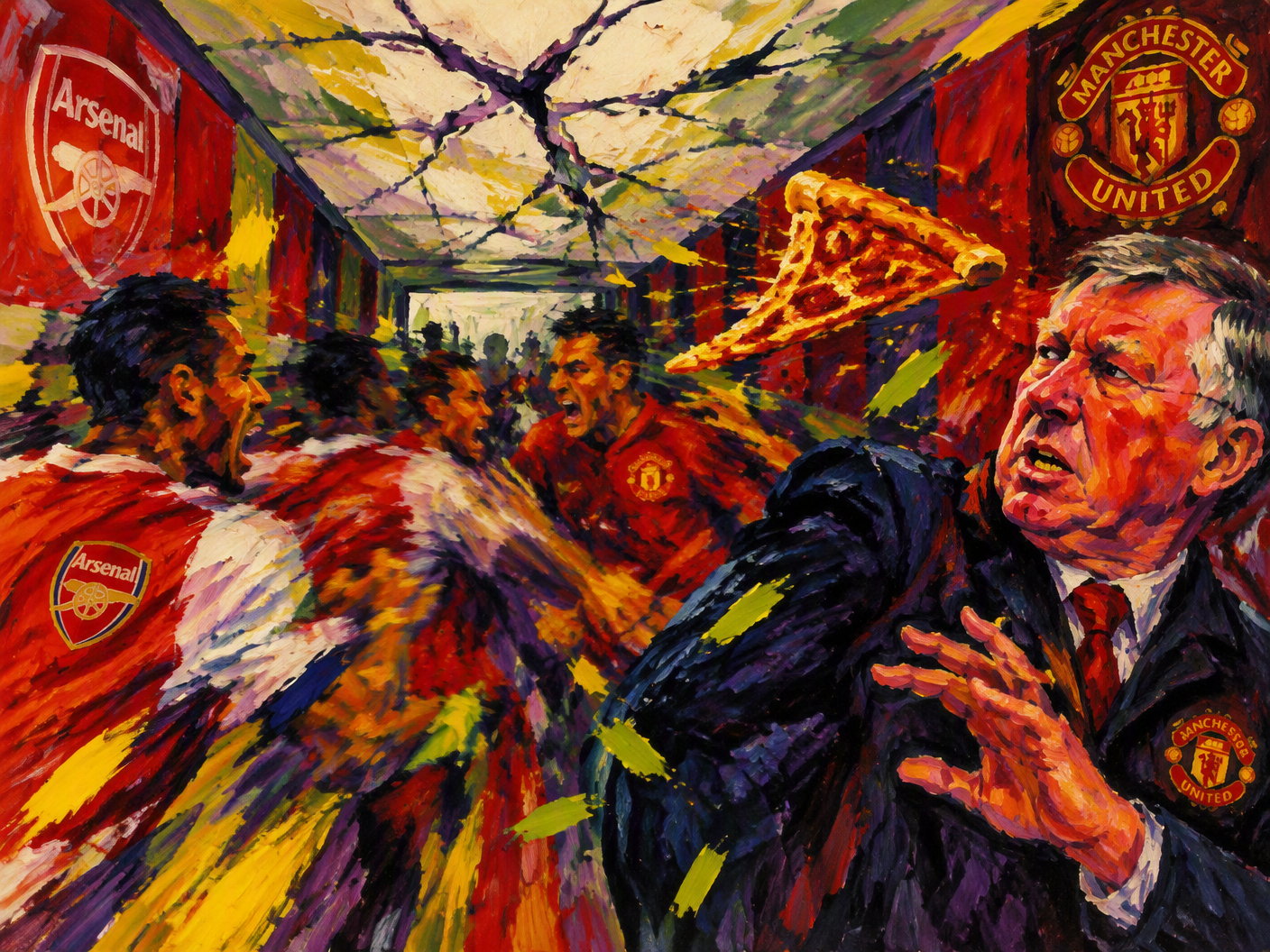
On 24 October 2004, Manchester United beat Arsenal 2-0 at Old Trafford and ended Arsenal’s 49-match unbeaten league run. The result settled the match. It did not settle what followed it. In the players’ tunnel, tempers boiled over after the final whistle, and a slice of pizza struck United manager Sir Alex Ferguson. The incident became known as “Pizzagate,” but its most durable facts were narrower: a defeat that terminated a historic run, a disturbance in a confined passage beneath the stadium, and food thrown at the manager who had spent the preceding week attacking Arsenal’s conduct.
The fixture had been sharpened before either side reached the pitch. In the press buildup, Ferguson publicly criticized Arsenal’s behavior, adding managerial authority to a rivalry already carrying the pressure of a title race and an unbeaten record. Arsène Wenger managed Arsenal; Ferguson managed United. Their dispute was not an abstract exchange between clubs. It placed two managers, their players, and the officials around them inside a contest whose stakes were measurable: Arsenal had gone 49 league matches without defeat, and United had the opportunity to end that sequence at home.
The match remained goalless until the 73rd minute, when Ruud van Nistelrooy converted a penalty for United. The goal gave the home side the lead and attached a specific decision to the result: a spot kick, taken by the striker whose later disciplinary case would become part of the match’s afterlife. Arsenal had spent more than a year avoiding defeat in league play. One penalty placed that run within reach of an ending, but the score still left the outcome vulnerable to a late response.
Wayne Rooney removed that uncertainty in stoppage time. He scored United’s second goal, producing the 2-0 final score and closing the match as a sporting contest. Arsenal’s unbeaten league run ended at 49 matches. The number mattered because it converted an ordinary league fixture into a fixed point in the club’s history: the run stopped at Old Trafford, against United, with van Nistelrooy’s penalty and Rooney’s late goal defining the result.
The players’ tunnel carried the conflict beyond the field. After the match, tempers boiled over in that post-match passage, where players and staff moved away from the formal contest but remained within reach of one another. During the disturbance, a slice of pizza was thrown at Ferguson. The object was trivial; the target was not. Ferguson had managed the victorious team and had publicly attacked Arsenal in the buildup. The thrown food became the physical act that outlasted the arguments surrounding it.
For years, the identity of the thrower circulated as part of the story’s unresolved core. Cesc Fàbregas, then an Arsenal midfielder, was reported at the time as the likely culprit. He later admitted that he had thrown the pizza. That admission fixed the central act without supplying a complete map of the tunnel confrontation. It identified who threw the slice at Ferguson. It did not turn every rumor about every participant, gesture, or exchange into an established finding.
The Football Association addressed Wenger through a separate disciplinary route. It fined him £15,000 for improper conduct over his post-match comments. The sanction concerned what the Arsenal manager said and how the governing body classified that conduct. It did not constitute a formal resolution of every detail inside the tunnel. The distinction was built into the outcome: Wenger received a financial penalty, while the pizza episode remained attached to the match through public admissions and recollection rather than a completed disciplinary account naming every person involved.
Van Nistelrooy’s own case began on the pitch. The FA later charged him with serious foul play for his challenge on Ashley Cole, Arsenal’s left-back, and gave him a three-match ban. The charge separated the striker’s conduct from the tunnel disturbance that followed the final whistle. His penalty had opened the scoring; his challenge on Cole produced a later sanction. Both episodes belonged to the same fixture, but they moved through different channels and carried different consequences.
That separation explains why the disciplinary fallout never produced a single official explanation of the afternoon. The match result was definite. So were the end of Arsenal’s unbeaten run, Wenger’s £15,000 fine, and van Nistelrooy’s three-match suspension. Fàbregas’s later admission established the pizza throw. The tunnel disturbance itself remained a smaller, less formalized event: visible in its consequence, remembered through its nickname, and only partly assigned to individual actions.
The surrounding folklore expanded beyond those settled points. Claims that Arsenal players wore “50 not out” shirts were never proven, and no completed Football Association finding established a full “Pizzagate” case with every participant and exchange accounted for. The stronger account requires less embellishment. United won 2-0. Van Nistelrooy scored from the penalty spot in the 73rd minute. Rooney scored in stoppage time. Arsenal’s 49-match run ended, pizza hit Ferguson, Wenger was fined, and van Nistelrooy was banned for his challenge on Cole.
The final consequence was not a single punishment but a division of responsibility. United kept the victory and Arsenal lost the unbeaten record. Wenger paid for his post-match comments. Van Nistelrooy served a three-match ban for serious foul play. Fàbregas eventually accepted responsibility for throwing the pizza. The tunnel incident survived because it joined a completed sporting result to an incompletely disciplined confrontation: the scoreline could be recorded to the minute, while the corridor behind it retained only the acts that later became fixed.
Investigative Dossier & Evidence
Read the companion investigation notes, verified source claims, and primary documents.
Read the Companion Notes & Evidence Record →