
Tragedy · 1980s
The Lap-58 Pit Fire and the Indianapolis 500 Ruling That Followed
On May 24, 1981, Rick Mears’s refueling stop ended when fuel ignited across his car and upper body, forcing him out of the cockpit before Bill Mears extinguished the flames. The same race later produced a separate USAC dispute over Bobby Unser’s caution-period pit exit, a ruling reversed months afterward.
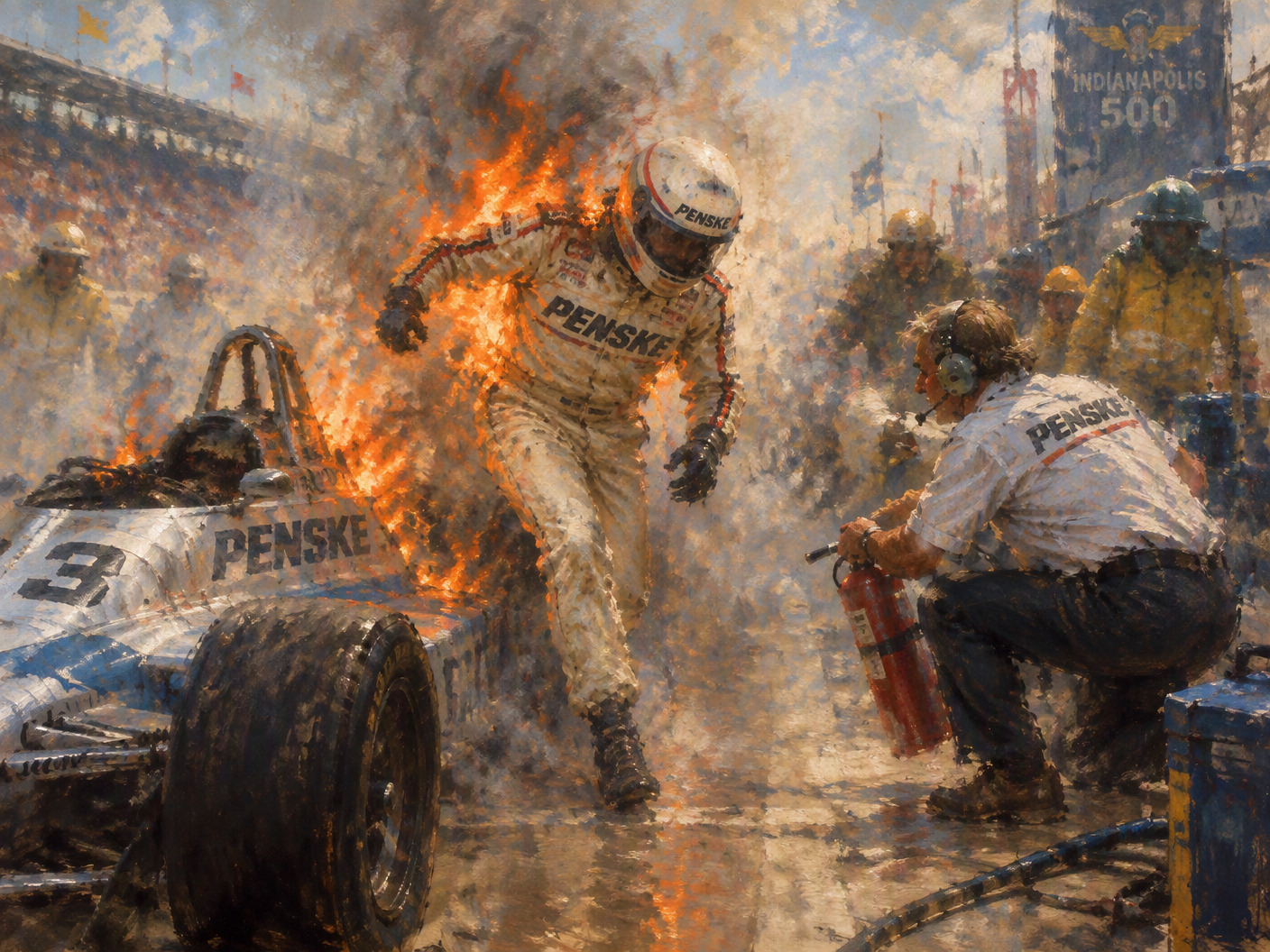
On May 24, 1981, at Indianapolis Motor Speedway, Rick Mears entered the pits on lap 58 of the Indianapolis 500. The stop was supposed to be a brief interruption in a race measured by laps, fuel, and seconds. During refueling, fuel sprayed from the hose onto the Penske car and into the cockpit area. It ignited at the pit box. Mears’s upper body was burning as he climbed out of the car, turning an ordinary service stop into the race’s most immediate emergency.
Mears did not remain inside the car. He exited while the fire covered him from the waist up, and the response moved from pit procedure to rescue. Bill Mears, Rick’s father, used a fire extinguisher to put out the flames. Derrick Walker was also identified among those present in the pit-lane response. The sequence was direct: pit entry, fuel release, ignition, escape, extinguishment. Its force came from the speed with which a controlled refueling operation became a threat to the driver it was intended to return to the race.
The incident later acquired a more dramatic vocabulary than the documented sequence requires. The fuel fire was dangerous because it spread across the car and cockpit area and because Mears was caught inside the working space of a race car during refueling. Nothing else is needed to explain the urgency of the scene. The established account is not a tale of an unknowable phenomenon. It is a pit stop in which fuel escaped, ignition followed, and a driver had to leave the cockpit while his father fought the flames with an extinguisher.
Mears’s injuries continued beyond the moment of evacuation. He later underwent facial plastic surgery. The procedure belonged to the aftermath rather than the race itself, but it gave the pit fire a personal consequence that race summaries could compress into a sentence. In the Indianapolis system, a driver’s work was visible in laps completed and positions gained; the damage from a failed stop was carried on the body. Mears had entered the pits to preserve his place in the contest and left requiring treatment that would remain after the cars were gone.
The race continued after the fire, and its other defining dispute came much later. On lap 149, under caution, Bobby Unser exited the pit area and passed 14 cars. The action became a question for the sanctioning body rather than an emergency for the pit crew. USAC officials ruled that Unser had passed illegally and applied a one-position penalty. Mario Andretti, who had finished second on the track, was elevated to first place under the initial decision.
The two episodes occupied the same Indianapolis 500, but they belonged to different parts of its history. Mears’s fire was an in-race crisis resolved at the pit box by a driver leaving his car and a man operating an extinguisher. Unser’s case arose from a caution-period maneuver and moved through post-race review, protest, and appeal. One demanded immediate physical action. The other required officials to decide how the rules applied to cars moving out of the pits while the field was under caution.
For Unser, the first ruling changed the order in which the race would be remembered. He had crossed the finish line as the apparent winner, but USAC’s penalty transferred the victory to Andretti. That decision did not alter what had happened on lap 58, nor did the pit fire determine the caution-period ruling. The incidents were joined by date and venue, not by any documented connection between the fuel ignition and the later dispute over passing cars.
The penalty did not end the matter. Unser protested, and the decision moved through the appeals process that governed USAC’s race results. On October 8, 1981, USAC rescinded the penalty and reinstated Unser as the Indianapolis 500 winner. Andretti returned to the position attached to his on-track finish. Five months after Mears had climbed from the burning car, the race’s official conclusion changed for an administrative reason rather than a physical one.
That reversal gave the 1981 race two separate afterlives. The first belonged to Mears: fuel on the car, fire in the cockpit area, an escape from the seat, Bill Mears’s extinguisher, and facial surgery afterward. The second belonged to Unser and Andretti: 14 cars passed under caution, a one-position penalty, an elevation in the standings, and a later reinstatement. Retellings often place both episodes under one heading because they occurred in one race. The chronology is less convenient and more revealing.
The surviving public account supports a narrow conclusion with unusual clarity. Rick Mears was refueling on lap 58 when fuel sprayed onto the car and into the cockpit, ignited, and set him on fire from the waist up. He got out, and Bill Mears extinguished the flames. Later, Bobby Unser’s pit-exit maneuver produced a USAC penalty that was eventually withdrawn. The enduring record is therefore divided between a bodily emergency at the pit box and a regulatory decision that changed the winner months after the checkered flag.
Investigative Dossier & Evidence
Read the companion investigation notes, verified source claims, and primary documents.
Read the Companion Notes & Evidence Record →