
Doping & Drugs · 2000s
Thomas Dekker’s Retested EPO Sample and the Tour de France Exclusion
A December 2007 urine sample collected while Thomas Dekker rode for Rabobank was retested with newer methods in 2009, confirmed by counter-analysis, and followed by his removal from Silence-Lotto’s Tour de France team. Dekker first protested his innocence, then acknowledged the EPO use as a one-time mistake through his lawyer.
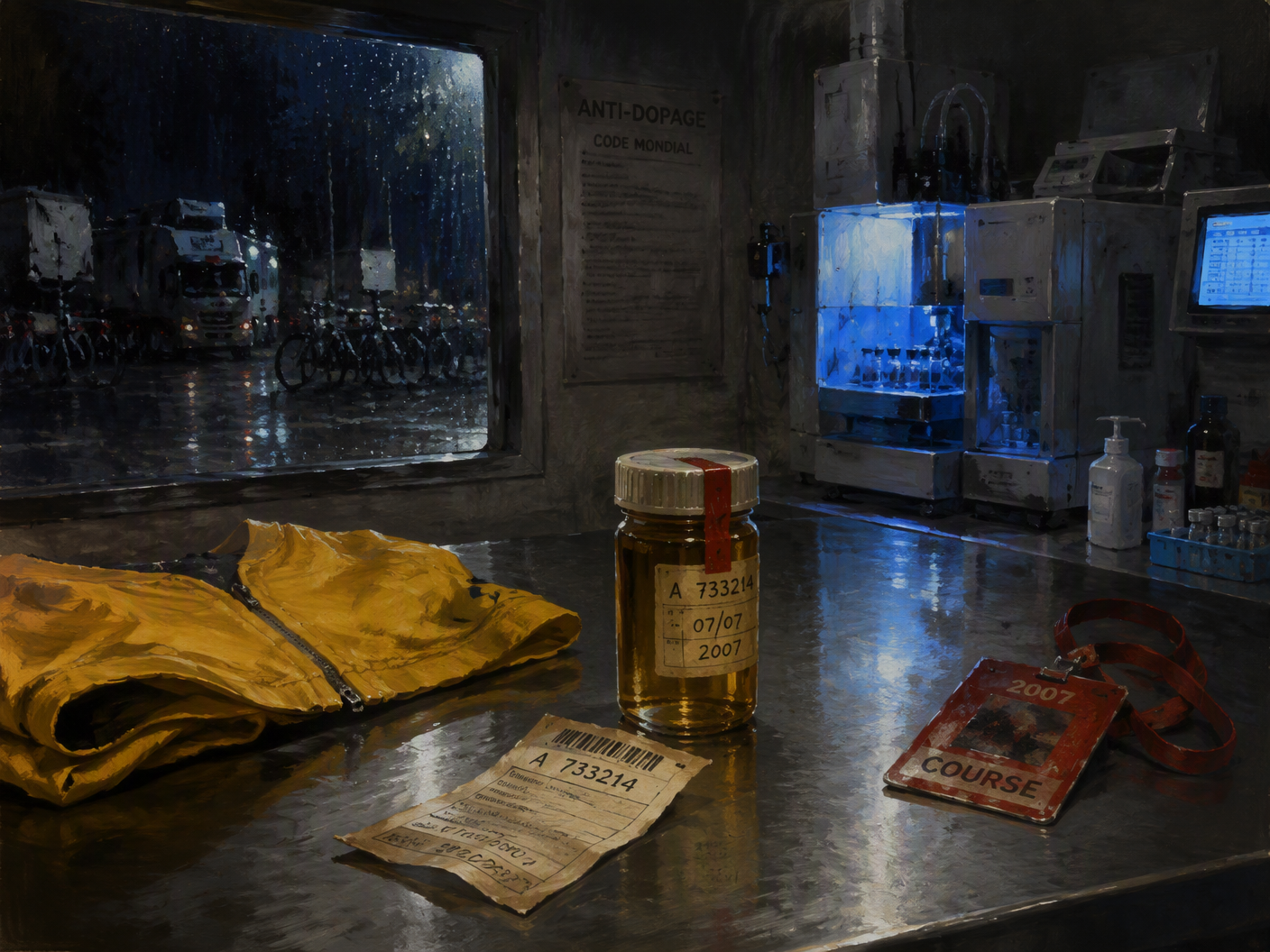
The sample was already two years old when it returned to the center of Thomas Dekker’s life. Collected out of competition in December 2007, when he was riding for Rabobank, the urine had sat inside the machinery of cycling’s anti-doping system while the sport moved on around it. By 2009, newer testing methods had changed what the laboratory could see. The old sample was retested. The result was reported as positive for EPO, the synthetic hormone used to stimulate red-blood-cell production and increase the blood’s capacity to carry oxygen.
The announcement reached Dekker at the point where preparation for the Tour de France was becoming public ritual: team lists, training schedules, sponsor expectations, the slow tightening of a rider’s world around a single race. Silence-Lotto had selected him for its 2009 Tour team. After the positive result was reported, the team removed him. A place that had existed on paper disappeared. The decision converted a laboratory finding from a distant season into an immediate professional sentence.
Dekker did not answer the result with an admission. In July 2009, he publicly protested his innocence. The retesting itself became part of his grievance: the sample had been taken in 2007, tested again years later, and had now overturned the future he believed he was preparing to enter. He said he felt betrayed by the process. His words placed the conflict in the space between an athlete’s memory of an old test and a laboratory’s new reading of it.
That conflict carried a particular cruelty for a rider whose career depended on the margins of physiology. EPO did not announce itself with a broken frame or a crash in the rain. It worked invisibly, through the body’s chemistry, while the public saw only speed, endurance, and the clean geometry of a cyclist climbing a mountain. The positive result reached backward into a season when Dekker had been wearing Rabobank colors and forward into a Tour team that no longer had room for him.
Then came the second analysis. Dekker’s counter-analysis also returned positive for EPO. The first result no longer stood alone in the public account of what had happened to the 2007 sample. The confirmation narrowed the space around his July protest, even as it did not answer every question about when, how, or how often the substance had been used. The case had acquired a second laboratory result and a team action that could not be separated from it.
For weeks, the story remained suspended between resistance and consequence. Dekker’s July position described a rider wronged by a delayed test. The team’s decision described an organization unwilling to place him on its Tour roster after the positive was disclosed. Between those positions stood the old urine sample, the newer method, and the counter-analysis. Cycling’s system had taken time to reach him, but once it did, the sport’s calendar made the result immediate.
In September, the language changed. Dekker’s lawyer issued a statement saying that Dekker acknowledged making a mistake, accepted responsibility, and would apologize. The statement did not preserve the July posture of innocence. It recognized the positive result and placed responsibility for the conduct with Dekker himself. The transformation was public and unmistakable: first the retested sample had been cast as a betrayal; two months later, the rider was speaking through his lawyer about accountability.
The September statement also supplied a boundary to Dekker’s own account. He described the EPO use as a one-time mistake. That phrase gave the episode a beginning and an end, compressing a complicated anti-doping case into a single act and a promise to apologize. It was his characterization of what he had done, delivered after the positive counter-analysis and the loss of his Tour place. The statement acknowledged the conduct without offering a detailed inventory of substances, dates, suppliers, or other riders.
Other names and larger doping investigations circulated through professional cycling during the same period, but Dekker’s 2009 public case turned on a more contained sequence: a December 2007 out-of-competition sample, a later retest, a positive counter-analysis, removal from the Tour team, and two sharply different public responses. The episode did not become a documented account tying him to the Fuentes blood-doping files or the HumanPlasma investigation. Its center remained the EPO result and what Dekker said after it.
The human cost was not confined to a start list. A professional cyclist’s public identity is built from repeated proof: the body tolerates the training, the team grants its trust, the race confirms the investment. Dekker lost that sequence in reverse. A sample from an earlier season reached into the present, his team withdrew him from the sport’s largest stage, and his own account shifted from denial to responsibility. The laboratory did not merely interrupt a race plan; it changed the terms under which his career could be understood.
By September 2009, the case had settled into an uneasy clarity. The retest had produced a reported EPO positive. The counter-analysis had confirmed it. Silence-Lotto had removed Dekker from the Tour de France team. Dekker had first protested the result and the delayed retesting, then acknowledged the use as a one-time mistake through his lawyer. Around that core, the larger rumors of cycling’s blood-doping era remained separate. What endured was the smaller, harder fact: a stored sample had waited, and when the method changed, it found him.
Companion notes
What the Retest Establishes—and What It Does Not
The captured material supports a documented chain from Dekker’s 2007 out-of-competition sample to the 2009 EPO result, counter-analysis, team removal, and public admission. It does not supply the underlying laboratory file or usable corroboration for separate Fuentes or HumanPlasma allegations.
The Sample and the Retest
Cyclingnews and the archived Monsters and Critics report identify the tested material as a December 2007 out-of-competition urine sample collected while Dekker rode for Rabobank. Both sources describe a 2009 retest using newer methods and report that the sample tested positive for EPO. The captured packet does not include the underlying laboratory report, chain-of-custody documentation, assay data, or an anti-doping tribunal file. The supported conclusion is therefore the reported retest and result, not an independent reconstruction of the laboratory procedure. [S2], [S3]
Counter-Analysis and Team Action
Cyclingnews reports that Dekker’s counter-analysis also tested positive for EPO. A Wikipedia reference entry summarizes the same outcome, but it functions as a secondary triage source rather than authoritative evidence. The convergence supports the factual claim that the counter-analysis was reported positive. The sources also state that Silence-Lotto removed Dekker from its 2009 Tour de France team after the result became known. No team disciplinary memorandum or roster decision is included, so the timing and action are documented through reporting rather than an internal club record. [S2], [S1], [S3]
Two Public Positions
The archived Monsters and Critics article documents Dekker’s July 2009 public protest of innocence and his statement that he felt betrayed by the retesting of the older sample. That establishes his position at the time; it does not establish that the laboratory result was erroneous. In September, Cyclingnews reported a statement issued by Dekker’s lawyer saying that Dekker acknowledged making a mistake, accepted responsibility, and would apologize. The statement is a public admission and accountability statement, not a detailed account of every instance, substance, or circumstance involved. [S3], [S2]
The One-Time Characterization
The September statement characterized Dekker’s EPO use as a one-time mistake. That wording should be attributed to Dekker’s own public account and should not be expanded into proof that the use occurred only once. The captured material supplies no detailed chronology of administration, no medical or pharmacological file, and no sworn testimony explaining the circumstances. It does establish a shift in Dekker’s public response—from protesting innocence in July to accepting responsibility in September. [S2], [S3]
Separate Allegations and the Evidence Boundary
The record does not substantively corroborate a verified link between Dekker and the Fuentes blood-doping files or the HumanPlasma investigation. Cyclingnews and the archived Monsters and Critics material support the narrower EPO case but do not provide documentary linkage to those separate matters. A Velonation item is unavailable as usable substantive evidence in the captured materials, and a DPG Media privacy gate prevents meaningful review of another article. The absence of usable corroboration here is not proof that no connection ever existed; it means those allegations cannot be treated as established within this investigation. [S2], [S3], [S4], [S5]
Source key
The associated evidence packet contains visible source URLs, source roles and the complete claim ledger.