
State Doping & Anti-Doping · 2014–2018
Sochi’s Mousehole and the Boundary of Individual Proof
The McLaren investigations reported a sample-swapping system at the 2014 Sochi Winter Olympics, including a passage between laboratory rooms and forensic signs of bottle tampering. CAS recognized the general scheme but required additional proof before assigning personal violations to individual athletes.
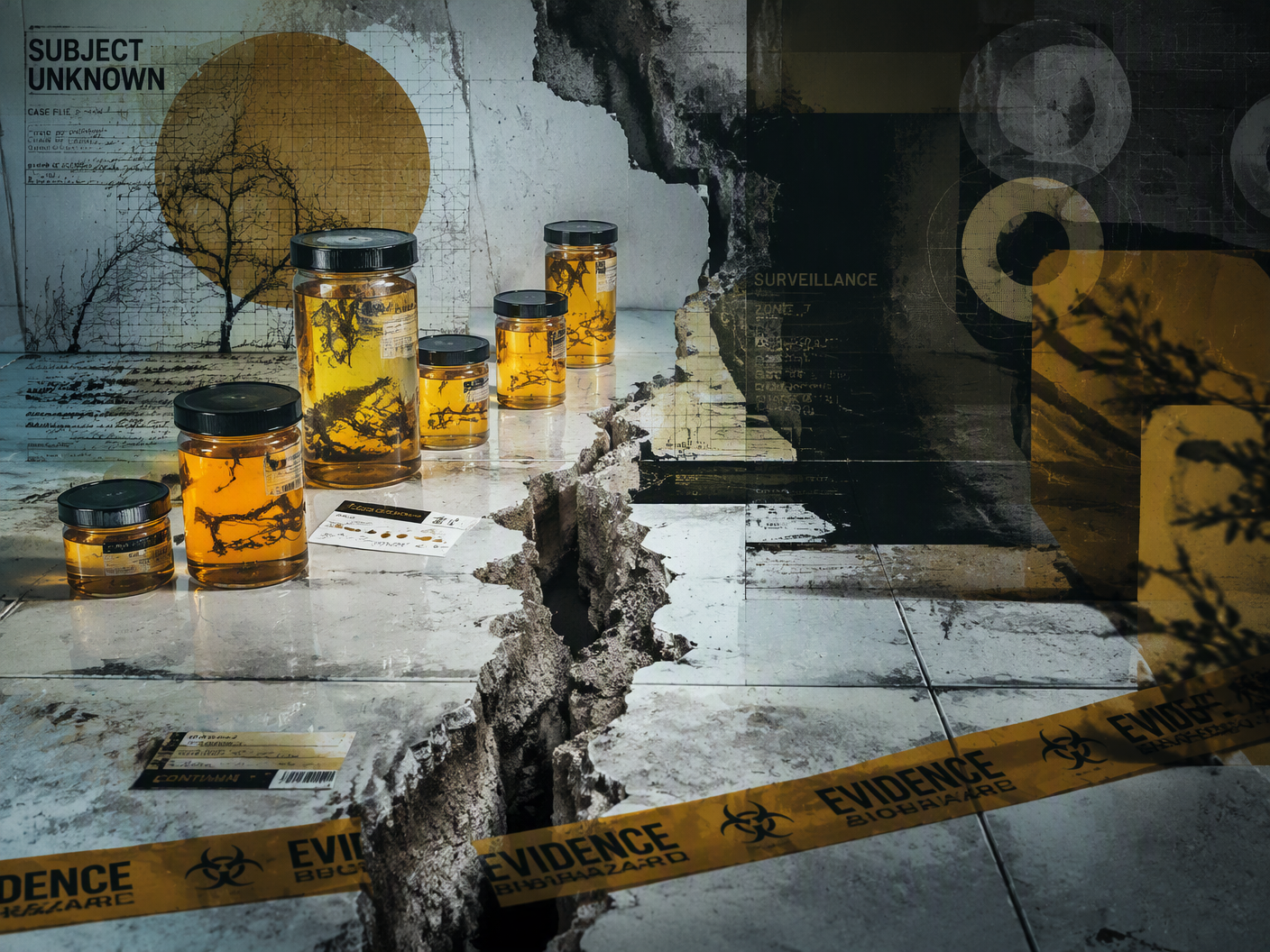
The record begins with a distinction inside the anti-doping laboratory at the 2014 Sochi Winter Olympics. Part I of the McLaren Independent Person investigation reported that the laboratory operated a sample-swapping system during the Games. That finding describes an institutional method, not a conclusion about every Russian athlete or every sample. The distinction matters because the same record later moved in two directions: toward evidence of a general system, and toward separate questions about what could be proved against particular athletes.
At the center of the reported method was a physical opening between rooms. McLaren Part I described a hole, known as the “mousehole,” between the laboratory’s secure operations room and an adjacent room controlled by Russian security personnel. The passage was not presented as a metaphor. It was part of the account of how bottles could move between the laboratory’s secure process and a space under the control of security operatives, placing the mechanics of the alleged scheme inside the architecture of sample handling.
The reported exchange depended on substitution. According to the McLaren investigation, contaminated urine was removed from selected bottles and discarded, while previously collected clean urine was used as a replacement. The bottles were then returned through the mousehole and back into the testing process. The operational description identifies a sequence involving selected bottles, replacement material, and re-entry into laboratory procedures. It does not identify every athlete whose sample was changed, and it does not establish that every sample passing through the laboratory received the same treatment.
Part II shifted the inquiry from the reported route of exchange to the objects themselves. Its forensic findings included scratches on bottle-cap components. The report said comparative testing attributed those marks to thin metallic tools used to open and reseal the caps. The marks therefore served as physical evidence in the investigation’s account of access to bottles after collection. But the captured record does not supply the underlying laboratory files or a sample-by-sample evidentiary schedule, limiting what can be said about the scope of that finding.
The same Part II account reported physiologically impossible sodium concentrations in several samples. It treated those concentrations as physical evidence of post-collection manipulation. That conclusion adds a second forensic feature to the narrative: not only bottle-cap marks, but sample chemistry that the report characterized as incompatible with physiology. The finding remains bounded by its wording. It concerns some samples, not every Sochi specimen, and the cited records does not establish an individual athlete’s responsibility merely because an irregularity appeared in a sample.
A separate account supplied by The New York Times reported Grigory Rodchenkov’s disclosure that a state-run doping program involved dozens of Russian athletes at Sochi, including at least 15 medal winners. In the verified record, that statement remains an attributed allegation or disclosure. It is not an independently adjudicated finding concerning each named or unnamed athlete. Its importance lies in showing how a witness account described the institutional reach of the program, while also showing why attribution must remain visible in any account of individual conduct.
CAS later addressed the tension between system evidence and individual proof in its 2018 determinations concerning 39 Russian athletes. The tribunal stated that the general systemic sample-swapping scheme described in the McLaren reports existed at Sochi. That recognition did not resolve every appeal in the same way. CAS treated the existence of a general scheme as one proposition, and the proof of a personal anti-doping rule violation by a particular athlete as another.
The outcomes made that distinction concrete. In the 39 appeals summarized by CAS, 28 athletes had their sanctions annulled and their Sochi results reinstated. In 11 cases, anti-doping rule violations were confirmed. The captured CAS summary also states that the IOC’s lifetime Olympic bans were declared unenforceable in those 11 cases. These results did not erase the reported system; they showed that recognition of the system did not automatically determine the legal outcome of every athlete’s case.
CAS held that evidence of a general scheme was insufficient, without additional individual proof, to establish that each athlete had committed a personal anti-doping rule violation. The tribunal placed the burden on the IOC to prove the case against each individual to the required standard. Its summary distinguished general evidence from proof concerning a particular athlete or bottle. The record therefore distinguishes the existence of an institutional or systemic scheme from proof of an individual athlete’s knowledge, consent, or participation—questions that cannot be answered for every athlete merely by establishing that the scheme existed.
Taken together, the sources establish a documented institutional distinction. McLaren Part I reported a mechanism involving the mousehole and replacement urine; Part II reported scratches consistent with opening and resealing and sodium concentrations treated as evidence of post-collection tampering. CAS recognized the general scheme, yet required athlete-specific proof. The record therefore supports a strong finding about sample manipulation at Sochi while refusing a broader conclusion that every Russian athlete knowingly participated. The laboratory evidence and the appeals cannot be collapsed into one claim.
Companion notes
What the Sochi Record Proves—and Where It Stops
The evidence combines two McLaren reports, forensic findings, an attributed witness account, and CAS determinations. Together they establish a general sample-swapping scheme while preserving a separate legal boundary around proof against individual athletes.
The McLaren Part I mechanism
The primary institutional source for the reported operating method is Part I of the WADA Independent Person investigation by Prof. Richard H. McLaren. It expressly states that the Sochi laboratory operated a unique sample-swapping methodology during the 2014 Winter Olympic Games. The report described the “mousehole” between the laboratory’s secure operations room and an adjacent room controlled by Russian security operatives. It also described contaminated urine being removed from selected bottles, replaced with clean urine collected before the Games, and the bottles being returned through that opening. Part I establishes the reported system as an investigative finding, but does not establish that every Russian athlete or every sample was involved. [Source 1]
Forensic findings in Part II
Part II of the WADA Independent Person investigation supplied the captured forensic component. It reported scratches and marks on bottle-cap components and stated that forensic experts attributed them to thin metallic tools used to open and reseal the caps. Part II also reported physiologically impossible sodium concentrations in several samples and characterized them as physical evidence of post-collection tampering. Those findings support the conclusion that some bottles or samples showed physical signs consistent with manipulation. the cited records does not provide the underlying laboratory files or a sample-by-sample evidentiary schedule, so it cannot support a broader claim about every Sochi sample. [Source 2]
The attributed witness account
The New York Times report is investigative journalism rather than an adjudicated ruling. It reported Rodchenkov’s disclosure that a state-run doping program involved dozens of Russian athletes at Sochi, including at least 15 medal winners. The account is relevant as an attributed description of the program’s alleged reach and as a source that also reported the operational account involving urine replacement. Its legal and factual limit is explicit: the captured record presents the statement as Rodchenkov’s allegation or disclosure, not as an independently adjudicated finding concerning each athlete. [Source 4]
CAS and individual responsibility
The controlling legal boundary within the public record comes from the Court of Arbitration for Sport’s 2018 arbitral determinations in the Russian athlete appeals. CAS stated that the general systemic sample-swapping scheme described in the McLaren reports existed at Sochi. But it also stated that the IOC still had to prove, to the required standard, that each individual athlete committed a personal anti-doping rule violation. In the 39 appeals summarized by CAS, 28 sanctions were annulled and Sochi results reinstated; violations were confirmed in 11 cases, while the IOC’s lifetime Olympic bans were declared unenforceable in those 11 cases. The determinations distinguish a general scheme from proof that a particular athlete knew, consented, or personally participated. [Source 3]
Source key
The associated evidence packet contains visible source URLs, source roles and the complete claim ledger.