
Violence & Brawls · 1990s
The 1990 England XI Rebel Tour and the Three-Year Ban
In January 1990, Mike Gatting led an England XI into apartheid-era South Africa despite an International Cricket Council ban. Riots, police violence, Nelson Mandela’s release, and the tour’s early termination turned the expedition into a public-relations disaster that removed every player from international cricket for three years.
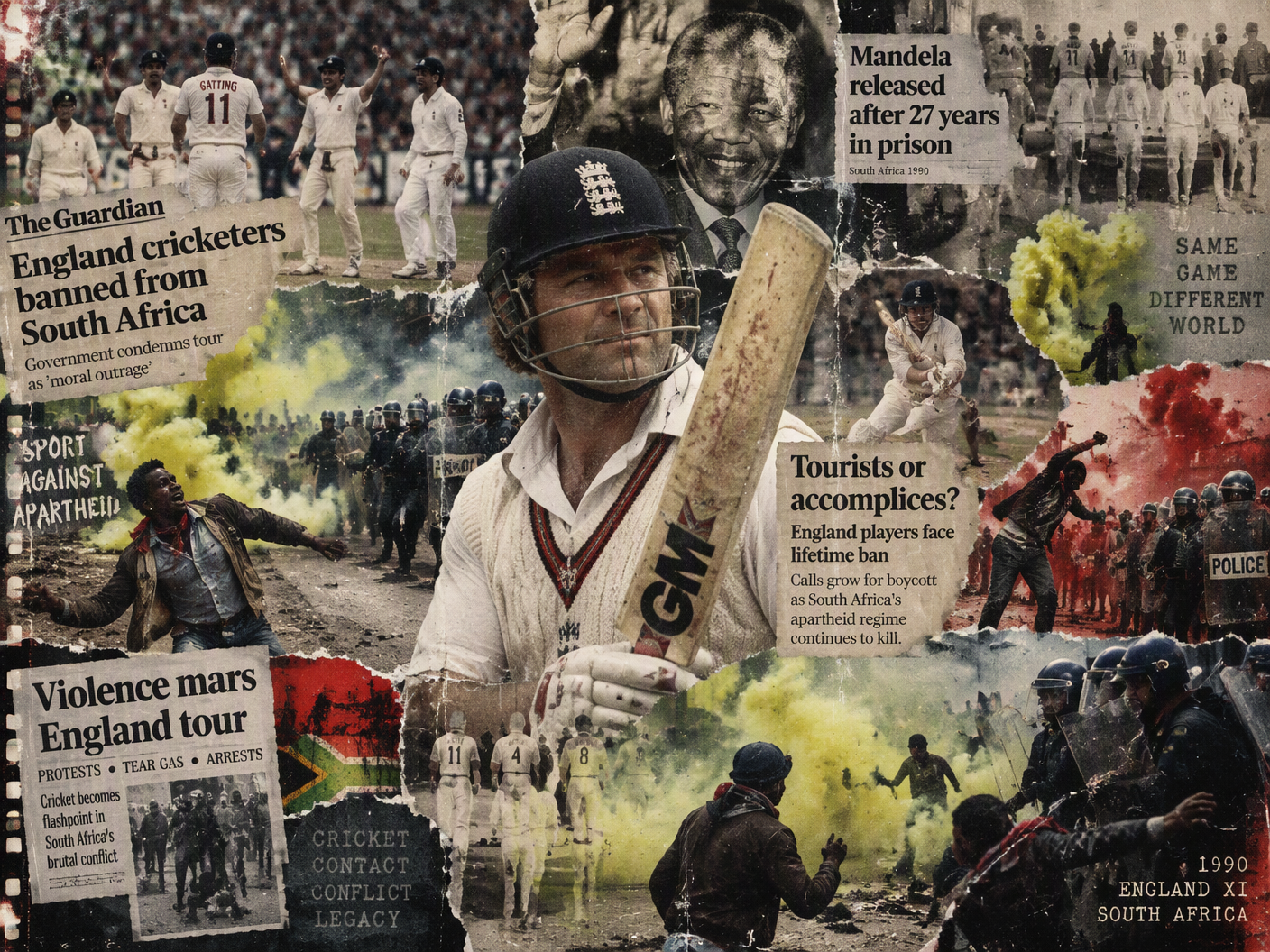
The cricket had barely begun before the tour became a street fight. In South Africa, an England XI played beneath the hard white glare of apartheid, while outside the grounds demonstrators surged against police lines and the political order that had kept the country isolated. Mike Gatting, the England captain, stood at the center of the collision: a famous cricketer carrying a bat into a country his sport had formally barred. David Graveney, player and manager, carried the argument for the expedition. The matches were supposed to speak for contact, reform, and change. Instead, the air filled with tear gas.
The International Cricket Council had banned cricket tours to South Africa because of apartheid. That prohibition gave the England XI’s arrival its particular voltage. This was not an ordinary overseas assignment, not a summer of harmless hotel rooms and green pitches. The players had entered a political quarantine by choice, assembling a private team and crossing a boundary the international game had drawn around the regime. From January 26, the England XI moved through a country in upheaval, playing matches while every appearance carried the image of white sporting privilege into the public square.
Gatting was the visible mechanism of the tour: captain, celebrity, the man whose name traveled ahead of the team. Graveney occupied the more complicated space beside him, both participant and manager, explaining why the players had come. The tour’s defenders presented cricket as an instrument that could force South Africa toward change. Graveney’s justification collided with the phrase that followed him—“bloody money”—a remark that hardened the suspicion that the players had crossed the line for payment rather than principle. The explanation did not calm the country. It sharpened the public argument.
Then the protests multiplied. Riots broke out around the matches, transforming the tour’s carefully managed route into a sequence of confrontations. Demonstrators faced police, and police answered with tear gas and rubber bullets. The chemical haze moved through the atmosphere of the cricket grounds, cutting across the old rituals of applause, luncheon intervals, and pressed whites. The players’ presence had become a fixed point in the unrest. Each match offered the organizers another chance to display normality; each disturbance tore the backdrop open and showed the violence surrounding it.
The South African Cricket Union began receiving threats of violence against the England team as the protests intensified. Security was no longer a perimeter detail beneath the floodlights. It was the condition of the tour. The organizers had to reckon with a visiting side whose arrival had become a political target, and with demonstrations that could gather faster than a police cordon could contain them. The England XI had come to play cricket inside an argument about legitimacy. Now the argument had acquired sirens, projectiles, gas, and the possibility that the players themselves could be attacked.
Outside the grounds, the country was moving toward a political rupture. South Africa was experiencing change at speed, and on February 11 Nelson Mandela was released from prison. The image of Mandela walking free altered the meaning of every white English player appearing on a South African field. The old order was loosening in public, under television cameras and across streets full of expectation. The England XI had arrived claiming that sporting contact might help produce transformation. Mandela’s release made the transformation visible without them, and made their presence look less like a bridge than an intrusion.
The promise of meaningful change began to buckle under the weight of what the tour actually produced. The players could point to matches completed and conversations held; the country around them supplied a harsher accounting. Apartheid remained the governing system. Protesters were being confronted by armed police. The team’s justification was widely viewed as insufficient, even disingenuous, because the expedition seemed to offer the regime a sporting picture of normal life at the exact moment that picture was collapsing. The cricket continued, but its political usefulness had become a claim no one could comfortably see on the field.
By February 14, the machinery could not keep turning. Escalating violence and the political developments reshaping South Africa forced the tour to end two weeks before its scheduled conclusion. The England XI departed with the matches unfinished, the security threats unresolved, and the original mission stripped of its protective language. A tour that had been sold as engagement now looked like an exposure: the players had entered a banned contest, crossed through riots, and left before the country’s pressure could consume the itinerary completely.
The consequences waited on the other side of the flight home. Every member of the England XI received a three-year ban from international cricket for taking part. The punishment reached beyond Gatting’s captaincy and Graveney’s management. It removed the entire group from the sport’s official stage, cutting into careers built around selection, travel, and the next Test match. The rebel label was no longer a newspaper description or a political insult. It had become an administrative sentence with a duration: three years, applied to every player who had made the journey.
For England cricket, the tour became a public-relations disaster. The violent protests supplied the pictures; the ICC ban supplied the violation; the political climate supplied the meaning. The team was perceived as supporting the apartheid regime simply by performing inside its borders, regardless of the players’ stated intention to promote change. Graveney’s defense, Gatting’s leadership, the money, the matches—each element fed the same machinery of public anger. The expedition had sought control over its message. South Africa, and the violence surrounding the tour, took that control away.
The strangest object left behind was the cricket itself. Scores could be recorded, overs completed, and players named, but the political weather swallowed the sporting details. A white ball traveled across a pitch while police fired rubber bullets at demonstrators beyond the boundary. The team’s argument required the match to remain the central event. The country’s upheaval made the match incidental. By the time the England XI returned, the tour’s loudest sounds were not bat on ball or applause from the stands, but the hiss of tear gas, the crack of unrest, and the institutional door closing for three years.
Gatting had led the players into the glare. Graveney had helped explain why they were there. Both became attached to a journey that promised contact and delivered isolation, a mission advertised as useful engagement and remembered through riot police, threats, and punishment. The tour ended on February 14, but its consequences extended beyond the last match and beyond the scheduled calendar. South Africa was changing without the England XI’s permission. The players went home carrying the cost of having mistaken access to a forbidden field for influence over the country around it.
Investigative Dossier & Evidence
Read the companion investigation notes, verified source claims, and primary documents.
Read the Companion Notes & Evidence Record →