
Bizarre & Myths · 1960s–1970s
Terrible Ted and the Long Exhibition of Bear Wrestling
Bear wrestling had become a public attraction in New York by 1877, decades before Terrible Ted entered Stampede Wrestling under Dave McKigney’s promotion. Ted became one of North America’s best-known wrestling bears, while the surviving account of the practice remains strongest on its public appearances and weakest on complete match totals and booking records.
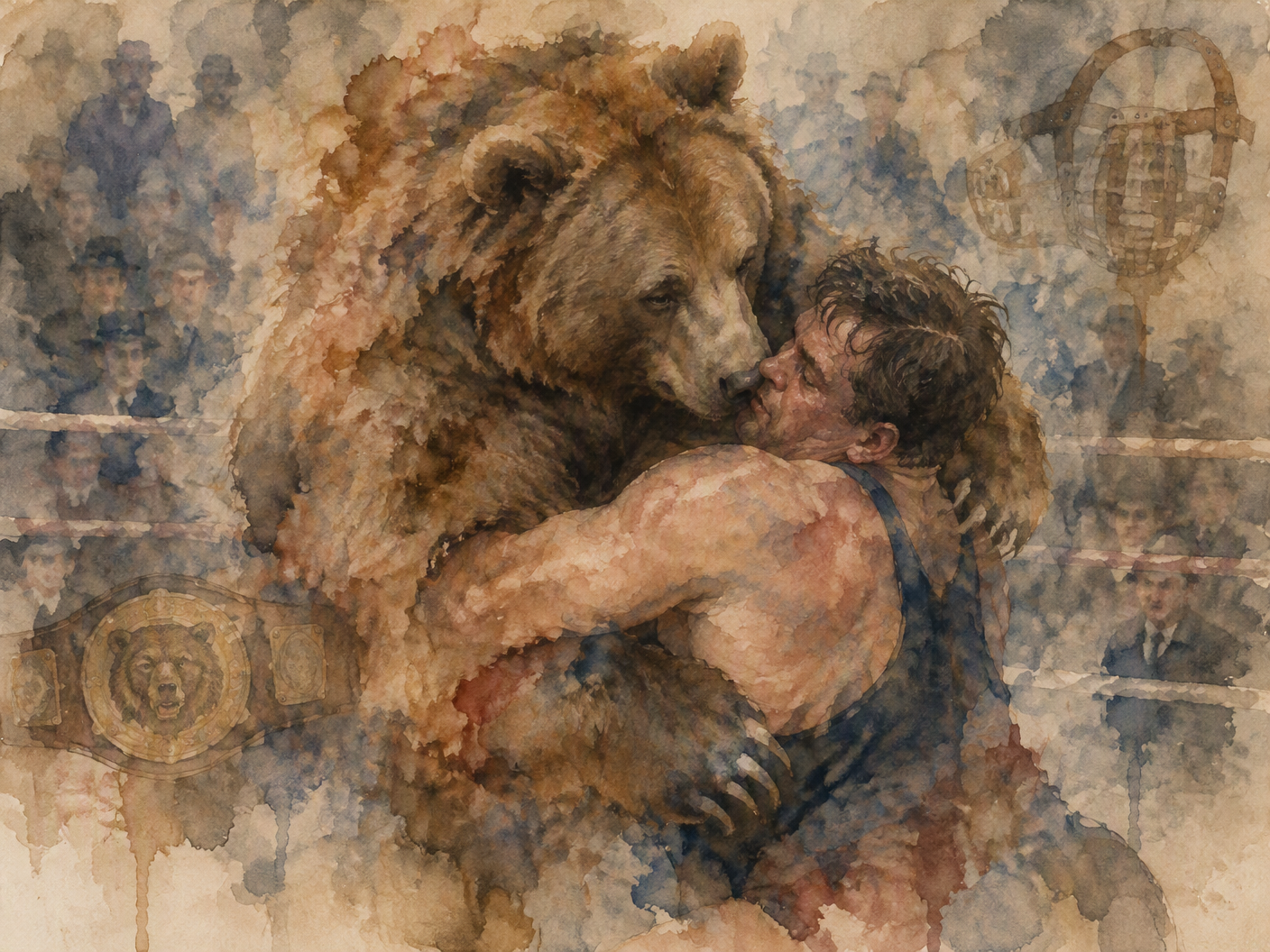
On December 11, 1877, Emil Regnier put two bears on a wrestling card at Athletic Hall in New York City. William Heyster wrestled one of them before a paying audience, and the bout ended in a tie. The event fixed the essential form of the attraction: a human wrestler, a trained animal, a set of rules borrowed from the ring, and a result announced as though the contest had been decided on equal terms. Bear wrestling was already a spectator business in the United States before professional wrestling acquired its modern vocabulary.
The details attached to Heyster’s opponent made the performance possible and revealed its limits. The bear wore an iron muzzle, and its foreclaws had been rounded. Those alterations reduced the animal’s capacity to injure the wrestler, but they also shaped the contest before it began. The match could be presented as a test of strength only after the bear had been modified for exhibition. A tie gave the card a sporting conclusion, yet the conditions belonged to the promoter as much as to either participant.
Regnier did not treat the Athletic Hall bout as an isolated curiosity. Later in 1877, at the Théâtre Français, he wrestled another bear, Lena, and was declared the winner. The sequence mattered commercially. One bear could be replaced by another, one hall by another, and a novelty could be repeated until it became a recognizable act. The language of wrestling supplied the structure—opponent, bout, winner—while the animal supplied the attraction that separated the performance from an ordinary athletic program.
The practice continued through exhibitions in which the animal’s participation was controlled before the audience saw it. Bears used in such displays were often half-tamed and managed with muzzles or altered claws and teeth. The public saw a collision between human technique and animal strength; promoters arranged the conditions under which that collision could occur. A pin, a tie, or a declared victory therefore belonged to a theatrical system as well as to the bodies inside the ring. The performance endured because its uncertainty could be advertised without surrendering control.
Terrible Ted entered that older tradition in the era of Stampede Wrestling. He was a wrestling bear used in the promotion and associated with Dave McKigney, a wrestler and promoter who built part of his act around bear wrestling. Ted appeared against human opponents across North American venues from 1958 through 1969. He was not presented as a single unusual booking like Regnier’s New York contests. He became a recurring attraction, carried from the margins of wrestling into the regular traffic of a professional wrestling business.
The numbers later attached to Ted gave the animal an unusually long working life. One account placed him beyond 500 matches by 1959 and said that he reached 1,500 by 1969. Those figures turned Ted from a memorable opponent into a measure of endurance: a bear whose career could be counted in hundreds of appearances and then counted again at a scale that approached legend. The totals circulated as part of the story of Ted, even as the complete booking ledger remained outside the surviving account.
Ted’s place in Stampede also brought him into the domestic orbit of Stu Hart, the wrestler and promoter whose Calgary operation helped define the regional wrestling business. During Ted’s time with Stampede, Hart hosted the bear at his home. That detail placed the attraction beside the ordinary arrangements of a wrestling household: the promoter’s family, the traveling performers, and the animal whose presence connected a commercial act to private space. Ted was both a booked performer and a living responsibility attached to the people who handled him.
McKigney’s use of Ted gave bear wrestling a durable North American identity, and Ted became one of the bears most closely associated with the practice. The attraction depended on a simple contradiction. The match had to look uncontrolled enough to sell danger, while the bear had to be managed closely enough for the act to continue. Every appearance rested on that balance. The wrestler took the fall or secured the hold; the promoter supplied the setting; the bear’s body made the contest marketable.
The custom did not end with Ted’s working period. On March 18, 2006, at the Cleveland Sport, Travel & Outdoor Show in the I-X Center, a high school wrestler named Lance Palmer faced a bear named Caesar. Palmer pinned the animal. The setting was no longer a New York theater or a regional wrestling card, but the structure remained familiar: an exhibition placed inside a public show, a human competitor, a bear, and a result legible to spectators as a wrestling victory.
By then, Terrible Ted had acquired the status reserved for the most prominent animals in the genre. His name appeared alongside bears remembered for achieving notoriety in bear wrestling, while the reported totals gave his career a scale larger than any single match. Yet the surviving history is uneven. It preserves the dates of major exhibitions and the broad shape of Ted’s career more clearly than it preserves every booking, every condition, or every event claimed in later retellings.
The afterlife of bear wrestling therefore rests on two records at once. One is the public record of appearances: Athletic Hall in 1877, Lena at the Théâtre Français, Terrible Ted in Stampede Wrestling, and Caesar at a Cleveland trade show in 2006. The other is the language of promotion, which converted managed animal performances into matches and measured them through wins, ties, and match counts. That language carried the practice across generations, leaving behind not a conventional sport but a recurring exhibition whose rules were made for the audience before the contest began.
Investigative Dossier & Evidence
Read the companion investigation notes, verified source claims, and primary documents.
Read the Companion Notes & Evidence Record →