
Tragedy · 1903
The 1903 Purdue Train Wreck and the Interrupted Indiana Rivalry
A fatal railroad wreck involving Purdue’s football team entered the Indiana–Purdue rivalry in 1903, disrupting the series without ending it. The teams’ games before and after the disaster show a competition altered by loss, not erased by it.
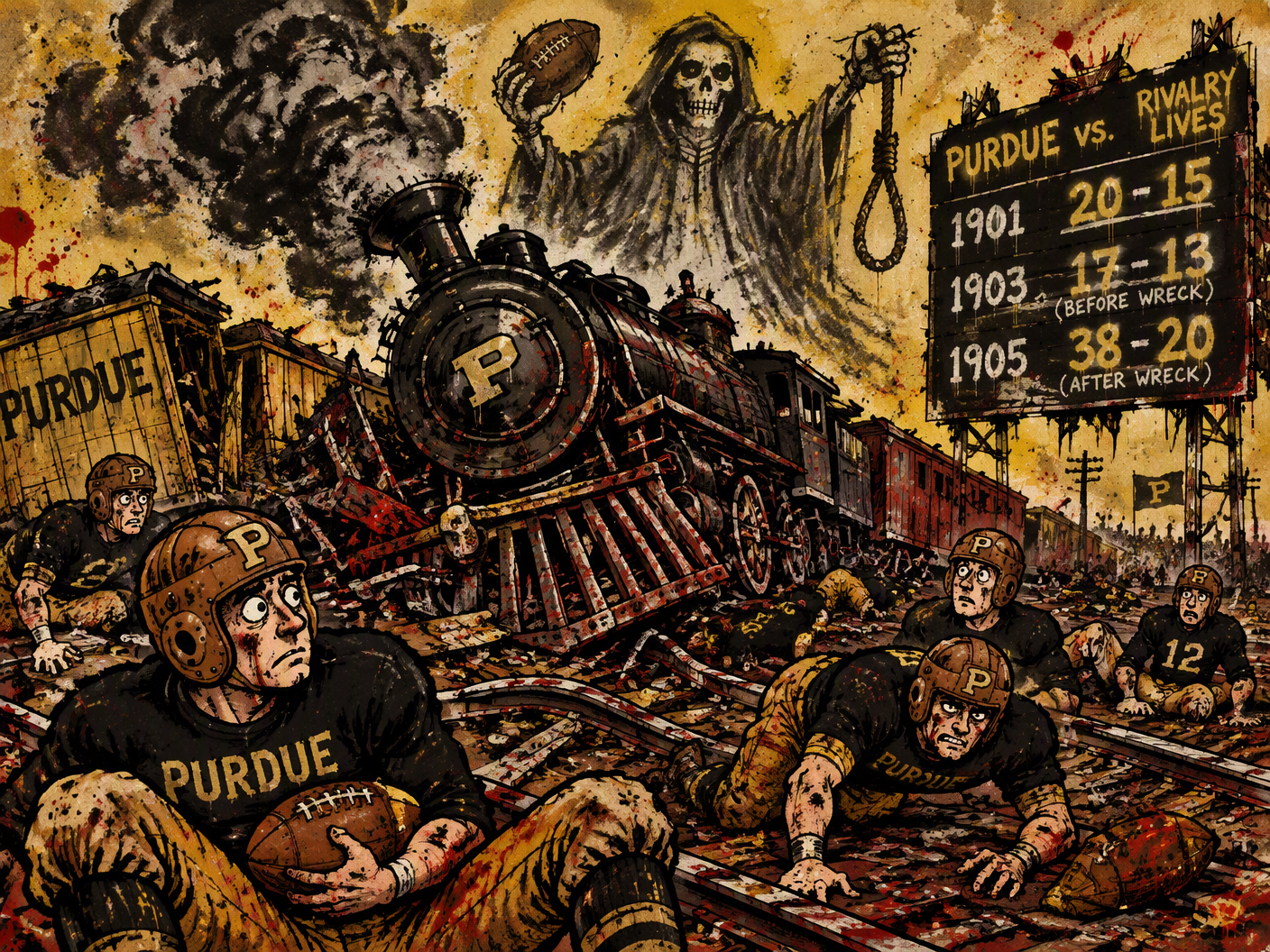
In 1903, a train carrying the Purdue football team was wrecked, and people died. The event entered the rivalry’s history not through a preserved account of the journey, its route, or the decisions made around the train, but as a fatal interruption placed inside the early schedule of Indiana and Purdue. The teams had begun meeting only two years earlier. Their football series was still being assembled when transportation—a practical condition of college competition—became part of its history. The wreck did not produce a clean ending. It left a break in the sequence, followed by another Purdue–Indiana game.
The first meeting came on March 2, 1901, in West Lafayette. Purdue won, 20–15, establishing the contest in the small but expanding world of regional college football. At the time, Indiana and Purdue were not custodians of an ancient tradition. They were nearby institutions building an athletic relationship through scheduled travel, local rivalry, and repeated play. A football game required players to reach another campus, and the train was among the ordinary means by which teams moved between towns. In the early record, the route between campuses was part of the contest’s practical foundation.
On March 6, 1903, the teams met in Bloomington. Purdue won again, 17–13. That result places a football game between the two schools in the calendar of 1903, before the wreck’s precise position in the year can be fixed. The rivalry’s preserved summaries also treat 1903 as a year in which Indiana and Purdue did not play football. Both entries remain part of the historical account, and together they show how incomplete early schedules can become when later summaries compress a disrupted season into a single line.
The wreck itself is stated plainly: a Purdue football team train was involved in a fatal railroad disaster in 1903. Its human cost is therefore part of the rivalry’s documented background, even though the surviving account does not supply the number of people killed. The disaster belongs to the team’s history before it belongs to the mythology of the series. It was not a metaphor when it occurred. It was a transportation catastrophe involving athletes whose movement between places had become necessary to the sport they played.
The consequences visible in the schedule are narrower than later retellings might suggest. Indiana and Purdue’s football history contains a 1903 interruption, but the teams were not permanently separated. The next listed meeting came on January 14, 1905, in West Lafayette. Purdue won, 38–20. The date matters because it places competition after the wreck and gives the series a continuation that the language of cancellation would conceal. Whatever arrangements were made in the aftermath, the schools returned to the field against one another.
That return did not resolve every question surrounding the disaster. The account of the wreck carries no arrest, criminal charge, or disciplinary ruling arising from it. It does not identify a railroad official, coach, player, or university officer as having been punished. Nor does it establish that the wreck alone caused the interruption in the football schedule. The institution’s formal response, if one occurred beyond the preserved rivalry history, is absent from the account that carries the event forward.
This distinction changes the shape of the story. The wreck was fatal, and the rivalry record places it amid a period when the teams’ meetings were irregular. But a break in a schedule is not the same as a proven cancellation, and a disaster’s presence in a chronology does not by itself explain every decision that followed. The documented sequence gives Purdue and Indiana a meeting in Bloomington, a fatal wreck in the same year, and another meeting in West Lafayette two years later. The event altered the frame around the rivalry without becoming its final boundary.
For the players and families connected to the Purdue team, the score lines could not contain the whole meaning of 1903. The record preserves victories—17–13 in Bloomington and later 38–20 in West Lafayette—but the wreck placed death alongside those figures. The available history does not preserve the private arrangements that followed, the names of every person affected, or the decisions made by the university and railroad. What remains visible is the collision between an athletic schedule and the physical dependence of that schedule on rail travel.
Decades later, the rivalry had moved into a different sport and a different kind of building. On December 14, 2002, Indiana defeated Purdue, 66–63, in the Duel in the Dome at the RCA Dome in Indianapolis. Jeff Newton scored all 16 of his points in the second half for Indiana. Purdue was coached by Gene Keady, while Mike Davis coached Indiana. The game’s setting—an enclosed professional football stadium rather than a turn-of-the-century campus field—showed how far the contest had traveled while retaining its opposing colors and names.
The 2002 game did not repair the missing details of 1903. It served a different historical purpose: it demonstrated that Indiana and Purdue remained a recognizable athletic pairing long after the fatal train wreck had entered their shared past. The rivalry survived in records that could preserve a score more easily than a journey, a date more easily than a death toll, and a later contest more easily than an institutional response. Its continuity is therefore part of the evidence, not an argument against the seriousness of the interruption.
What endured was not a single uninterrupted line but a record marked by an early disaster, conflicting schedule entries, and a return to competition. Purdue’s victories in 1901, 1903, and 1905 frame the first years of the series; the fatal wreck stands between them as an event whose consequences were real but only partly preserved. By 2002, Indiana and Purdue could meet before thousands in Indianapolis under a modern athletic economy. The old rivalry had acquired new venues and new records, while the 1903 wreck remained attached to it as a documented loss without a complete official aftermath.
Investigative Dossier & Evidence
Read the companion investigation notes, verified source claims, and primary documents.
Read the Companion Notes & Evidence Record →