
Violence & Brawls · 1922
Floriana–Valletta: Two Recorded Derbies and an Unfinished Title Claim
Floriana’s 2016 victory and the clubs’ added-time draw in 2019 fixed the rivalry in scores, scorers and dates. When the 2020 season stopped with Floriana first, the contest moved from the field to a federation decision over the championship.
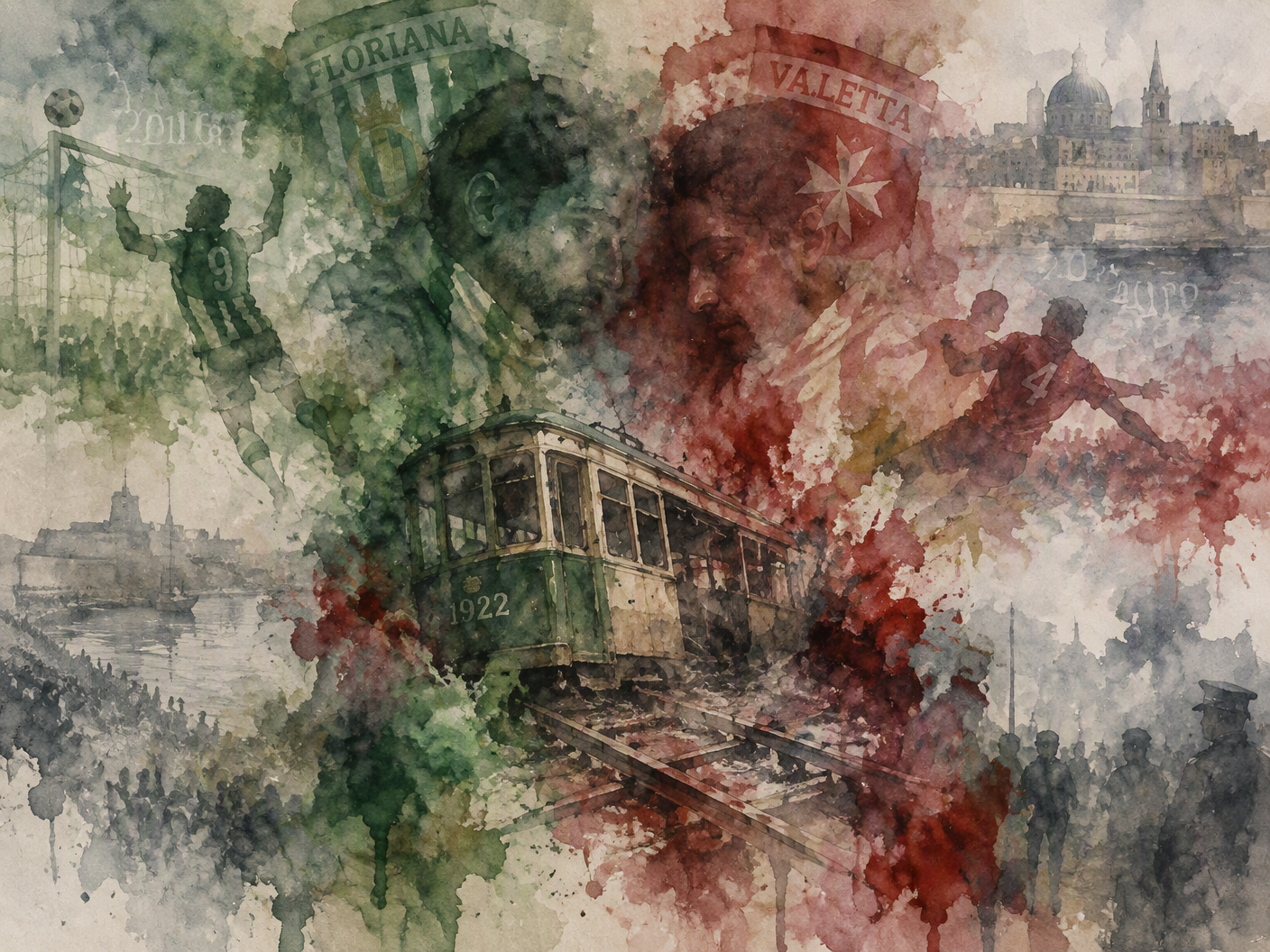
On September 22, 2016, Floriana defeated Valletta 2–0, producing a result fixed by a date, two scorers and a final whistle. Long before that match, a later rivalry tale had placed violence in 1922, when a Floriana gang purportedly derailed a tram and attacked Valletta supporters with stones. Repetition gave the episode a place in football folklore, but the modern fixture left a different kind of inheritance. Amadou Samb and Mario Fontanella scored the goals, and Floriana’s victory entered the public chronology through the ordinary machinery of league football.
The distance between those two episodes matters. The 1922 story survived through repetition, with the overturned tram serving as the image around which later generations could organize the rivalry’s severity. The 2016 match belonged to a different institutional world, one of scheduled league fixtures, named scorers and results preserved immediately after the final whistle. Floriana’s victory offered no comparable account of public disorder. It instead supplied the ordinary particulars through which modern football fixes an event in time: the date, the opposing clubs, the sequence of goals and the final score.
Floriana took control after the half-hour mark when Amadou Samb scored. Mario Fontanella added the second goal after halftime, completing the 2–0 victory. Those two actions were enough to decide the derby, but the result also restored Floriana’s place in a contest whose public meaning had accumulated far beyond any single league match. Valletta left without a goal; Floriana left with both points and a scoreline that required no inherited embellishment. In the modern history of the fixture, Samb and Fontanella supplied a dated result against which memory could be checked.
Two years later, the language of rivalry appeared in the communications of the Malta Football Association itself. On August 24, 2018, the association previewed Floriana against Sliema Wanderers under the name “Old Firm Derby.” That designation belonged to Floriana–Sliema, not Floriana–Valletta, an important separation within a football culture containing several durable antagonisms. Floriana’s institutional identity could therefore be presented through one historic derby while its meetings with Valletta carried another inheritance. Official vocabulary arranged these relationships into recognizable fixtures, giving each contest a place in the league’s public calendar.
Valletta nevertheless occupied the same 2018 preview because of what had happened in the opening league match. Sliema Wanderers had beaten the club 3–0, meaning Valletta began its campaign having conceded three times. The result placed the reigning concerns of league competition beside the inherited names of old rivalries. A derby could carry decades of accumulated meaning, but the immediate table still turned on goals scored and allowed. In the association’s presentation, Floriana–Sliema received the historic title while Valletta appeared through a recent defeat, its position defined by the first match of a new season.
By September 15, 2019, attention had returned directly to Valletta and Floriana. They met at the National Stadium and played to a 1–1 draw. The setting represented the regulated form the rivalry had assumed: a designated national venue, a league fixture and a result administered within the competition. The match did not require an episode beyond the field to acquire tension. Its decisive turns came through the rules of play—a penalty for Floriana, then the narrowing minutes in which Valletta attempted to recover. What had once been remembered through an attack on transport now unfolded under a match clock.
Kristian Keqi converted Floriana’s penalty, giving his club the lead. That advantage endured through the regulation minutes, bringing Floriana close to another derby victory. Added time then changed the result. Enmy Pena Beltre scored Valletta’s equaliser, turning defeat into a draw before the match ended. The two goals established the balance of the afternoon: Floriana had gone ahead through a formal sanction imposed during play; Valletta answered at the last available stage. The final score, 1–1, preserved neither side’s preferred conclusion, but gave the rivalry another exact sequence of action and response.
The following year moved the dispute away from a completed derby and toward control of the league itself. The Maltese season stopped with Floriana in first place. On May 20, 2020, club president Riccardo Gaucci publicly asserted that position while the federation was still deciding whether the championship would be awarded. His argument rested on the standings at interruption: Floriana occupied the place normally associated with the title, but the competition had not reached its intended conclusion. The unresolved question was no longer who had scored in a derby. It was who possessed the authority to convert an unfinished table into a championship.
Gaucci also raised the possibility of an appeal if Floriana did not receive the title. That prospect revealed the channels through which a modern football grievance advanced. The club president could state his case publicly, the federation could determine the status of the competition, and a dissatisfied club could challenge the outcome. The conflict remained intense, but its instruments were administrative: standings, federation authority and an appeal process. Floriana’s claim depended on being first when play ceased; the federation’s pending decision determined whether that position would be treated as sufficient.
Across the century, the rivalry changed forms without surrendering its accumulated meanings. The 1922 account located danger on a tram carrying Valletta supporters. The later sequence located conflict inside fixtures, official previews and league governance. Samb and Fontanella gave Floriana a clear victory in 2016. The association assigned historic derby language with precision in 2018. Keqi and Pena Beltre divided the 2019 match between a penalty and an added-time equaliser. Gaucci’s intervention in 2020 carried Floriana’s position from the table into a public argument over institutional power.
The durable chronology is narrower than the folklore surrounding the clubs. It contains Floriana’s 2–0 victory in 2016, the association’s precise use of “Old Firm Derby” for Floriana–Sliema in 2018, and the penalty and added-time equaliser that produced a 1–1 Floriana–Valletta draw in 2019. In 2020, it records Gaucci asserting Floriana’s first-place position while the federation’s decision remained pending. These moments preserve the rivalry through public acts: goals scored, language chosen by administrators and authority exercised over an interrupted competition. The tram tale remains outside that documented sequence.
Investigative Dossier & Evidence
Read the companion investigation notes, verified source claims, and primary documents.
Read the Companion Notes & Evidence Record →