
Point Shaving & Fixes ·
The Bribe Junius Kellogg Reported
After initially accepting a point-shaving offer, he told his coach. His report helped lead investigators to players on City College’s celebrated team.
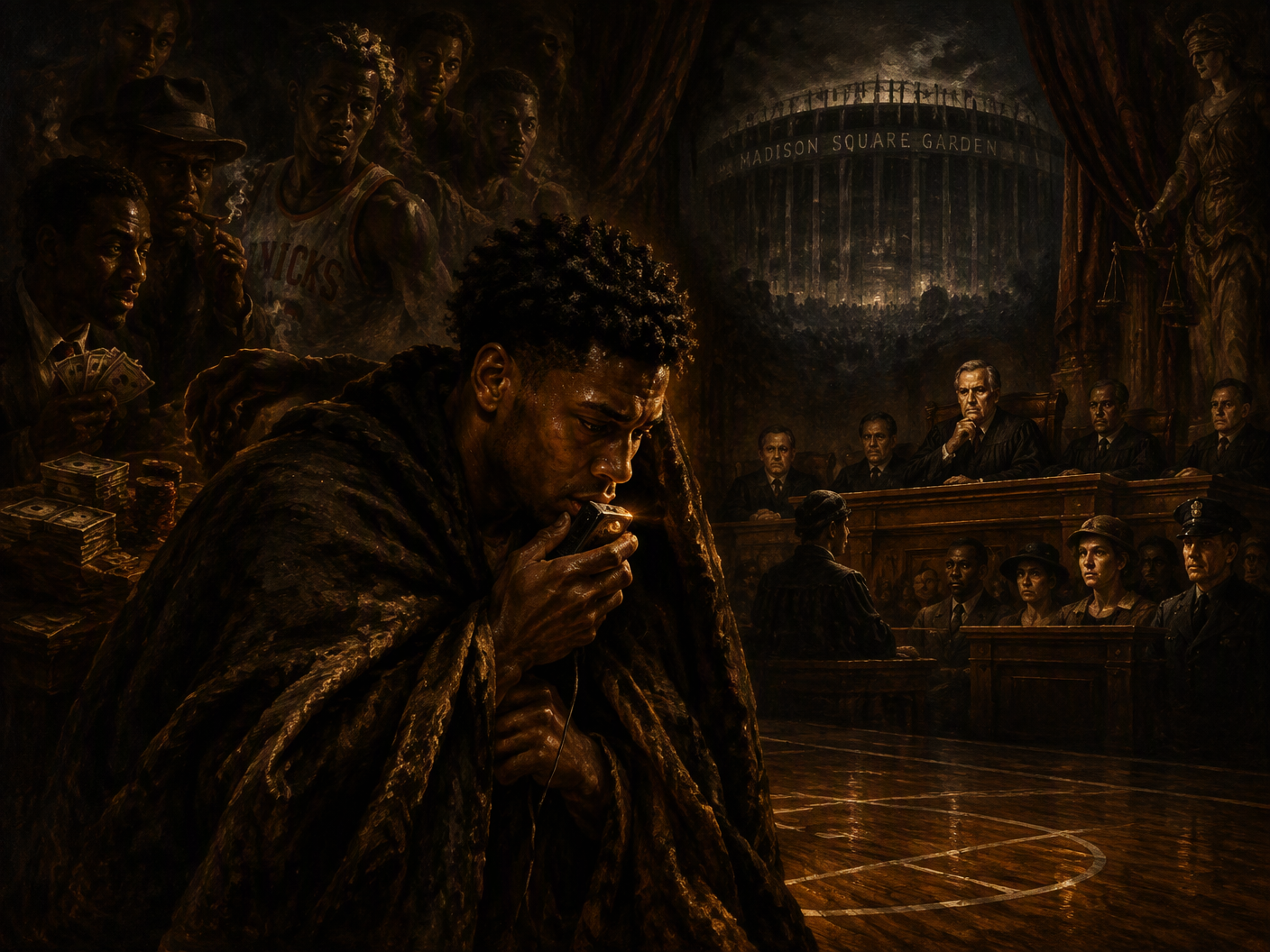
In January 1951, Junius Kellogg, a star on Manhattan College’s basketball team, reported a point-shaving offer to his coach. His account helped authorities investigating gambling reach the players involved. In a statement after Kellogg’s death in 1998, Mayor Rudolph Giuliani described the offer as a $1,000 bribe and credited Kellogg’s refusal with uncovering a point-shaving operation.
Author Matthew Goodman’s account, given in a 2020 WBUR retrospective, complicates the description of an outright refusal. Two former Manhattan players involved in the cheating approached Kellogg, Goodman said, and Kellogg initially told them he would do it. He then reported the approach to his coach. The coach went to the district attorney, and Kellogg was fitted with a wire. “That was really the beginning of the players being arrested for point shaving,” Goodman said.
The scheme did not require a team to lose. A player could help keep a winning margin below the betting spread: with an 11-point spread, a victory by eight, nine or 10 points would serve the purpose. Goodman described that distinction as part of the temptation for players who might balk at deliberately losing. At Madison Square Garden, where City College of New York played almost all its games, he estimated that about $300,000 was wagered on each game, much of it inside the arena.
City College had won both the NIT and NCAA tournaments in 1950. Its roster was entirely Jewish and African American, and its victories brought a full-page photograph in Life and an appearance by coach Nat Holman on The Ed Sullivan Show. But some players had already been taking money to shave points during the regular season. According to Goodman, when gamblers offered $2,000 per player to do the same in the NIT, senior forward Norm Major brought the offer to the other starters. They refused: “No, we’ve come too far.”
Soon after Kellogg went to his coach, authorities wiretapped the telephone of another former college player who was acting as a liaison between players and gamblers. Three City College players were implicated. Early on February 18, 1951, detectives met the team’s train at Penn Station as it returned from a game against Temple in Philadelphia and took the three players to the district attorney’s office.
Goodman said the players were questioned separately for hours, without being allowed to call lawyers or their parents. They eventually confessed to shaving points in three games that season. Four more City College players were arrested later; across seven schools, 32 players confessed to involvement.
City College kept its championships. It was nevertheless banned from Madison Square Garden, where its players had drawn crowds of 18,000, and eventually dropped to Division III. The championships stood, but the team never regained the same fame or success.