
Tragedy · 1963
The Propane Explosion Beneath the Coliseum Bleachers: At Least 62 Dead in the First Account, 74 or 81 in Later Summaries
A rusty propane tank ignited during a 1963 Holiday on Ice performance at the Indiana State Fairgrounds Coliseum; the earliest contemporaneous account reported at least 62 dead, while later summaries reported 74 or 81. About 400 spectators were injured, and the ensuing prosecutions reached gas-company employees, arena personnel, and senior fire officials, but the only identified conviction was later overturned.
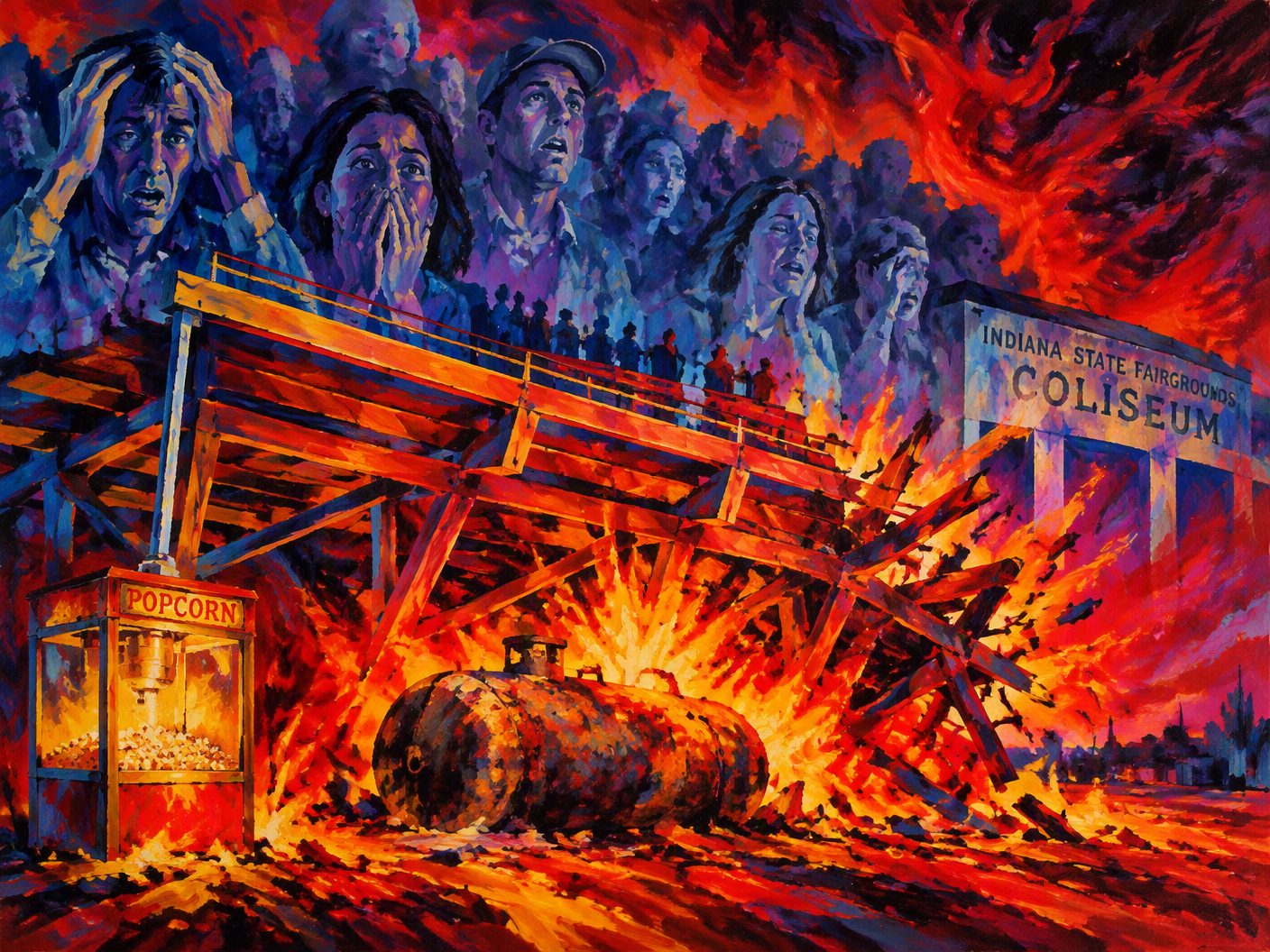
On October 31, 1963, propane gas ignited inside the Indiana State Fairgrounds Coliseum while the opening-night performance of Holiday on Ice was underway. Spectators occupied the building as the blast tore through the structure. Dozens of people died, and about 400 were injured. The explosion transformed an evening performance into a mass-casualty emergency and placed the arena's storage practices, the gas supplier, and the city's fire-inspection system under criminal scrutiny.
The physical sequence began beneath the south-side bleachers. A rusty propane tank stood in an unventilated concessions-area room, where leaking fuel could accumulate instead of dispersing. The tank was improperly stored, and its condition made the leak possible. The gas moved into the room until it encountered an electrical appliance used to prepare or warm popcorn. The ignition source was described as an electric popcorn machine or popcorn warmer. The blast followed that sequence: fuel escaped, collected, and met electricity.
The location mattered because the tank was not isolated from the public areas above it. It sat under the bleachers at a venue being used for a commercial ice show, close to concessions and beneath seating occupied by spectators. A storage failure therefore carried consequences beyond the room where the propane leaked. The hazard was embedded in the building's ordinary operation. When the electrical popcorn equipment ignited the gas, the resulting explosion reached an audience that had come to watch performers on the ice.
The emergency response continued after the initial blast. On November 1, firefighters, police officers, the coroner, and Red Cross volunteers remained engaged in rescue, triage, and the identification of the dead. The work had several separate demands: treating the injured, moving through the damaged Coliseum, accounting for victims, and giving families an official answer about those who had not returned. About 400 people required medical attention, while the death toll reached into the dozens.
That response established the scale of the event before the legal questions were resolved. The Coliseum was both the site of the explosion and the center of the first effort to determine who had been harmed. Firefighters and police handled the immediate emergency; the coroner managed the identification process; Red Cross volunteers supported the people displaced by the disaster. The sequence continued into the following day, separating the moment of ignition from the longer work of rescue, treatment, and identification.
On December 9, the Marion County grand jury brought the incident into a formal criminal proceeding. It indicted seven people. The group included employees of the gas supplier, Discount Gas Corporation; employees of the arena operator, Indiana Coliseum Corporation; Indiana Fire Marshal Ira J. Anderson; and Indianapolis Fire Chief Arnold W. Phillips. The indictments shifted attention from the leaking tank itself to the people and offices responsible for supplying fuel, operating the building, and overseeing fire safety.
Anderson and Phillips entered the case through their public authority. Anderson was indicted on misdemeanor charges after the explosion. Phillips was indicted on a misdemeanor charge for failing to inspect the Coliseum. Their positions placed inspection and fire oversight alongside the private responsibilities of the gas supplier and arena operator. The charges did not carry the same procedural outcome for everyone named. Phillips's charge was later overturned, and the broader prosecution did not produce a uniform set of convictions.
Edward J. Franger occupied a different position in the case. As president of Discount Gas Corporation, he represented the company linked to the propane supply. A jury later convicted Franger of assault and battery. That conviction became the principal criminal judgment identified in the aftermath, but it did not survive appellate review. The Indiana Supreme Court later overturned it, removing the judgment that had attached criminal liability to the company's president.
The legal aftermath therefore narrowed rather than completed the assignment of responsibility. Seven people had been indicted, but the proceedings did not end with seven convictions. Charges were dropped or reversed, including the case against Phillips, and Franger's assault-and-battery conviction was overturned by the Indiana Supreme Court. No one served jail time. The prosecution produced official accusations and one subsequent conviction, followed by appellate reversal, rather than a lasting criminal sentence for the disaster.
The cause and the legal outcome moved on different tracks. The physical chain remained defined: propane leaked from a rusty tank stored without ventilation beneath the south-side bleachers, and an electric popcorn machine or warmer ignited the accumulated gas. The grand jury then distributed responsibility among private employees and public officials through indictments. But the courts did not preserve a final conviction against the central corporate figure, and the fire officials' cases did not yield enduring punishment.
The final consequence was not a single courtroom ruling but a divided public record: a Holiday on Ice performance interrupted by an explosion, dozens of spectators dead, about 400 injured, and an emergency response that continued into November 1. The grand jury acted on December 9. Later proceedings overturned the identified conviction and left no one in jail. What remained fixed was the storage-and-ignition sequence beneath the Coliseum, while the legal responsibility for placing that hazard there never settled into a punishment that endured.
Investigative Dossier & Evidence
Read the companion investigation notes, verified source claims, and primary documents.
Read the Companion Notes & Evidence Record →