
Tragedy · 1972
Munich, the Retaliation Campaign, and the Lillehammer Mistake
The September 1972 attack on Israel’s Olympic team led Golda Meir to authorize a covert campaign against figures believed connected to Black September. The killings crossed Europe and the Middle East before the mistaken death of Ahmed Bouchiki exposed the operation to Norwegian police, criminal courts, and diplomatic scrutiny.
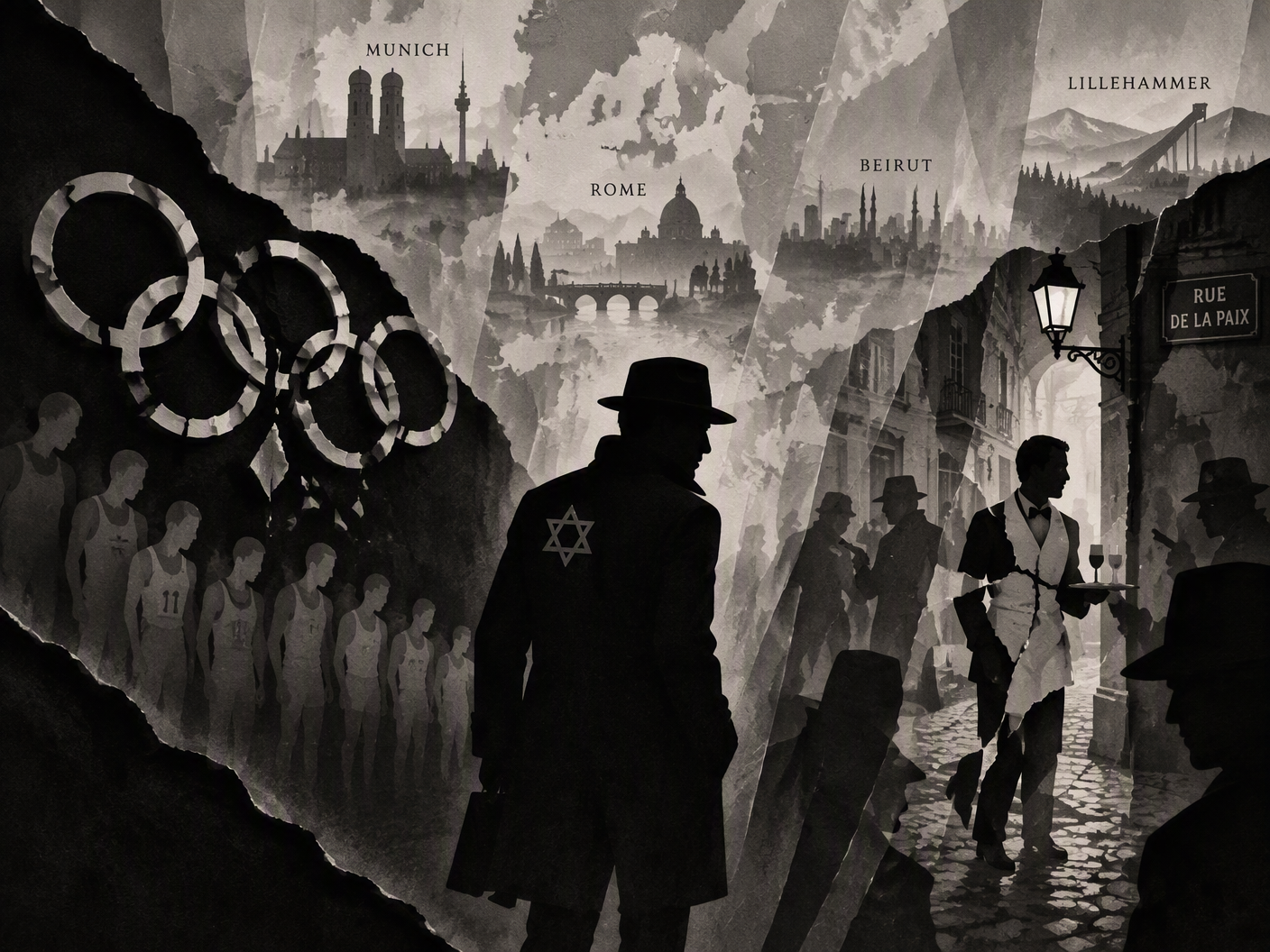
On September 5, 1972, Black September entered the Olympic Village in Munich and attacked the Israeli athletes housed there. The assault transformed an international sporting event into a hostage crisis and then into a killing. Eleven members of Israel’s Olympic delegation died. For the people directing Israel’s response, the question was not confined to what had happened inside the village. It became a question of how a state should pursue those it held responsible when the perpetrators were outside its jurisdiction and no ordinary trial appeared likely.
Golda Meir, Israel’s prime minister, authorized Mossad to pursue those responsible for the Munich attack. The decision placed the response inside the secret institutions of the state rather than before an international court or a public commission. Zvi Zamir, the director of Mossad, traveled to Munich and coordinated with West German authorities as the immediate crisis unfolded. Afterward, the Israeli response moved beyond the Olympic Village, carried through clandestine teams, assumed identities, intelligence files, and operations conducted in countries where Israel possessed no police authority.
The campaign extended across Europe and the Middle East. Its targets were figures whom Israeli intelligence associated with Black September or with the wider Palestinian militant network. The method was not a single reprisal carried out at one location, but a sequence of operations separated by borders, languages, and different systems of law. European intelligence cooperation formed part of the operating environment. Agencies linked through the Club de Berne and the Kilowatt program shared intelligence that assisted Israeli operations, creating channels through which information could travel even when the killings themselves remained concealed.
The first killing identified in the campaign took place in Rome on October 16, 1972. Wael Zwaiter was shot and killed there. The operation established the pattern that would define the months that followed: a man selected as connected to the Munich attackers, located in a European city, and killed outside any public judicial process. The speed of the sequence mattered. Barely six weeks had passed since the Olympic assault, and the Israeli response had already shifted from emergency protection to a long-term effort to find and eliminate people believed to belong to the network behind it.
On January 22, 1973, Ali Hassan Salameh was killed by a car bomb on Rue Verdun in Beirut. Salameh, a PLO and Black September figure, had become one of Mossad’s principal targets. Some accounts treated him as the mastermind of Munich; that conclusion has been challenged, and the campaign’s understanding of his role was never converted into a public criminal judgment about the Olympic attack. His death nonetheless showed how far the operation had traveled: from the German Olympic Village to Rome, and then into the Lebanese capital.
The campaign’s most consequential reversal came in Lillehammer, Norway, on July 21, 1973. Mossad agents believed they had found Salameh. The man they followed was Ahmed Bouchiki, a Moroccan waiter who had no connection to the Munich attack. The agents killed him after mistaking his identity. The error was not absorbed into a secret file and left there. Norwegian police investigated, arrested six members of the Mossad team, and brought the operation into the jurisdiction of a national criminal justice system.
Five of the captured agents were convicted in Norway and later released. The convictions gave the Lillehammer operation a public legal consequence that the earlier killings had avoided. They also exposed the practical weakness of a policy that depended on accurate identification across foreign cities and relied on intelligence judgments unavailable to the people who would bear the risk of an error. Bouchiki’s death was not an intended strike against a militant organization. It was the killing of an unrelated civilian produced by a mistaken target selection.
Lillehammer also altered the meaning of the campaign for the governments that had enabled or tolerated its movement through Europe. Before the Norwegian arrests, the operations could be described within Israel as a controlled pursuit of those responsible for Munich. Afterward, the same policy carried a demonstrated risk of killing the wrong person and exposing agents to prosecution. Intelligence sharing through the Club de Berne and the Kilowatt program had assisted Israeli operations, but cooperation did not guarantee correct identification, legal immunity, or political control over what followed.
The Munich attack itself remained the fixed point around which the campaign was justified. Black September had attacked Israeli athletes, and eleven had been killed. Yet the later killings did not produce a single public judicial record proving that every person targeted had planned that assault. The identities, affiliations, and responsibilities assigned to individual targets rested on intelligence-linked assessments and retrospective reconstructions. The state had chosen secrecy as its method, and secrecy limited the public ability to test each accusation in the manner of a criminal trial.
By the time Norwegian courts had convicted five agents, the campaign had acquired two histories. In Israel, it stood as an authorized answer to the deaths in Munich and as an effort to reach a militant network that conventional jurisdiction could not easily reach. In Norway, Lillehammer stood as a case of mistaken identity, unlawful killing, arrests, and convictions. Both histories belonged to the same sequence. The campaign began with eleven dead athletes and a prime minister’s secret authorization; it endured in the legal record through the death of a waiter who had never been part of that conflict.
Investigative Dossier & Evidence
Read the companion investigation notes, verified source claims, and primary documents.
Read the Companion Notes & Evidence Record →