
Violence & Brawls · 1989
The Injured Bodies and Six-Point Margin of the 1989 Grand Final
On September 25, 1989, Hawthorn defeated Geelong at the Melbourne Cricket Ground by six points in a Grand Final defined by repeated injuries, Dermott Brereton’s kidney laceration, and Gary Ablett Sr.’s nine-goal performance. The match secured Hawthorn’s late-1980s dominance while turning an intense rivalry into something harder and more enduring.
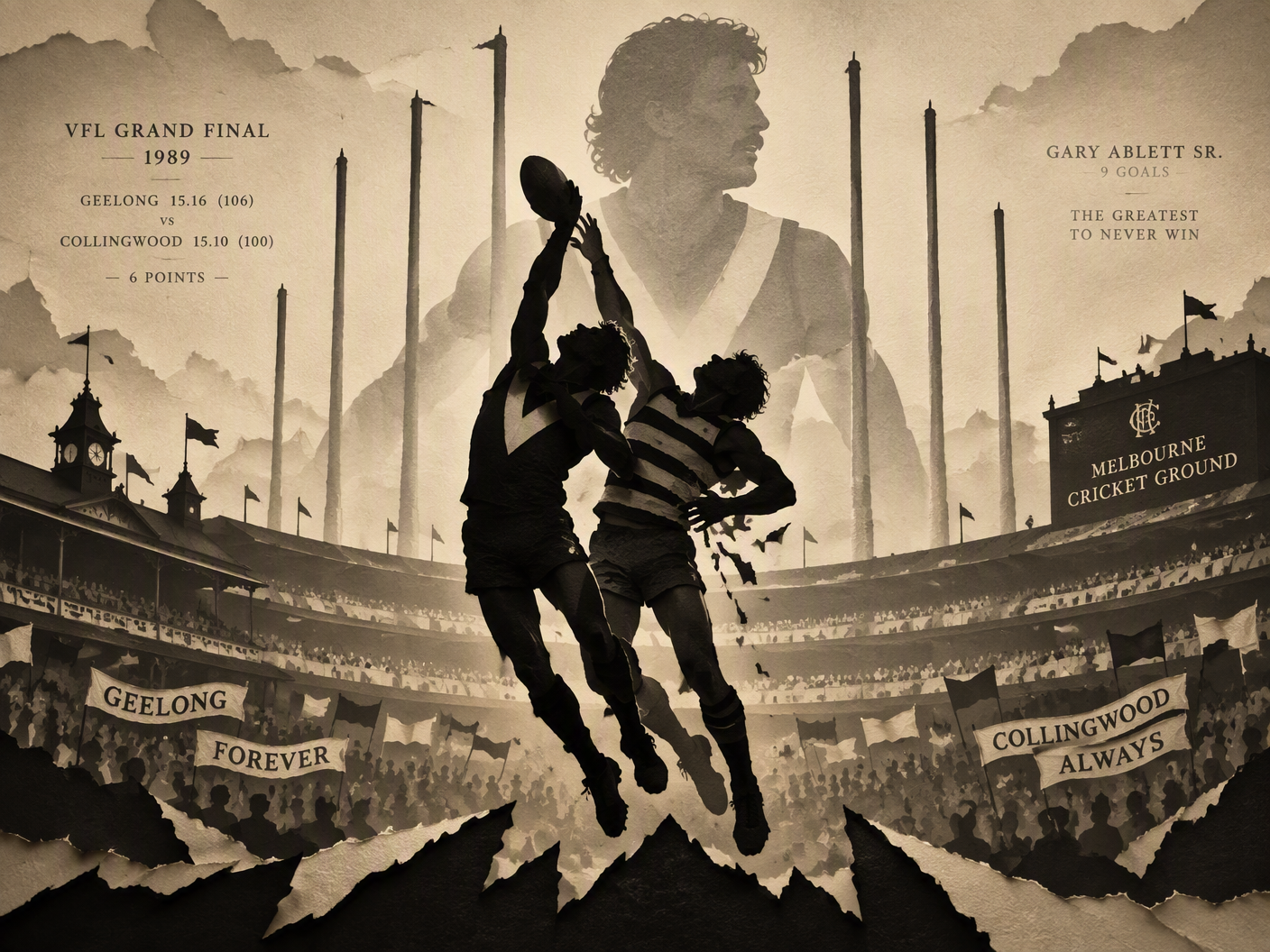
By the time the final siren sounded at the Melbourne Cricket Ground on September 25, the contest had become a catalogue of damaged bodies and unfinished movement. Hawthorn had made 14.14, or 98 points. Geelong had made 14.8, or 92. Six points separated the premiership from the team that had spent the afternoon absorbing punishment, returning it, and sending another injured player toward treatment. The margin was narrow enough to fit inside a single mistake. The physical cost was scattered across the ground.
The Grand Final carried the weight of a season compressed into one afternoon, with Hawthorn defending its place at the top of Australian rules football and Geelong attempting to take it. The Melbourne Cricket Ground held the noise, the banners, the churn of boots across the turf. Beneath that public ceremony, the match moved according to smaller calculations: whether a shoulder would hold, whether a player could rise, whether the next contest could be reached before the pain made the decision for him.
At least three Hawthorn players required treatment during the game. The interruptions did not change the basic demand placed upon them. The player left the field had to be assessed, strapped, steadied, or returned to the contest. The players who remained had to cover the space he had occupied. Each absence altered the shape of the match for a few minutes, then became part of its accumulated burden. By the end, the injury list was not a side detail. It was one of the match’s central structures.
Dermott Brereton carried the most consequential injury into the mythology of the afternoon. During the match, he suffered a kidney laceration. He continued to play through the damage, placing the requirements of the contest above the body’s warning. The injury was internal, concealed beneath the uniform and the ordinary mechanics of running, marking, and contesting the ball. Nothing in the visible rhythm of football could show the full extent of what had happened inside him.
Brereton’s decision gave the match one of its defining human facts. Determination in sport is often measured in distance covered or possessions won, but that afternoon it was measured against an injury that could not be seen from the stands. He remained part of Hawthorn’s effort while the body carried a wound that belonged to a colder, quieter setting: examination rooms, medical hands, and the clinical language used after the crowd had gone home.
Geelong had its own instrument of pressure in Gary Ablett Sr. He scored nine goals, a total that made him the most productive attacking player on the ground even as his team moved toward defeat. The goals came against a Hawthorn side that would not yield the result. Ablett’s performance separated individual excellence from collective outcome: one player could dominate the scoring, command attention, and still watch the premiership pass to the other side of the ground.
When Ablett received the Norm Smith Medal as the best player on the ground, the ceremony placed a formal seal on that contradiction. The medal belonged to Geelong’s leading figure. The premiership belonged to Hawthorn. Nine goals could define an afternoon without deciding it. Around the presentation, the arithmetic remained immovable: Geelong had scored 14 goals and eight behinds; Hawthorn had scored 14 goals and fourteen behinds. Six points had survived everything that came before them.
The brutality of the game was not contained in one collision or one injury. It emerged through accumulation: treatment after treatment, players continuing while impaired, and the steady demand that the next contest mattered more than the last wound. The 1989 Grand Final entered Australian rules football’s memory as one of its most brutal matches because the violence was woven into the full duration of the contest. It was not an interruption to the football. It became the football’s governing condition.
For Hawthorn, the six-point victory completed more than a single afternoon’s work. It reinforced the club’s position as a dominant force in Australian rules football during the late 1980s. The team had endured the physical attrition, protected its narrow scoring advantage, and reached the final siren ahead. The result gave institutional weight to the suffering visible on the field. Injuries had not stopped the side. The damaged bodies had been absorbed into a victory that would help define Hawthorn’s standing in the period.
For Geelong, the defeat did not close the relationship between the clubs. It sharpened it. The Grand Final transformed an established contest into a historical rivalry marked by the memory of impact, injury, individual brilliance, and a result decided by six points. Future encounters carried the residue of that afternoon: Hawthorn’s refusal to surrender, Geelong’s near success, Ablett’s nine goals, and Brereton continuing with a lacerated kidney. The rivalry had acquired a physical archive, and neither club could enter it empty-handed again.
The final score remains clean on the page: Hawthorn 14.14, Geelong 14.8. The numbers do not show the treatment rooms, the internal injury, or the player who produced nine goals for the losing side. They show only the narrowest public verdict. Beneath it lies the longer account: a premiership secured by a team already dominant, a defeated club whose star claimed the medal, and a match remembered for how much the players were required to leave behind on the ground.
Investigative Dossier & Evidence
Read the companion investigation notes, verified source claims, and primary documents.
Read the Companion Notes & Evidence Record →