
Violence & Brawls · 1999
The Missile, the Touchline, and the Old Firm’s Match-Day Violence
In May 1999, a missile thrown from the Celtic support struck referee Hugh Dallas and stopped a Scottish Cup match for medical treatment. Twelve years later, a confrontation between Celtic manager Neil Lennon and Rangers assistant manager Ally McCoist produced misconduct findings, suspensions, and another official response to a rivalry whose violence reached beyond the ground.
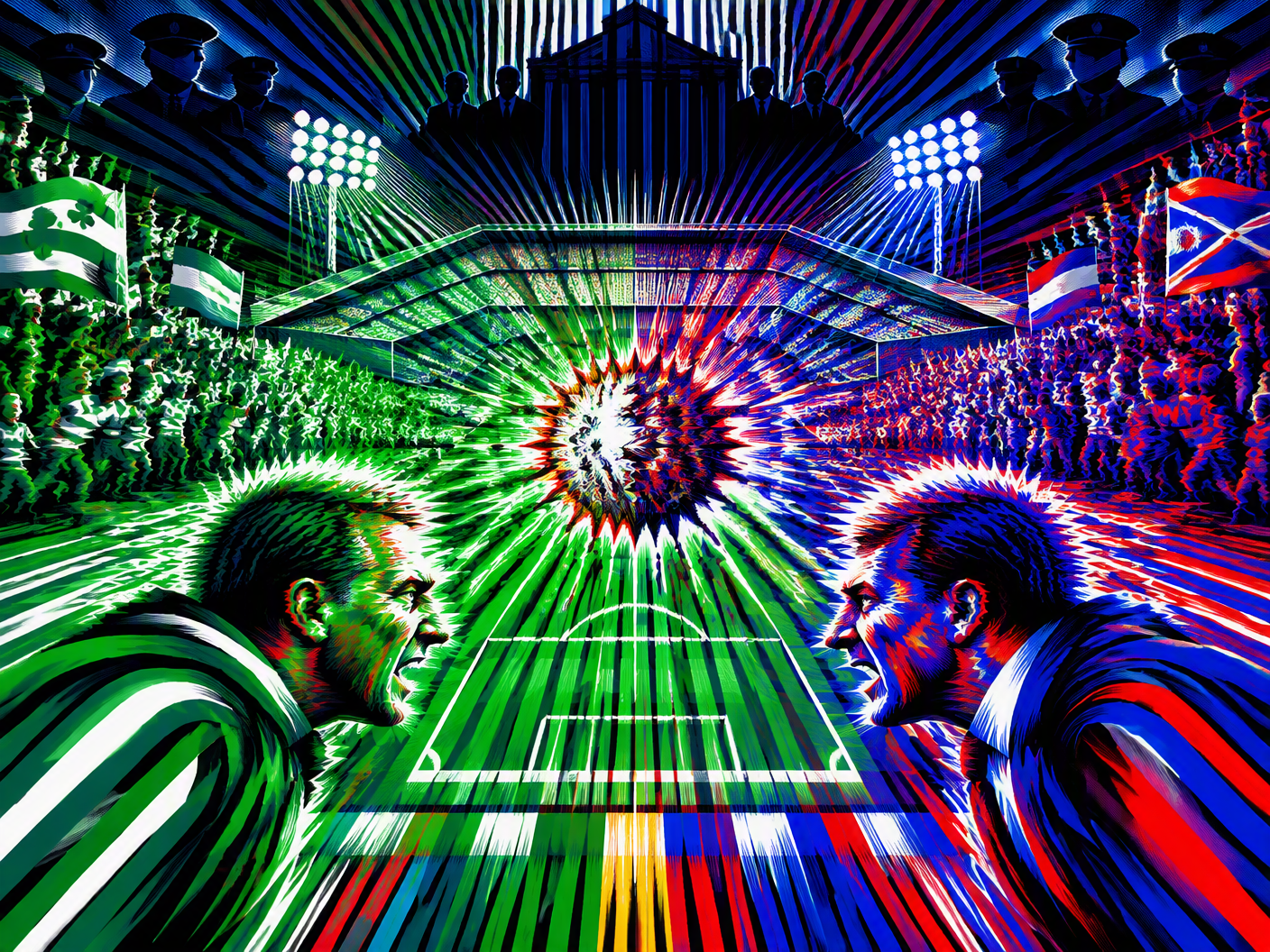
In May 1999, at Celtic Park in Glasgow, a Scottish Cup match was interrupted by an object thrown from the Celtic support. It struck referee Hugh Dallas. Play stopped while Dallas received medical treatment, and the ordinary machinery of the fixture—players waiting, officials conferring, the crowd held behind its barriers—gave way to the blunt fact of an injured match official. For several minutes, the game was no longer governed by the whistle. It was governed by the missile, the wound, and the decision whether the contest could continue.
The object had crossed a short distance through a stadium built for noise and tribal allegiance before it reached the person responsible for enforcing the rules. Dallas was not a distant symbol on a television screen. He was standing on the pitch, exposed to thousands of spectators, carrying the authority of the match in his hands. The stoppage converted that authority into a physical vulnerability. Players could remain in position; supporters could remain in their seats. The referee had to be treated before football could resume.
The exact intention behind the throwing was never legally substantiated. What remained fixed was the sequence: a missile left the crowd, Dallas was struck, medical treatment followed, and the Scottish Cup match was stopped. In a rivalry already accustomed to treating hostility as part of the spectacle, the interruption made the boundary between abuse and injury impossible to ignore. The pitch was still a field of play, but the danger had arrived from the stands, carried by an act that required no elaborate plan—only a crowd, an object, and a moment of release.
The Old Firm rivalry had been built through repeated contests between Celtic and Rangers, but its pressure did not end with the final whistle. Match days produced a wider pattern of violence, including assaults and domestic abuse associated with the intensity surrounding the fixtures. The damage was distributed unevenly. Some incidents occurred under floodlights and entered the public ritual of the derby. Others moved into streets, homes, and rooms where there were no cameras, no linesmen, and no crowd to absorb the sound.
That wider violence changed the meaning of a match-day precaution. Policing was tightened around Old Firm fixtures, and alcohol was banned at stadiums as authorities tried to reduce the conditions under which confrontation could escalate. The measures did not belong to the grammar of football. They belonged to crowd control, public order, and the management of foreseeable harm. A sporting event that required more officers and fewer drinks had acquired a second identity: not only a contest between two clubs, but a recurring security operation.
By March 2011, the danger no longer needed to come from the seats. At Celtic Park, Neil Lennon stood as Celtic’s manager and Ally McCoist as Rangers’ assistant manager during another Old Firm derby. Their confrontation became the central incident of the match day. The touchline, usually a narrow strip of technical instructions and restless movement, became a place where the rivalry’s old antagonism was acted out by men whose positions gave the scene institutional weight. The argument did not remain a private exchange between football employees.
The Scottish FA found both men guilty of misconduct. Lennon was banned from touchline duties. McCoist received a suspension. The penalties separated them from the immediate theater of the derby, but they also described the conduct in the language of regulation: an incident that had crossed the boundary of acceptable behavior and required formal punishment. Neither man was merely a spectator carried along by the crowd. One was Celtic’s manager; the other was a senior Rangers figure. Their confrontation placed the rivalry’s code of hostility inside the official structure of the match.
The two episodes were separated by twelve years and involved different actors. In 1999, a referee was struck by a missile from the stands. In 2011, opposing club officials were disciplined after confronting one another on the touchline. Between them ran the same exposed channel of the Old Firm: pressure converted into conduct, conduct requiring intervention, and intervention arriving only after the atmosphere had already produced harm. The scale changed, but the mechanism remained recognizable. A match permitted emotion to gather until someone had to stop it.
The response accumulated in practical forms. Police presence increased. Alcohol disappeared from stadiums. Governing bodies imposed bans and suspensions. These measures addressed different points in the chain: the crowd, the environment, and the people entrusted with representing the clubs. They also left behind a colder image of the derby than the one sold in programs and television promos. Barriers, searches, restricted movement, disciplinary notices, and empty spaces on the touchline became part of the fixture’s operating conditions.
For Hugh Dallas, the match in May 1999 stopped because an object from the crowd found his body. For Neil Lennon and Ally McCoist, the March 2011 derby continued into hearings and sanctions after the confrontation had ended. For people beyond the stadium, the rivalry’s consequences could take the form of assault or domestic abuse, carried into places where the language of football offered no protection. The Old Firm did not contain its violence within ninety minutes. It carried the habits of the match outward, and institutions answered by narrowing the space in which those habits could operate.
Investigative Dossier & Evidence
Read the companion investigation notes, verified source claims, and primary documents.
Read the Companion Notes & Evidence Record →