
Violence & Brawls · 2004
The Planned Halftime Riot at Ruch Chorzów–ŁKS
On 3 May 2004, planned riots erupted at halftime during a Ruch Chorzów match against ŁKS. Fans from three clubs were injured, 55 police officers were hospitalized, 12 police cars were damaged, and more than 100 hooligans were captured while the search for participants continued.
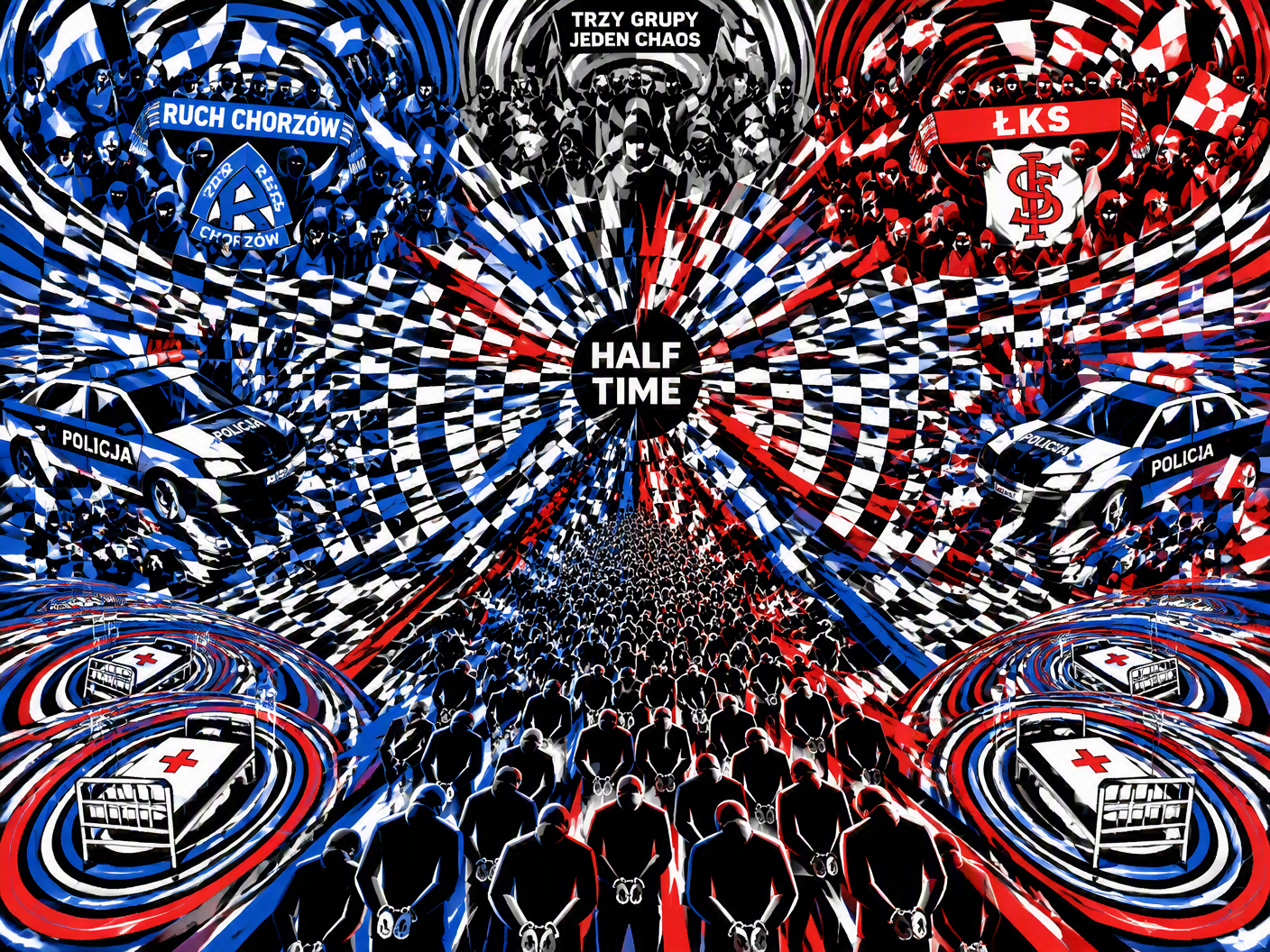
At halftime on 3 May 2004, planned riots erupted during a match between Ruch Chorzów and ŁKS. The interval became the dividing line. Before it, two Polish football clubs were playing; after it, fans from three clubs were injured, 55 police officers were hospitalized, 12 police cars were damaged, and more than 100 hooligans were captured. The violence entered before the match had reached its ordinary conclusion. The ball and the score were pushed aside by a public-order emergency.
Ruch Chorzów is a Polish football club listed at Superauto.pl Stadion Śląski in Chorzów. On that date it met ŁKS, giving the afternoon its formal frame and its two club names. The riot widened that frame immediately. The injured supporters came from three clubs, not only the two printed on the fixture. Police officers became patients. Police vehicles became damaged property. The response produced a capture count above one hundred. A football match remained at the center of the event, but it no longer controlled the terms of the day.
The riots were planned, and they erupted at halftime. Those facts belong together. The disorder broke into the match at the interval, before the fixture had run its course. Whatever the planning looked like away from the field, its public result was plain: fans were injured, police officers went to hospitals, police cars were damaged, and officers began capturing participants after the brawl. The interval was a moment in the schedule. The consequences were not.
Fans from three clubs were injured during the disorder. Their injuries gave the riot a human cost before the numbers reached the police. The match had two named sides, but the injured supporters were not confined to that neat pairing. Three fan groups entered the consequences. The event was therefore larger than a quarrel between two sides, even if the match supplied the setting. People were hurt, and the football was no longer the principal fact of the afternoon.
Then the police count took over. Fifty-five officers were hospitalized. That number places the officers inside the event, not outside it as a uniformed backdrop. They were present when the disorder erupted, and afterward 55 of them required hospital care. The figure is exact enough to resist the loose language usually attached to a crowd disturbance. It describes a response that absorbed serious human damage while it was still trying to restore control. The uniforms disappeared into hospital rooms, while the work of dealing with the brawl continued elsewhere.
Twelve police cars were damaged in the disorder. The cars make the police impact visible in another way: the riot reached the vehicles used by the officers who responded. The damage was practical as well as financial. It placed police property among the consequences of the brawl, alongside 55 hospitalized officers and the people hurt from three clubs. The figures do not describe a passing disturbance. They describe a scene in which the force sent to contain the violence also absorbed injury and damage.
After the brawl, police captured more than 100 hooligans. The count crossed the threshold that changes a police response from a single confrontation into a broad operation. It also placed the officers’ actions beside the damage already done: 55 hospitalized, 12 cars damaged, fans from three clubs injured. Capture was the immediate answer available to police, and it came in numbers. The scene had produced enough disorder to require a response measured not in one or two people, but in more than a hundred captured by police.
Police work did not end with the captures. Polish police were still looking for participants in the brawl after the event. More than 100 hooligans had been captured, but the search continued beyond those already taken. That detail gives the aftermath its unfinished shape. The halftime riot had become a sequence extending past the match: injuries, hospitalizations, damaged vehicles, captures, and a continuing effort to locate people connected with the brawl. The field was one part of the episode. The police search was the part that remained in motion.
Ruch Chorzów and ŁKS supplied the names printed over the fixture. Ruch’s listing at Superauto.pl Stadion Śląski in Chorzów gives the club a concrete place in Polish football, but the incident’s center is the halftime break and what followed. Supporters from three clubs were injured. Police officers were sent to hospitals. Twelve police cars were damaged. More than 100 hooligans were captured. The match’s formal identity was simple; the consequences were spread across supporters, police bodies, police property, and a search for more participants.
Numbers can flatten a violent afternoon, but here they also preserve its outline. Fifty-five officers in hospitals marks the injury to the police. Twelve damaged cars marks the material hit. More than 100 captured hooligans marks the scale of the response. Fans from three clubs marks the reach of the harm. Together, the figures follow a hard line from halftime to aftermath. Planned disorder erupted. People were hurt. Police answered. The answer carried its own losses and did not finish the search.
On 3 May 2004, the match between Ruch Chorzów and ŁKS became a date attached to a riot rather than a result. At halftime, planned violence broke into the fixture. By the time the police response had taken more than 100 hooligans, 55 officers had been hospitalized and 12 police cars damaged. Fans from three clubs had been injured. More than 100 hooligans had been captured. The police were still looking for participants.
Investigative Dossier & Evidence
Read the companion investigation notes, verified source claims, and primary documents.
Read the Companion Notes & Evidence Record →