
Violence & Brawls · 2000s
The Sparks-Shock Fight and the Suspensions That Emptied Detroit’s Bench
A fight in the final seconds of the Los Angeles Sparks-Detroit Shock game on July 22, 2008 brought suspensions to seven participants and forced Detroit into an immediate roster decision. The league assigned different penalties to punches, bench departures, and escalation, while a knee injury further reduced the Shock’s available players.
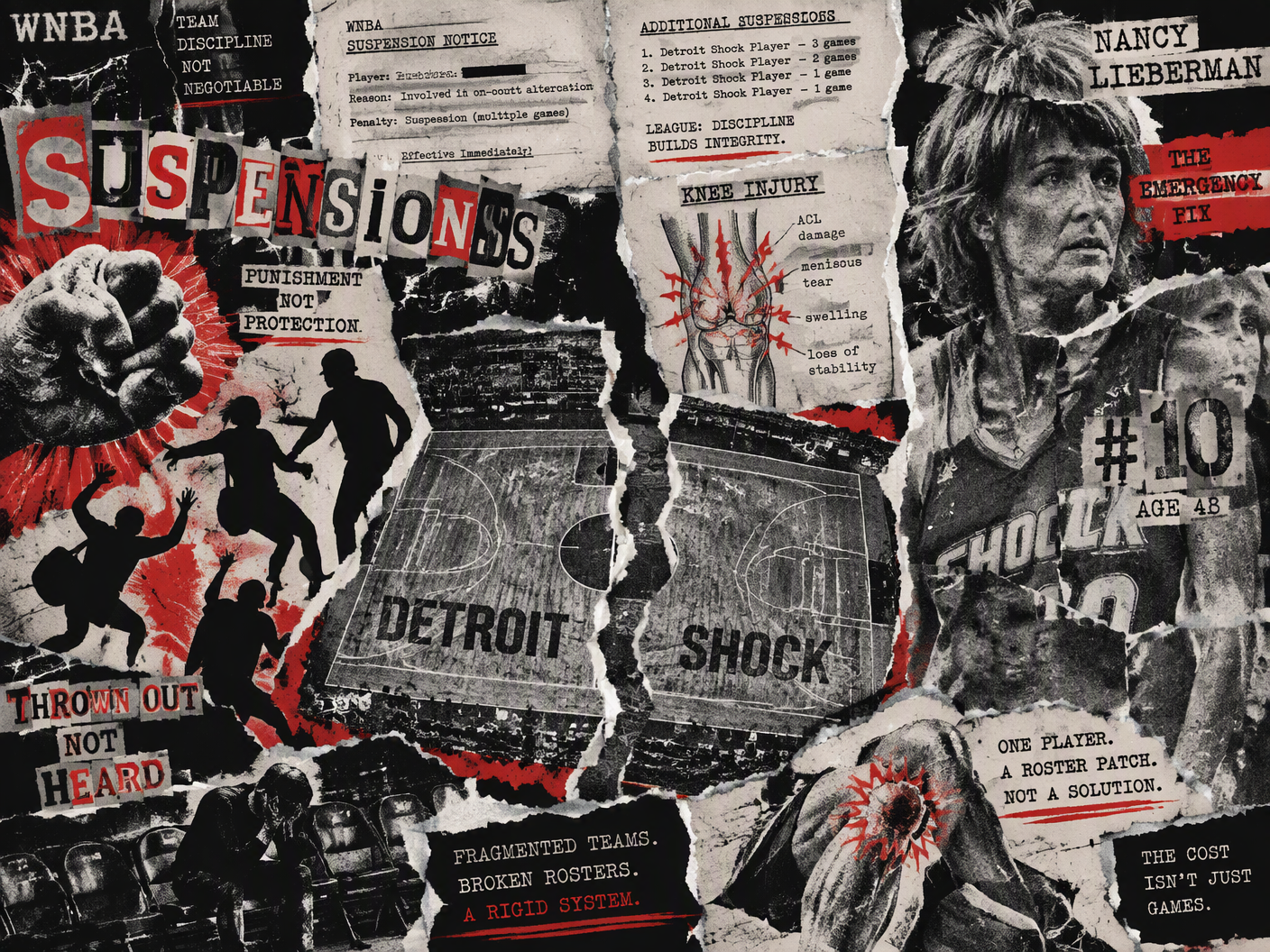
The Los Angeles Sparks and Detroit Shock had only seconds left to play on July 22, 2008, when the game at The Palace of Auburn Hills broke into an on-court altercation. What had been a professional basketball game became a confrontation involving players from both teams, Detroit assistant coach Rick Mahorn, and Sparks players moving in from the bench area. The consequences reached beyond the final horn. Detroit lost bodies to injury and suspension; Los Angeles lost players to suspension; and the WNBA was required to decide which conduct had intensified the confrontation and who had crossed the line set by league discipline.
Plenette Pierson, Detroit’s forward, received the longest penalty. The WNBA suspended her four games for escalating the altercation. That sanction placed Pierson at the center of the league’s disciplinary decision, not because she alone had been involved, but because the league treated escalation as a separate and more serious act within a fight that had drawn in players, bench personnel, and a coach. Four games was a substantial removal in a compact season. It also left Detroit without a frontcourt player at the moment the team was already confronting the physical cost of the incident.
Candace Parker received a one-game suspension for throwing a punch. Lisa Leslie, the Sparks center who entered the confrontation to aid Parker, received the same one-game penalty for throwing a punch. DeLisha Milton-Jones also received a one-game suspension for throwing a punch. The WNBA’s decision separated their conduct from Pierson’s escalation while still treating each punch as conduct requiring removal from a game. The sanctions imposed a practical cost on Los Angeles: three established players would be unavailable, and the team’s next lineup would be shaped by a fight that had begun after the game was nearly complete.
Mahorn had entered the confrontation as Detroit’s assistant coach. The league suspended him for two games for escalating it. His penalty put a coach inside the same disciplinary action that reached players from both clubs. A coach holds authority different from that of a player: he is expected to direct a team, manage conflict, and protect the limits around competition. The WNBA’s two-game suspension identified Mahorn’s intervention as conduct that worsened the episode rather than contained it. Detroit would therefore proceed without an assistant coach as well as without suspended players.
The fight also extended beyond those already on the court. Sparks guard Shannon Bobbitt and forward Murriel Page left the bench area and made contact with Mahorn. Each received a two-game suspension. Their penalties reflected a second category of conduct: the movement of players from the bench into an active confrontation. The league did not treat the altercation as a single act committed by one player at one point on the floor. It divided responsibility among punches, escalation, and bench departure, then assigned penalties that tracked those categories and removed seven people from their teams’ immediate operations.
Cheryl Ford, Detroit’s forward, suffered the most immediate bodily consequence. While trying to restrain Pierson during the fracas, Ford re-injured her right knee and sustained a torn ligament described as season-ending. The injury changed the meaning of the disciplinary list for Detroit. Suspensions have defined endpoints; a torn ligament does not follow the league calendar. Ford’s attempt to restrain a teammate left the Shock with another absence at the same time Pierson and Mahorn faced their own bans. The closing-seconds fight had become a roster crisis with an injury at its center.
On July 25, the WNBA announced its disciplinary package. Pierson would miss four games. Parker, Leslie, and Milton-Jones would miss one game each. Bobbitt, Page, and Mahorn would miss two games each. The announcement gave the episode its formal consequence: the league had reviewed the confrontation and assigned punishment across both teams. Detroit carried the heaviest individual suspension and the additional loss of Ford’s season. Los Angeles absorbed three one-game suspensions and two longer bench-related absences. The distribution of penalties showed that the league had treated the fight as a series of distinct actions rather than an undifferentiated melee.
Detroit’s response was immediate and unusually revealing. Between July 24 and July 25, with the Shock short-handed for the next game, the club signed Nancy Lieberman to a seven-day contract. Lieberman was 50 years old. Her return was not built around nostalgia or a ceremonial appearance; Detroit needed an eligible player after the altercation, the suspensions, and Ford’s knee injury compressed its available roster. Coach Bill Laimbeer’s club turned to a former WNBA player whose age alone underscored the narrowness of the team’s options. The brawl had forced a personnel decision within days.
Lieberman joined Detroit for its next game and played nine minutes. She recorded two assists. Those numbers were modest, but they measured the concrete result of a disciplinary event that had begun in the final seconds at Auburn Hills. A seven-day contract placed a 50-year-old player back in the WNBA because the Shock needed bodies available to take the floor. Her appearance made the roster disruption visible in a way a suspension notice could not. Detroit had moved from restraining an on-court fight to reconstructing a usable rotation before its next scheduled game.
By August 6, the suspensions remained the defining formal outcome of the Sparks-Shock confrontation: four games for Pierson; two each for Bobbitt, Page, and Mahorn; one each for Parker, Leslie, and Milton-Jones. Ford’s torn right-knee ligament had already carried a season-ending consequence outside that scale. Lieberman’s nine-minute return had supplied Detroit a temporary answer to a depleted bench, not a restoration of what the team had lost. The final ledger contained league discipline, an injured player, and an emergency contract signed because the closing seconds of one game had altered both clubs’ next available lineups.
Investigative Dossier & Evidence
Read the companion investigation notes, verified source claims, and primary documents.
Read the Companion Notes & Evidence Record →