
Scandals & Feuds · 2020s
Bishop Sycamore’s 58–0 ESPN Loss and the School Behind It
On August 29, 2021, IMG Academy defeated Bishop Sycamore 58–0 in a nationally televised game that exposed unanswered questions about the program’s roster, academic status, and operating history. The fallout connected the school’s operators to earlier financial disputes and public legal records.
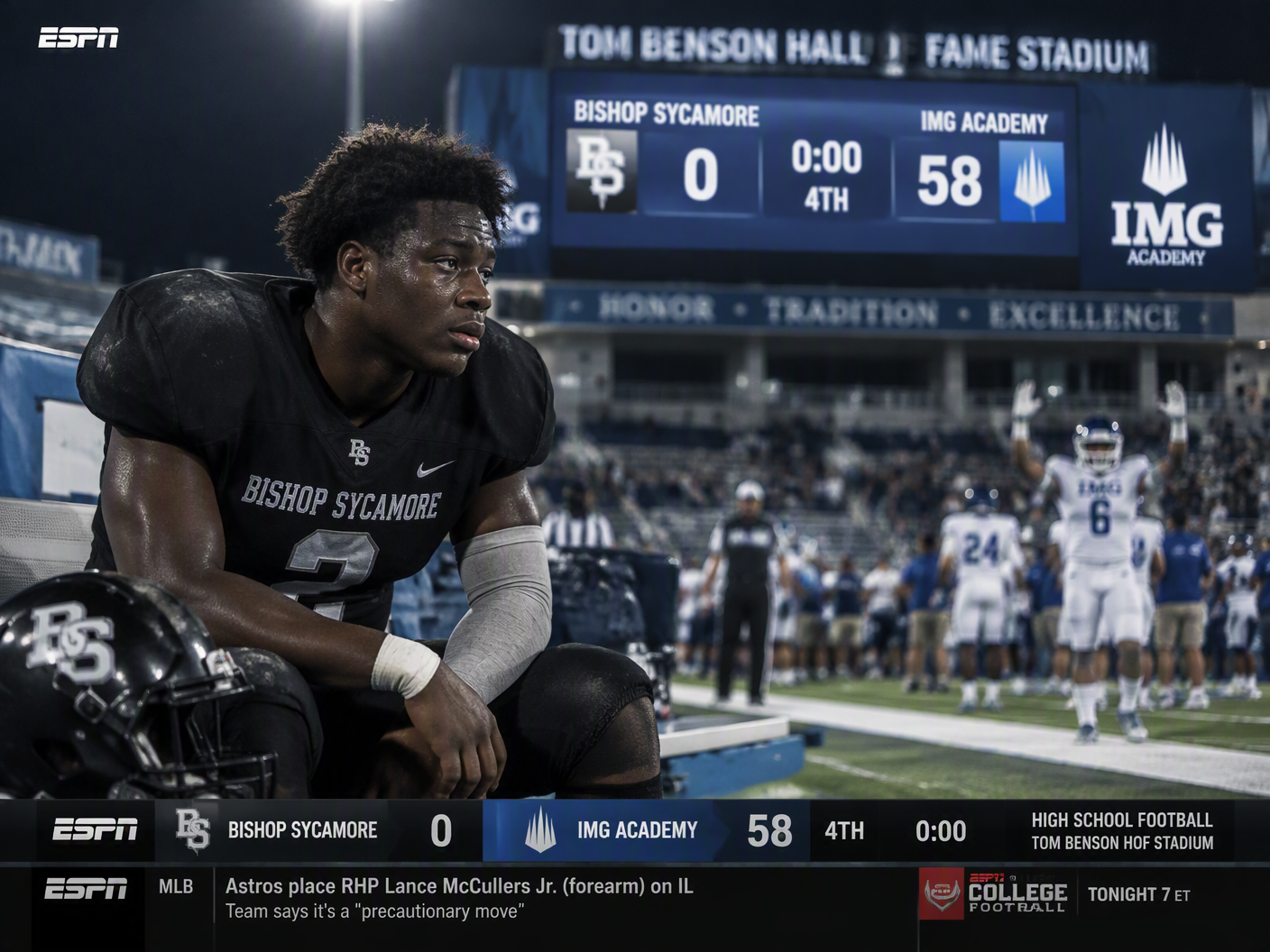
On August 29, 2021, Bishop Sycamore arrived at Tom Benson Hall of Fame Stadium in Canton, Ohio, for a nationally televised game against IMG Academy. IMG won 58–0. The score settled the contest, but the broadcast created a second one: whether Bishop Sycamore functioned as the school its operators presented to the public. ESPN announcer Anish Shroff said the network could not verify the program’s claim that its roster included Division I prospects. Analyst Tom Luginbill warned on air that the apparent lack of depth could make the game dangerous. The questions moved beyond football before the game had been fully absorbed.
The matchup had also been arranged inside a compressed and difficult schedule. Two days earlier, Bishop Sycamore had played Sto-Rox High School in the Pittsburgh area and lost 19–7. The IMG game followed almost immediately. That sequence placed a team with limited visible depth against one of the country’s most established football programs, while the ESPN broadcast gave viewers a direct comparison between the two institutions. Bishop Sycamore’s 58-point defeat was therefore not an isolated score. It was the public endpoint of a program whose competitive claims had not been matched by readily verifiable answers.
Bishop Sycamore’s football operation had taken its current form by 2019, when it finished 4–5. Its earlier institutional predecessor operated in Columbus under the name Christians of Faith Academy. That operation was already entangled in unpaid-loan and unpaid-bill litigation in 2018. Roy Johnson was associated with both the football program and the earlier academy. Jay Richardson, identified as a co-founder or business partner in the earlier operation, later appeared alongside Johnson in litigation involving a bank loan. The names changed, but the questions about who controlled the program and how it met its obligations followed it forward.
The legal identity of Bishop Sycamore did not match the ordinary assumptions attached to a televised high-school football team. For the 2020–21 school year, the Ohio Department of Education listed it as a non-chartered, non-tax supported school. That designation placed the program outside the state’s charter-school system and outside public funding. State and local reporting after the ESPN game further described a school without a physical classroom location or teachers. Those details did not answer every question about the students or their instruction, but they made the program’s claimed status impossible to treat as self-evident.
Andre Peterson, identified as a founder and director associated with Bishop Sycamore, told reporters that the school was separate from Christians of Faith Academy. He also said he had enrolled his son there. That distinction mattered because the earlier academy carried its own history of unpaid obligations and organizational disputes. Peterson’s account placed distance between the two operations; the chronology placed them in the same administrative orbit. Roy Johnson remained central to the football program, while the public explanations around the school had to account for the predecessor’s finances, the new name, and the absence of conventional institutional markers.
The broadcast forced another problem into view: the roster could not be independently confirmed in the way ESPN expected for a game built around elite prospects. Shroff stated that the network could not verify Bishop Sycamore’s Division I claims. That was not a finding that every player was ineligible or older than high-school age. It was a direct failure to substantiate the promotional premise attached to the team. When the players struggled against IMG and the bench appeared thin, the absence of verification became part of the event itself, not a separate administrative footnote.
Johnson’s personal legal history added another layer to the scrutiny. Delaware County sheriff’s office records showed an active warrant tied to a 2020 domestic-violence case. Johnson later pleaded guilty to criminal mischief and received probation. The warrant and the probation disposition did not arise from the ESPN game, but they concerned the person operating the football program and became part of the public examination that followed. The issue was no longer limited to whether Bishop Sycamore could compete. It included whether its leadership had been subjected to the ordinary checks expected of an educational institution.
The financial dispute involving Johnson and Richardson supplied a more formal measure of that scrutiny. First Merchants Bank sued over a $100,000 loan. A Franklin County judge ruled that Johnson and Richardson had admitted the bank’s claims of fraudulent misrepresentation, conversion, and unjust enrichment. Those were civil claims, resolved in civil litigation, not criminal convictions. Their importance lay in the specificity of the court’s disposition: the dispute identified a loan, named the operators, and attached legal consequences to the way the money had been obtained or handled.
After the 58–0 loss, state and local attention widened from the scoreboard to the school’s operation. Officials and reporters examined Bishop Sycamore’s state classification, its physical presence, the identity of its teachers, its roster claims, and the relationship between the program and its earlier predecessor. The questions arrived because the broadcast had made the institution visible at national scale. A private football venture could present itself as a school, arrange games against recognized opponents, and reach ESPN without carrying the same documentary footprint as those opponents. That gap became the central fact of the aftermath.
The final picture was not a single deception proved in a single proceeding. It was a chain of documented conditions: a 2018 predecessor facing unpaid-loan and unpaid-bill litigation; a Bishop Sycamore team playing in its current form by 2019; a 19–7 loss to Sto-Rox two days before an ESPN appearance; a 58–0 defeat by IMG; a state designation as non-chartered and non-tax supported; and legal records involving the people who ran the operation. The civil judgment against Johnson and Richardson, Johnson’s warrant and probation history, and the unresolved school-status questions remained attached to the program after the broadcast ended.
Investigative Dossier & Evidence
Read the companion investigation notes, verified source claims, and primary documents.
Read the Companion Notes & Evidence Record →