
Violence & Brawls · 2020s
The Red Card, Tear Gas, and Crowd Crush at Nzérékoré
On 1 December 2024, a disputed refereeing decision at a tournament honoring Guinea’s military leader preceded a pitch invasion, tear gas, and a fatal crush at Stade du 3 Avril. Authorities said at least 56 people died and promised an inquiry into the disaster.
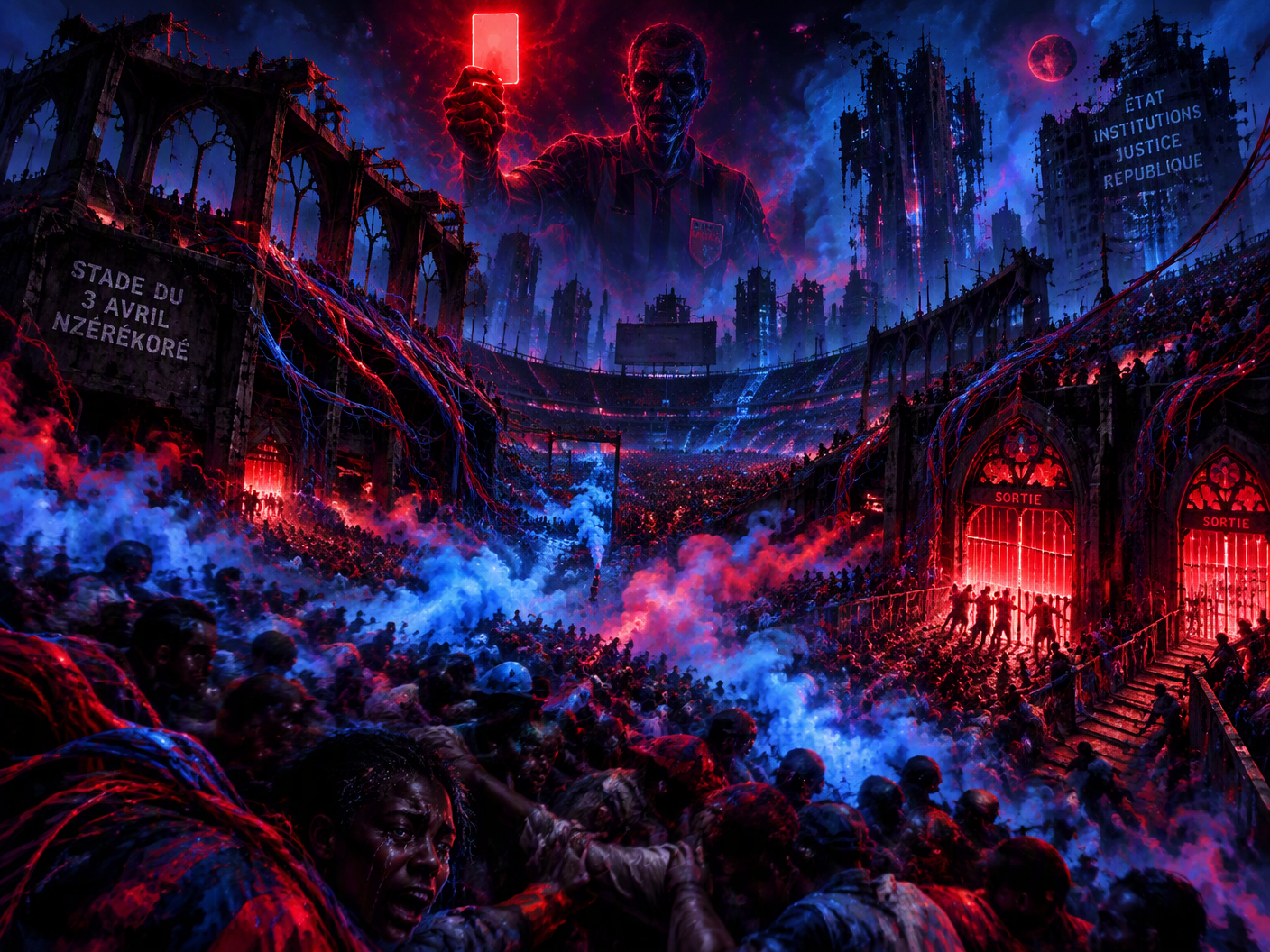
In the 82nd minute of the match at Stade du 3 Avril in Nzérékoré, the referee sent off a Labé player and awarded a penalty to Nzérékoré. The decision altered the movement of the afternoon. Labé supporters entered the pitch and threw stones. Security personnel responded with tear gas. Spectators began moving toward the exits and over the stadium walls, trying to get away from the disturbance. In that flight, bodies compressed against one another, and a crowd crush formed inside and around the stadium. By the time the movement stopped, people had died.
The match belonged to a tournament held in honor of Mamady Doumbouya, Guinea’s military leader. That political setting gave the fixture a significance beyond the two teams on the field. Doumbouya had taken power in a coup, and opposition figures viewed public events bearing his name as part of an effort to support his political ambitions. The tournament brought that contest into a football ground in Nzérékoré, where a refereeing decision in the closing stages turned an organized ceremony into a disorderly rush for escape.
The stadium itself had carried visible deficiencies before the match. In October 2023, it was described as unfinished, with incomplete stands and missing toilets and ticket offices. Its field could become muddy during the rainy season. Those conditions did not by themselves produce the crush, but they formed the physical setting in which people had to move when the match broke apart. The exits, walls, and surrounding approaches became part of the emergency route. A venue built for football had to absorb a crowd suddenly moving without a common direction.
The immediate sequence was compact. First came the red card to the Labé player and the penalty for Nzérékoré. Then visiting supporters crossed from the stands onto the playing surface and threw stones. Police and other security personnel used tear gas to disperse the disturbance. The gas added urgency to an already unstable crowd. People did not remain in orderly rows or wait for instructions. They ran toward the exits and climbed over walls, carrying the panic into the spaces where spectators were trying to leave at the same time.
The crush developed during that escape. It was not the original refereeing call, by itself, that killed people; the fatal movement came as spectators tried to get away from the pitch invasion and the tear gas. At the exits and along the walls, the crowd became compressed. Individuals who had entered the ground to watch a match were now part of a mass whose movement depended on every person around them. The distinction between spectator, fleeing bystander, and injured person disappeared as the crowd pressed through the available routes.
News of the deaths reached the city’s hospitals on 1 December. By the following day, hospital staff were dealing with large numbers of casualties, and the facilities were described as overwhelmed. The response moved from the stadium to clinics and emergency rooms, where the consequences of the crowd’s movement became a medical crisis. The government said at least 56 people had died. That figure gave the disaster its first official scale, even as families and communities continued to account for those who had not returned home.
Prime Minister Amadou Oury Bah confirmed the casualties and said the government would launch an inquiry. His announcement established the state’s immediate public response: acknowledge the deaths, promise a formal examination, and begin the process of determining what had happened. The statement did not settle the conditions at the exits, the conduct of security personnel, or the responsibility of those who had invaded the pitch. Those questions belonged to the investigation that authorities said would follow.
The sequence had begun with a decision made under the ordinary authority of a football match: a dismissal and a penalty. Its consequences depended on what followed. Labé supporters crossed the boundary between stands and field. Stones entered the disturbance. Police used tear gas. Spectators sought openings through exits and over walls. Each action narrowed the time available for the next response. By the time people were running, the match’s rules had ceased to organize the space, while the physical limits of the stadium still controlled where the crowd could go.
The political purpose of the tournament remained inseparable from the event that ended it. It had been staged in Doumbouya’s honor, at a time when the junta leader’s opponents were already treating such public displays as political support. The match therefore gathered sport, authority, and public allegiance in one place. When the crowd broke apart, the consequences did not belong only to the teams or the referee. They reached the hospitals, the government, and the families of those killed at the stadium.
The government’s inquiry became the final documented act within the immediate response of 2 and 3 December. The authorities had acknowledged a fatal crush, reported at least 56 deaths, and pledged to examine the incident. Later casualty estimates rose or varied, but the contemporary public account did not fix a final number above that initial figure. Nor did it provide completed findings assigning legal or administrative responsibility. What endured from those first days was a clear sequence: a disputed call, a pitch invasion, tear gas, a panicked escape, and a crowd crushed at Stade du 3 Avril.
Investigative Dossier & Evidence
Read the companion investigation notes, verified source claims, and primary documents.
Read the Companion Notes & Evidence Record →