
Bizarre & Myths · 2020s
The 16-Team Relaunch That Unraveled During the 2024 Arena Football Season
The Arena Football League announced a 16-team return, a technology partnership, and the revival of established markets. Within weeks of play, teams began folding or suspending operations, leaving scheduled games and the league’s promised footprint uncertain.
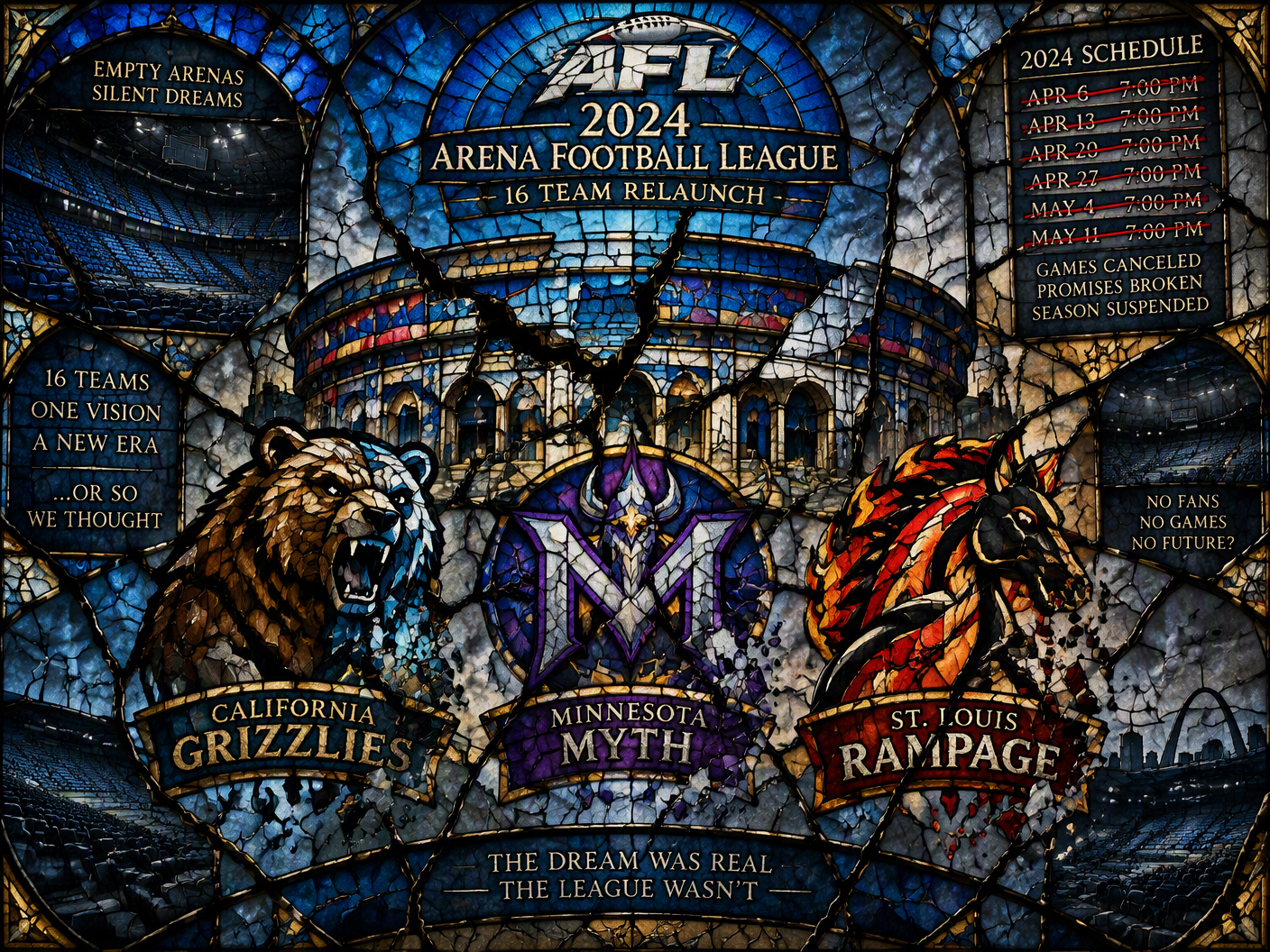
On June 18, 2024, a game that was supposed to bring the West Texas Desert Hawks to the field against the Salina Liberty instead became part of a shutdown. The Odessa team had ceased operations, a player and a league official confirmed, and the scheduled matchup had no stable home on the calendar. The Desert Hawks were identified as the eighth AFL team to close during the season. For the players, coaches, arena workers, and local businesses attached to each weekly game, the failure was practical before it was historical: a roster, a paycheck, and a date on a public schedule had become uncertain.
Less than a year earlier, the Arena Football League had presented a very different scale of ambition. Its planned 2024 relaunch called for 16 teams, a national circuit that would turn familiar city names and new markets into a working schedule. Commissioner Lee Hutton said the Philadelphia Soul would return, giving the revived league a recognizable franchise and a connection to the AFL’s earlier identity. The announcement offered supporters a future they could understand: teams in places with histories, rivalries, and indoor arenas prepared for another season of football.
The relaunch was paired with a digital promise. On July 18, 2023, the AFL and HUMBL announced a technology-platform partnership extending through the 2028 season. The arrangement covered a league website, a digital wallet, ticketing integrations, and related online services. These were the ordinary tools of a modern sports business, the infrastructure through which fans buy entry, receive information, and move money. Their presence in the announcement suggested an organization preparing not merely to play games but to operate a durable commercial enterprise around them.
At the same time, the geography of the relaunch was still being negotiated one arena at a time. In Bossier City, Louisiana, Brookshire Grocery Arena general manager Becky Bonnevier said the facility had been in discussions with the AFL about a possible team. The conversation placed Bossier City inside the league’s expanding public map, but a discussion was not a completed franchise. It did not yet give local workers a confirmed season, residents a guaranteed team, or the arena a settled tenant whose dates and payroll could be counted on.
That distinction followed the league into the season. A team name could be announced before its business arrangements had hardened; a venue could be mentioned before a full schedule was secure. The public language of expansion moved faster than the obligations required to sustain professional football: travel, equipment, insurance, staffing, field preparation, ticket sales, and wages. In a league built across distant markets, each team was also a small local employer. When one disappeared, the cost was distributed among athletes who lost work, venues that lost dates, and communities that had sold the return of a franchise as civic renewal.
The first clear break came in Council Bluffs, Iowa. On May 2, the Iowa Rampage announced that it had folded after playing one game. A season designed around a 16-team structure had therefore lost a participant almost immediately, not after a long competitive campaign. For players, one game could represent the boundary between expected employment and sudden unemployment. For opponents and fans, it altered the value of every remaining date. A league schedule is a promise made in public, but its fulfillment depends on organizations capable of reaching the next week.
Philadelphia followed on May 9. The Soul, the club Hutton had identified as part of the planned return, suspended operations for the remainder of the 2024 season. The name carried continuity, but continuity was not enough to keep the team on the field. A franchise presented as an anchor of the relaunch became another absence in the schedule, affecting the people hired to make its games possible and the fans who had been asked to invest in its revival.
Four days later, the Minnesota Myth became another suspended operation. Diana Hutton, an owner associated with the team, sent an email stating that the Myth was suspending operations, and the closure was later publicly confirmed. The sequence made the league’s instability visible through a series of administrative decisions rather than a single dramatic collapse: one club folded, another stopped for the season, then another. Each announcement reduced the working circuit available to everyone else, narrowing the margin for travel, scheduling, and competition.
By the time the West Texas Desert Hawks shut down, the problem had reached the point where a scheduled opponent became evidence of the league’s fragility. The Salina Liberty was still listed as the team West Texas was supposed to face during the week of June 18. But a fixture on paper could not put athletes on a bus, prepare an arena, or sell tickets to a game that no longer had two functioning teams. The shutdown was confirmed by people inside the operation, and later league reporting placed the official folding on June 21.
The collapse of the announced structure did not erase the earlier promises; it clarified their limits. The AFL had established an intention to relaunch with 16 teams, a public return for the Philadelphia Soul, a digital partnership with HUMBL, and conversations about additional markets such as Bossier City. It had not produced a stable circuit in which every announced location, ownership arrangement, and weekly contest functioned as promised. The distance between those two conditions was carried by people with less control than the executives making the announcements.
For the athletes, the season’s instability was measured in immediate necessities rather than promotional language. A suspended franchise could mean lost games, lost wages, interrupted travel, and uncertainty about whether another employer existed in the same league. For arenas, it meant dark dates where a team had been scheduled to arrive. For fans, it meant that a ticket represented an intention rather than a dependable event. The 2024 relaunch remained visible in announcements and partnerships, but its workers encountered the more exacting test: whether an organization could keep operating after the first game, the next road trip, and the next payroll.
The Desert Hawks’ abandoned meeting with Salina was the final image left by the captured period: a team named on a schedule, an opponent waiting in the structure of the season, and an operation that had already stopped. The league had promised a broad return, and its public plans reached from Philadelphia to possible new markets in Louisiana and through a technology deal aimed at the future. What remained for the people tied to the 2024 season was narrower—a canceled contest, a suspended job, an empty date, and the unpaid uncertainty of a league that announced sixteen teams but could not keep them all in operation.
Investigative Dossier & Evidence
Read the companion investigation notes, verified source claims, and primary documents.
Read the Companion Notes & Evidence Record →