
Doping & Drugs · 1980s
The Belfast Urine-Sample Substitution Request
At a 1986 track-and-field meeting in Belfast, Australian team manager Maurie Plant asked heptathlete Jane Flemming to provide a urine sample in place of javelin thrower Sue Howland, fearing Howland would test positive for an anabolic steroid. The episode sits at the edge of a national anti-doping system that Australia later formalized, expanded, and gave broader investigative authority.
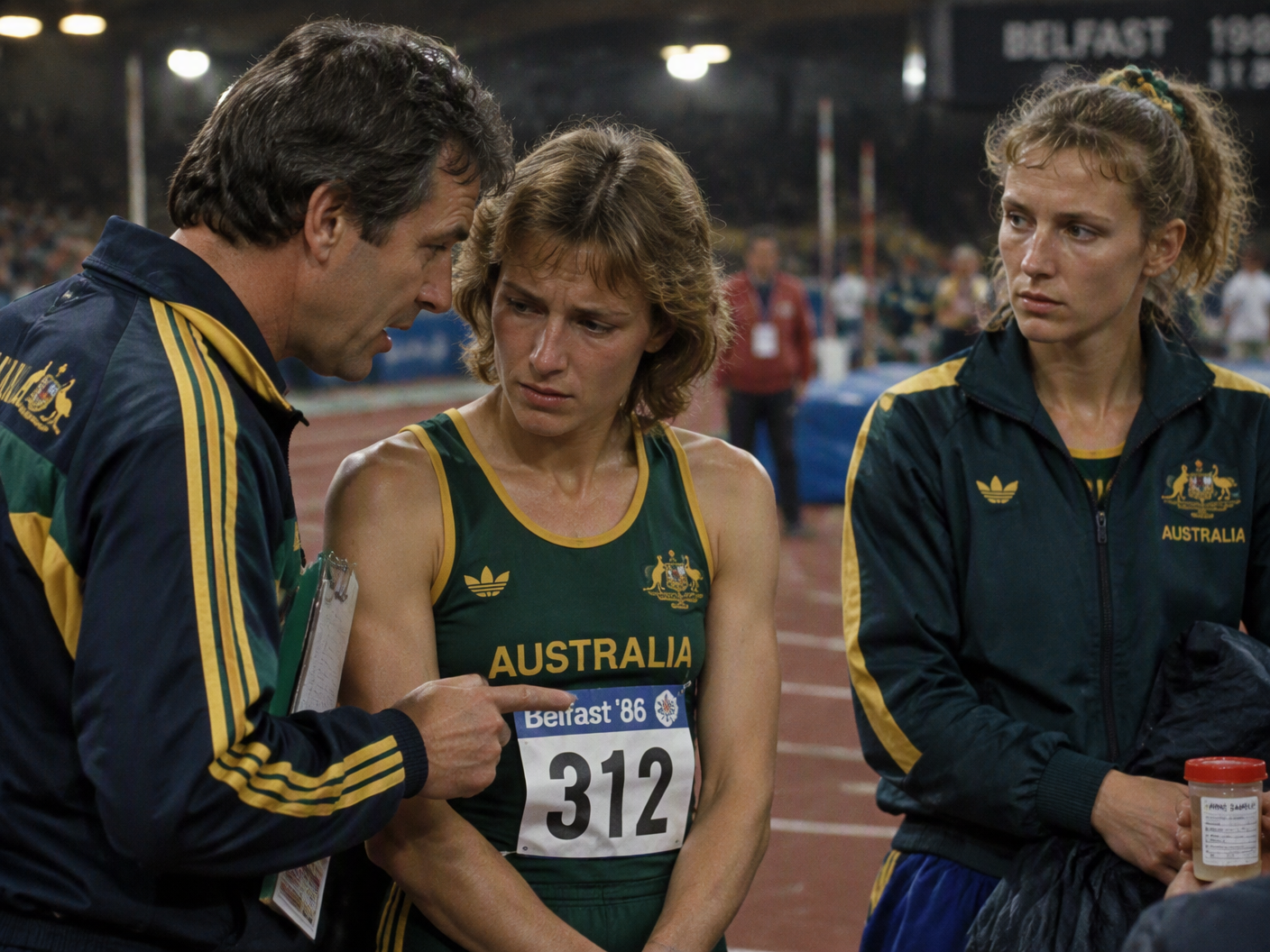
At a track-and-field meeting in Belfast in 1986, Australian team manager Maurie Plant made a request that converted an anti-doping test into a question of identity. He asked Jane Flemming, an Australian heptathlete, to provide a urine sample in place of Sue Howland, the team’s javelin thrower. Plant feared Howland would test positive for an anabolic steroid. The request placed Flemming between an official control procedure and the athlete whose sample was supposed to enter it. It also gave a private managerial decision the shape of an institutional act: one athlete’s body proposed as the biological stand-in for another.
The episode was not a dispute over a result already issued. It began with anticipation of a result Plant believed might be dangerous to Howland. That distinction fixes the known sequence. Plant asked Flemming to substitute for Howland; the stated reason was fear of an anabolic-steroid positive; the setting was an international track meeting in Belfast. The request itself is the central act. It shows a manager treating the sample-collection process not as a fixed safeguard but as an obstacle that might be managed through another athlete.
Flemming’s role made the proposed substitution especially direct. She was not an anonymous team official or a laboratory intermediary. She was a competitor, identifiable through the same sporting delegation and subject to the same culture of selection, representation, and managerial authority. Howland was the athlete whose urine was supposed to be tested. Plant was the person who asked for the exchange. The arrangement depended on those roles remaining distinct while the test treated them as interchangeable.
An anabolic-steroid suspicion carried consequences beyond a single competition. A positive test could affect an athlete’s eligibility, reputation, and place within the national program. In that setting, the request sought to move the immediate risk away from Howland and onto the collection process itself. Flemming would have supplied the biological material; Howland’s name would have governed its official meaning. The proposed substitution therefore targeted the basic premise of anti-doping control: that the specimen belongs to the athlete identified on the form.
Australia did not yet possess the national anti-doping agency that would later define the country’s formal response. In 1990, the Australian Government established the Australian Sports Drug Agency. The decision created a centralized public institution for sports-drug control, replacing the kind of improvised authority represented by a team manager handling a feared positive within an athletic delegation. The Belfast episode belonged to an earlier period, when the integrity of testing could depend heavily on the conduct of people operating close to the athletes.
The institutional sequence continued on 14 March 2006, when the Australian Sports Anti-Doping Authority replaced the Australian Sports Drug Agency. The new agency inherited a national task but operated within a more developed international compliance environment. Anti-doping was no longer only a matter of whether a manager, athlete, or coach would cooperate with a test. It had become an administrative function with designated investigators, formal procedures, and consequences extending beyond the track.
By 2000, the testing problem had also become technical. On 2 August of that year, the IOC Medical Commission recommended a combined blood-and-urine test for detecting synthetic erythropoietin at the Sydney Olympic Games. The recommendation recognized that a single specimen type could not answer every doping question. Blood and urine would be used together to detect a substance designed to alter athletic capacity while evading older forms of control. The laboratory, not the team manager, was being assigned the burden of distinguishing the athlete from the method.
That recommendation placed the Belfast request inside a longer movement from personal intervention toward controlled detection. In 1986, Plant’s concern centered on whether Howland might produce a positive anabolic-steroid result and whether Flemming could be used to prevent that result from attaching to her. In the years that followed, Australia built agencies and testing capacity around the opposite principle: the sample had to be tied to the athlete, and the detection system had to withstand attempts to manipulate either identity or substance.
The later agency also gained a wider investigative role, but the 2013 legislation did not simply create an unlimited power to interrogate athletes or inspect records. It expanded the statutory process through which the Australian Sports Anti-Doping Authority could require relevant people to attend interviews and provide information or documents in specified anti-doping investigations, subject to the limits and protections set by law. The change moved scrutiny beyond the sealed specimen to the conduct surrounding a test: what managers, support personnel, and organizations knew, did, or failed to disclose.
The human consequence of the Belfast request rests in the roles it assigned. Flemming was asked to become the source of a specimen bearing Howland’s sporting identity. Howland became the athlete whose feared test prompted the proposal. Plant exercised the authority to ask one competitor to absorb the practical risk created by another competitor’s suspected result. The later creation of national agencies did not erase that earlier relationship. It marked the point at which such decisions began moving out of informal team control and into a system designed to document, test, and compel.
The Belfast incident remains narrow in its factual core but broad in its institutional meaning. It identifies a manager, two athletes, a location, a proposed substitution, and a stated fear of an anabolic-steroid positive. It does not turn the suspicion into a laboratory result. It does not transform the request into a completed substitution or a later sanction. What endures is the decision to ask: a moment when the credibility of an anti-doping test depended on whether the people surrounding it would preserve the identity of the sample or try to replace it.
Investigative Dossier & Evidence
Read the companion investigation notes, verified source claims, and primary documents.
Read the Companion Notes & Evidence Record →