
Violence & Brawls · 1980s
Blackpool Football Violence, Arrests, and the Banning Orders That Followed
From Kevin Olsson’s fatal stabbing at Bloomfield Road in 1974 to the arrests and court-imposed football banning orders that followed disorder in 2006, Blackpool’s violence record moved from match-day confrontation to organized police and judicial intervention. By 2007, exclusion from football grounds had become a central legal response to supporters identified as troublemakers.
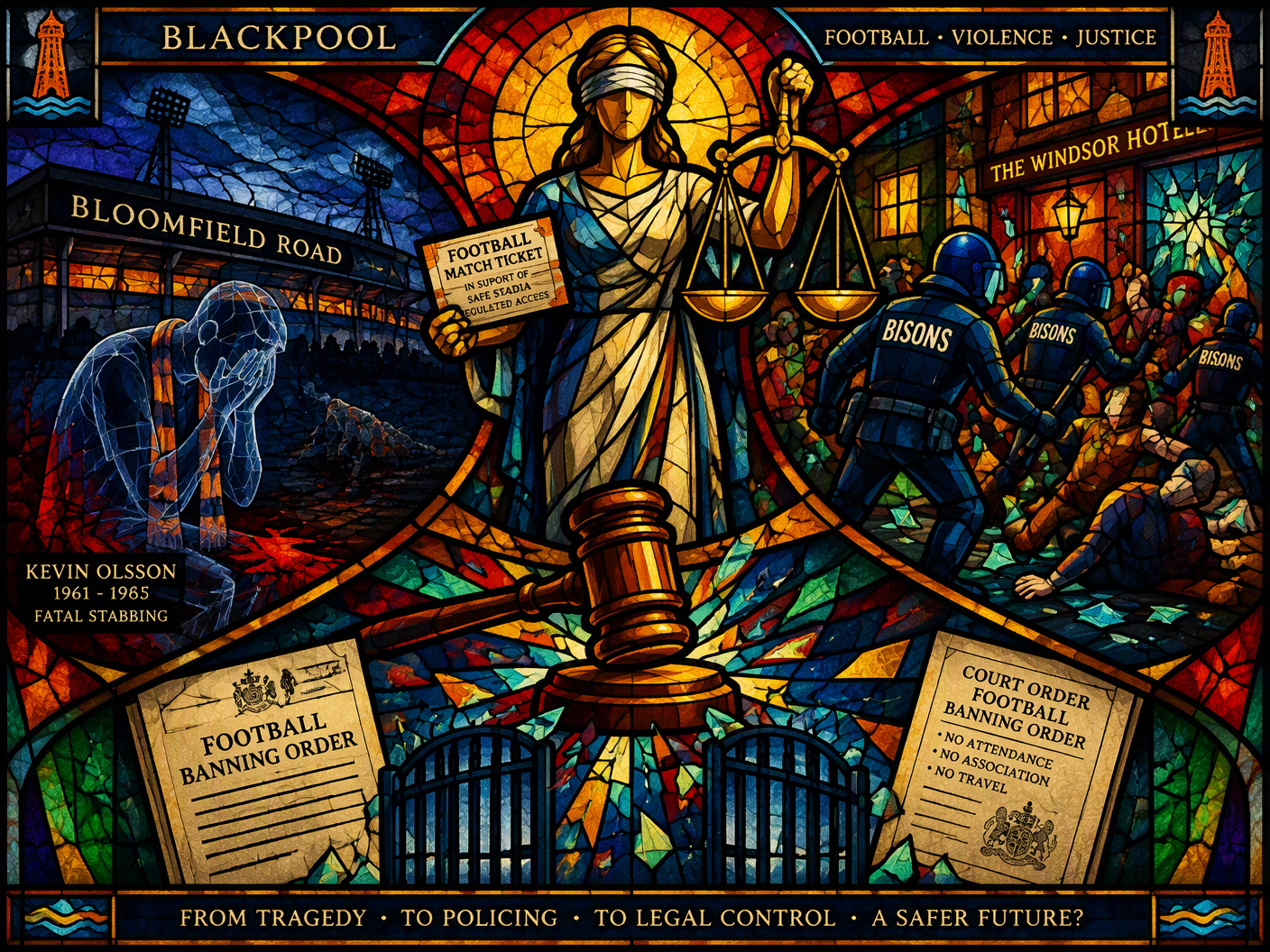
Kevin Olsson was fatally stabbed at Bloomfield Road on 24 August 1974 during Blackpool’s home match against Bolton Wanderers. The killing fixed violence to the club’s ground in its most irreversible form: a supporter entered a football afternoon and did not leave alive. The incident became the earliest established point in a Blackpool-linked history that later included mass fighting, police raids, criminal proceedings, and restrictions on attendance. It also exposed the limit of the match itself as a boundary. The violence did not remain confined to the pitch or the turnstiles.
The legal response that developed over the following decades did not depend on one permanent organization or one uniform group of offenders. Courts could restrict individual supporters from football grounds after particular incidents, separating attendance from entitlement. After a Brighton incident, three fans received football ground bans. The order was not a club suspension or a private decision by a steward. It was a court-imposed condition that removed access to matches, turning the ordinary act of buying a ticket into a regulated privilege.
That distinction became more important as disorder shifted beyond the stadium. On 4 February 2006, after Blackpool played Nottingham Forest, large-scale fighting developed around the Castle pub and the Swift Hound pub in Blackpool. Pubs became the locations in which the confrontation was investigated: public places with witnesses, entrances, exits, and police jurisdiction. Lancashire Police treated the events as a broader football-violence inquiry rather than an isolated exchange between strangers. The match supplied the connection; the subsequent investigation followed the people and places around it.
Lancashire Police moved from investigation to arrests in April 2006. Officers arrested seven people in Blackpool and Lytham in connection with the Nottingham Forest-related violence. The geography mattered. The inquiry extended beyond the ground and beyond the immediate scene of the fighting, reaching into two Lancashire locations associated with suspected participants. Raids converted a public disturbance into a prosecutable case. They also transferred the question of responsibility from the crowd to named individuals, each now subject to police custody and the later decisions of prosecutors and courts.
The case reached Preston Crown Court on 11 July 2007. Six fans appeared before Judge Norman Wright, who imposed football banning orders on all six. The orders operated alongside the criminal process but served a distinct purpose: they kept the subjects away from football grounds for a specified period, restricting the opportunity for further match-related disorder. A court had moved beyond punishment for what had already happened. It had also imposed a forward-looking control on where those supporters could go and when they could attend.
The difference between the April arrests and the July hearing marked the route through which authority accumulated. Police identified suspects and assembled the case. The Crown Court then exercised its power to impose exclusion orders. The sequence was not a single administrative act. It ran from violence around two Blackpool pubs, through raids in Blackpool and Lytham, to a hearing in Preston where attendance at football became the subject of a formal judicial restriction. Six people reached that endpoint. Seven had been arrested during the investigation.
The Home Office placed those local proceedings inside a national enforcement system. During the 2007–08 football season, it recorded 3,842 arrests for disorder connected to matches across England and Wales. The figure counted arrests, not convictions, and it described the scale of police intervention rather than assigning guilt to every person detained. Still, it showed how far football disorder had moved into routine public administration. Match-day violence was being measured through arrests and managed through courts, police operations, and restrictions on attendance.
The same Home Office figures recorded 3,172 known troublemakers subject to football banning orders in that season. A banning order was not simply a warning from a club. It was a legal exclusion that could prevent a person from attending matches and, depending on its terms, impose additional reporting or travel restrictions. The policy treated football violence as a problem that could be reduced by removing identified individuals from the places where supporters gathered. The ground became safer for some by becoming legally inaccessible to others.
Blackpool’s sequence shows why a single label cannot carry the whole account. Olsson’s death occurred inside Bloomfield Road during a match with Bolton Wanderers. The 2006 violence unfolded around pubs after a Nottingham Forest fixture. The Brighton case produced three court-imposed ground bans. These events belonged to different moments, locations, and proceedings. Their connection lies in the repeated collision between football affiliation and public disorder, followed by increasingly formal attempts to identify participants and limit their access to matches.
The final measurable consequence was not a single verdict that explained every episode. It was a system of interventions: a fatal stabbing at the stadium, police investigation after fighting in Blackpool, seven arrests in Blackpool and Lytham, six fans before Judge Norman Wright, and thousands of national arrests and banning orders in the following season. By 2007, the state’s answer to football violence had become both punitive and preventive. The court did not merely decide what had happened; it decided who would be permitted to return.
Investigative Dossier & Evidence
Read the companion investigation notes, verified source claims, and primary documents.
Read the Companion Notes & Evidence Record →