
Tragedy · 1960s
Davey Moore’s Final Title Defense and the Death After the Ramos Fight
Davey Moore entered his March 21, 1963 title defense as a former Olympian and reigning world featherweight champion. After his neck struck the bottom rope in the tenth round, he finished the round, collapsed after the bout, entered a coma, and died four days later; the death produced a public argument over responsibility that never became a legal finding against a named person or institution.
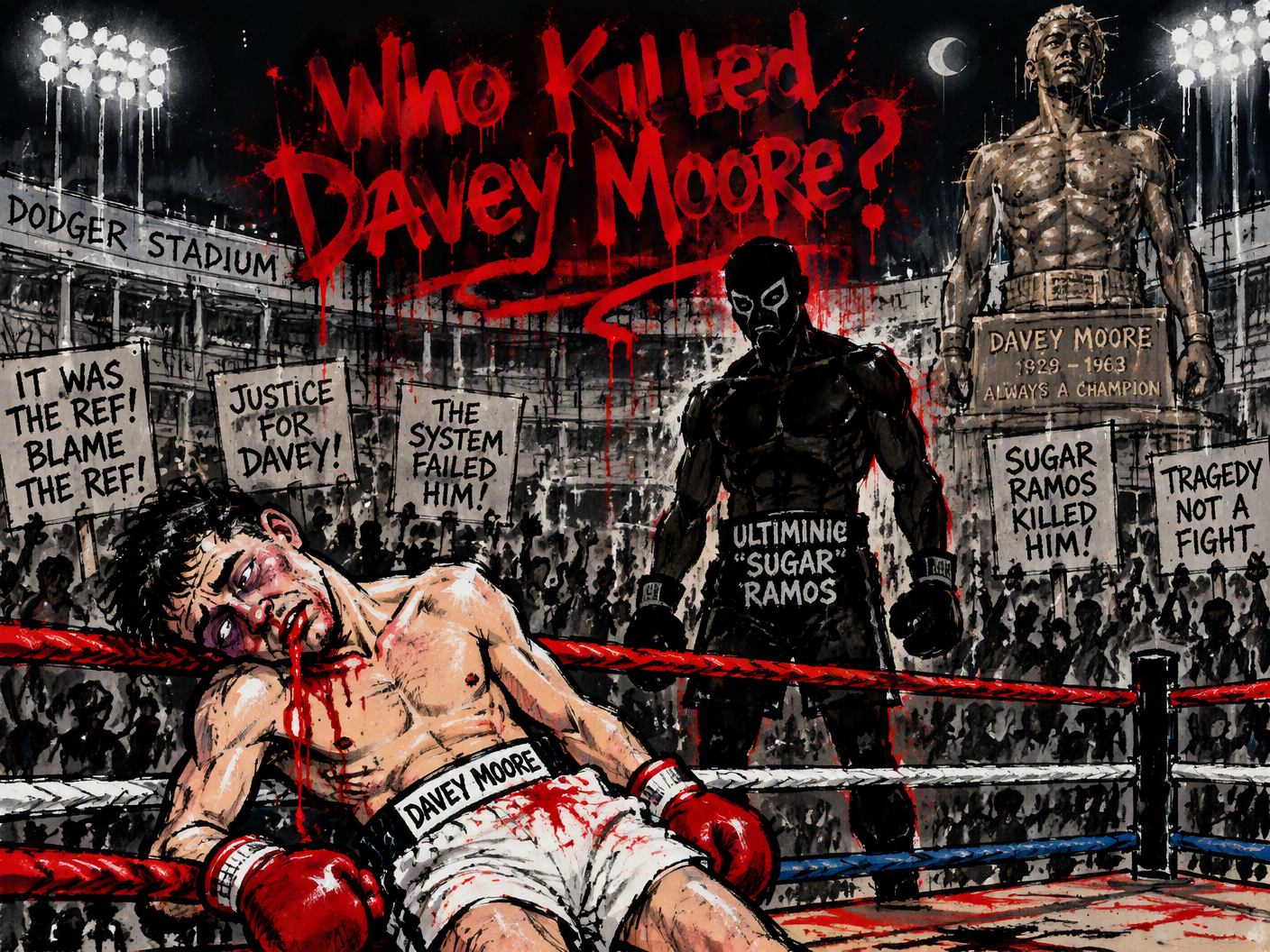
On March 21, 1963, at Dodger Stadium in Los Angeles, Davey Moore’s final championship fight ended before the eleventh round. Moore had completed the tenth on his feet after his neck struck the bottom rope. The bout was stopped, and he went from the ring toward the dressing-room area. There, the athletic contest gave way to a medical emergency. Moore collapsed after the fight, entered a coma, and died in Los Angeles four days later, on March 25. The sequence was short: ten completed rounds, a delayed collapse, four days of unconsciousness, and a death that carried boxing’s ordinary language into a question no scorecard could answer.
Moore had been moving through boxing’s formal ladders for more than a decade. At the 1952 Summer Olympics in Helsinki, Finland, he boxed for the United States as a bantamweight. His Olympic tournament ended in the quarter-finals, after bouts against Egon Schidan and Kang Joon-Ho. The result did not determine the scale of his professional career. Amateur boxing gave him an international beginning; professional boxing offered the longer route, the championship belt, and the repeated obligation to defend what he had won.
On March 18, 1959, in Los Angeles, Moore won the professional world featherweight championship from Hogan Bassey. The title changed his position within the sport. He was no longer only a boxer who had represented his country or accumulated victories on a crowded professional schedule. He was the champion whose next appearance would be organized around the belt, the challenger, and the expectation that the contest could continue until one man prevailed. Four years later, that expectation remained embedded in the arrangement at Dodger Stadium.
Ultiminio “Sugar” Ramos was the challenger for Moore’s scheduled title defense on March 21, 1963. The fight took place in the ballpark in Los Angeles, a venue built for baseball but used that night for boxing’s portable economy of ring, ropes, officials, and rounds. Moore and Ramos went through ten rounds. The decisive moment came late in the tenth, when Moore’s neck struck the bottom rope. He did not immediately collapse in the ring. He finished the round on his feet, and the bout was stopped before the bell could summon him for the eleventh.
That order mattered to the people who had to understand what had happened. Moore was hurt during the round, yet the visible contest did not end with an immediate knockout. He remained upright through the close of the tenth, then left the arena for the dressing-room area. The danger appeared after the scheduled action had ended. Boxing had a vocabulary for a stoppage, a technical decision, and a fighter unable to answer the bell. Moore’s condition required a different vocabulary: collapse, coma, and the guarded passage from treatment to death.
In the hours that followed, Moore went into a coma. The public chronology narrowed around the same facts: the championship bout on March 21, the injury in the tenth round, the collapse afterward, and death on March 25. Medical details remained sparse in the accounts that carried the event into public discussion, but the sequence itself was clear enough to alter the meaning of the fight. What had begun as a title defense was now being considered through the fate of the champion who had not lived to see another morning of competition.
Ramos became inseparable from the public argument because he had stood opposite Moore when the injury occurred. The question of responsibility moved outward from the ring: toward the opponent, the officials, the promoters, and the sport’s acceptance of bodily risk. But the death did not produce a legal judgment naming any of them as responsible. The documented event was a fatal injury sustained during a championship fight and a medical collapse afterward. The larger accusations belonged to public debate, where grief and anger often seek a human name even when the formal institutions provide none.
Geraldine Moore, Davey’s widow, rejected the simplest version of that search. In later coverage, she said she did not blame Ramos for Moore’s death and described it as a tragic accident. Her position did not erase the physical sequence inside the ring, and it did not end the wider discussion about boxing’s conditions. It did, however, distinguish the opponent from the event. Ramos had been the man across from Moore; Geraldine Moore’s statement declined to convert that fact into a claim of personal guilt.
The debate also moved beyond boxing’s own institutions. Bob Dylan wrote “Who Killed Davey Moore?” in response to the death, turning the question into a song about distributed responsibility. Its premise gave voice to the argument that no single participant could absorb the whole burden: not the fighter who delivered the blow, not the officials who permitted the contest, not the promoters who arranged it, and not the audience that accepted the violence as sport. The song preserved the question in cultural form, where it could circulate without the authority of a court’s verdict.
Moore’s earlier career remained part of the public memory that followed him. The Olympic bantamweight from Helsinki had become the professional featherweight champion in Los Angeles, and the champion had died after defending the title against Ramos at Dodger Stadium. In September 2013, fifty years after the fight, Moore was memorialized with a bronze statue in Springfield, Ohio. The unveiling and the family’s remembrance placed the boxer within a permanent civic setting rather than leaving him only in the compressed language of a final round.
The enduring record is therefore both exact and incomplete in the way many deaths in public competition remain exact and incomplete. Moore boxed for the United States, won a world title, fought ten rounds with Ramos, struck the bottom rope with his neck, finished the round, collapsed, entered a coma, and died four days later. Those facts fixed the chronology. The reactions that followed—Geraldine Moore’s refusal to blame Ramos and Dylan’s question in song—fixed the afterlife of the event. The statue in Springfield gave that afterlife a physical address, while the unanswered question remained attached to the fight itself.
Investigative Dossier & Evidence
Read the companion investigation notes, verified source claims, and primary documents.
Read the Companion Notes & Evidence Record →