
Tragedy · 1980s
Bobby Chacon’s Final Title Win After Valorie Chacon’s Death
On December 11, 1982, Bobby Chacon defeated Rafael Limón by decision at Sacramento’s Memorial Auditorium to win the WBC super-featherweight title. The victory came after the suicide of Chacon’s wife, Valorie, and later reporting joined the two events to the champion’s account of grief and his eventual brain-damage-related decline.
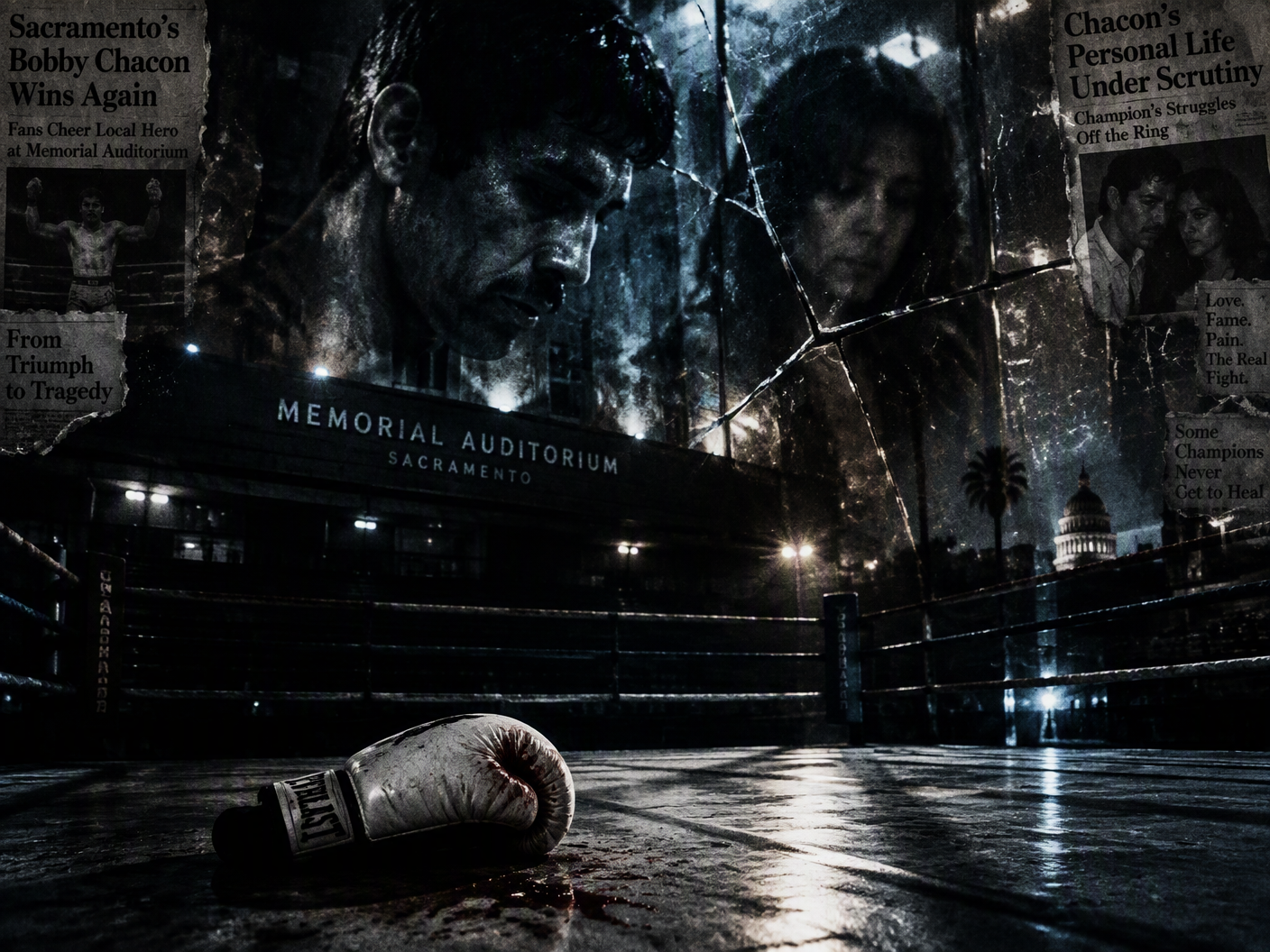
On December 11, 1982, Bobby Chacon entered Memorial Auditorium in Sacramento to fight Rafael Limón for the WBC super-featherweight title. By the decision’s end, Chacon had won the championship. The contest became the last title victory of his career, but its public meaning was fixed by an event that had occurred earlier that year in Sylmar, where his wife, Valorie Chacon, died by suicide in the family home. The two events were separated by distance and months. Later accounts placed them together, not as a single incident, but as the defining sequence of Chacon’s life in 1982.
Valorie’s death preceded the Sacramento fight. The family home in Sylmar became the place associated with the private catastrophe, while the boxing ring remained the public arena in which Chacon continued to work. Chacon later said he was in the gym when Valorie committed suicide. That statement supplied the central human detail in the account that followed: the champion was away training while his family life broke apart. It also fixed the limits of what could be responsibly said. The event was a suicide in 1982, and the grief that followed was real; the public story contained no criminal case against Chacon and no official finding that he had caused her death.
By December, the obligations of a championship fight had imposed their own timetable. Chacon and Limón met in Sacramento, and the bout went to the judges rather than ending by knockout. Their decision gave Chacon the WBC super-featherweight championship. The result was concrete: a title changed hands, and Chacon’s name was restored to the place occupied by active champions. Around that result, however, accumulated a private dedication. Chacon dedicated the fight to Valorie, turning the contest into an act of mourning as well as a professional engagement.
That dedication did not erase the chronology. Valorie had died before the fight, not during it and not because of anything that occurred in Sacramento. Chacon’s title win came afterward, when the loss was still part of the immediate circumstances surrounding him. The later telling joined the family death and the championship because Chacon himself supplied that connection through the dedication and his account of where he had been. The sequence was therefore more exact than the legend that grew around it: a wife’s suicide in Sylmar, a training period, a December title bout, and a decision victory over Limón.
For years, the championship remained the most visible part of the story. Boxing preserved Chacon as a former world champion, a man whose career could be summarized through titles, opponents, and dates. But the private loss stayed attached to the Sacramento victory whenever his life was revisited. The ring offered a public measure that could be recorded in a result: Chacon defeated Limón by decision. The family tragedy had no comparable sporting notation. It entered the account through memory, through the dedication, and through the difficult fact that the celebration of a title occurred within the same year as Valorie’s death.
On May 6, 1999, Los Angeles Times staff writer Fernando Dominguez published a retrospective that brought the sequence into a later period of Chacon’s life. The article treated the title fight, Valorie’s suicide, and Chacon’s declining condition as parts of one biography. By then, the fight was no longer only a contest in Sacramento. It had become the final championship achievement against which the rest of Chacon’s life was measured, while Valorie’s death remained the private event that gave the victory its enduring emotional weight.
The retrospective also described what boxing had left in Chacon’s body and mind. The Los Angeles Times reported that he had long suffered from the effects of brain damage. The phrase placed his later condition within the accumulated consequences of a professional career built on repeated blows, though the reporting did not present a formal medical file or a clinical chronology. What readers encountered was a former champion living with serious cognitive and physical decline, his public identity still tied to the night he won the title from Limón.
The connection between Valorie’s death and Chacon’s decline was often made through narrative rather than legal process. Valorie’s suicide was described as a family tragedy. Chacon’s championship was described as a dedication. His later health problems were described as the effects of brain damage. Those facts could occupy the same account without becoming a charge against him. No indictment, court proceeding, or official criminal finding entered the story. The enduring public image was built from bereavement, athletic achievement, and bodily deterioration—not from an adjudicated accusation concerning Valorie’s death.
Seventeen years after the 1999 retrospective, Chacon died in a care facility in Hemet, California. On September 7, 2016, he fell and struck his head. The event closed the life of a boxer whose final title win had occurred thirty-four years earlier, in a Sacramento auditorium, after the death of the woman to whom he dedicated it. The later account of Chacon’s health did not replace the fight result; it changed the scale of the story. The championship became an early marker in a longer history of physical damage and personal loss.
What endured was an unusually compressed public biography. Chacon beat Rafael Limón by decision on December 11, 1982, and won the WBC super-featherweight title. In that same year, Valorie Chacon died by suicide in the family home in Sylmar. Chacon said he was at the gym when it happened and dedicated the fight that followed to her. Later reporting carried those facts forward alongside accounts of brain-damage-related decline and his death after a fall in Hemet. The record’s lasting shape is not a verdict, but a sequence: a private death, a public victory, and the long cost that followed.
Investigative Dossier & Evidence
Read the companion investigation notes, verified source claims, and primary documents.
Read the Companion Notes & Evidence Record →