
Scandals & Feuds · 1980s
The Belfast Fixtures and the Final British Home Championship
The 1980–81 British Home Championship was voided after England and Wales did not travel to Belfast for Northern Ireland’s home matches. The competition continued for three more seasons, ending after England and Scotland withdrew and Northern Ireland won the completed 1983–84 edition.
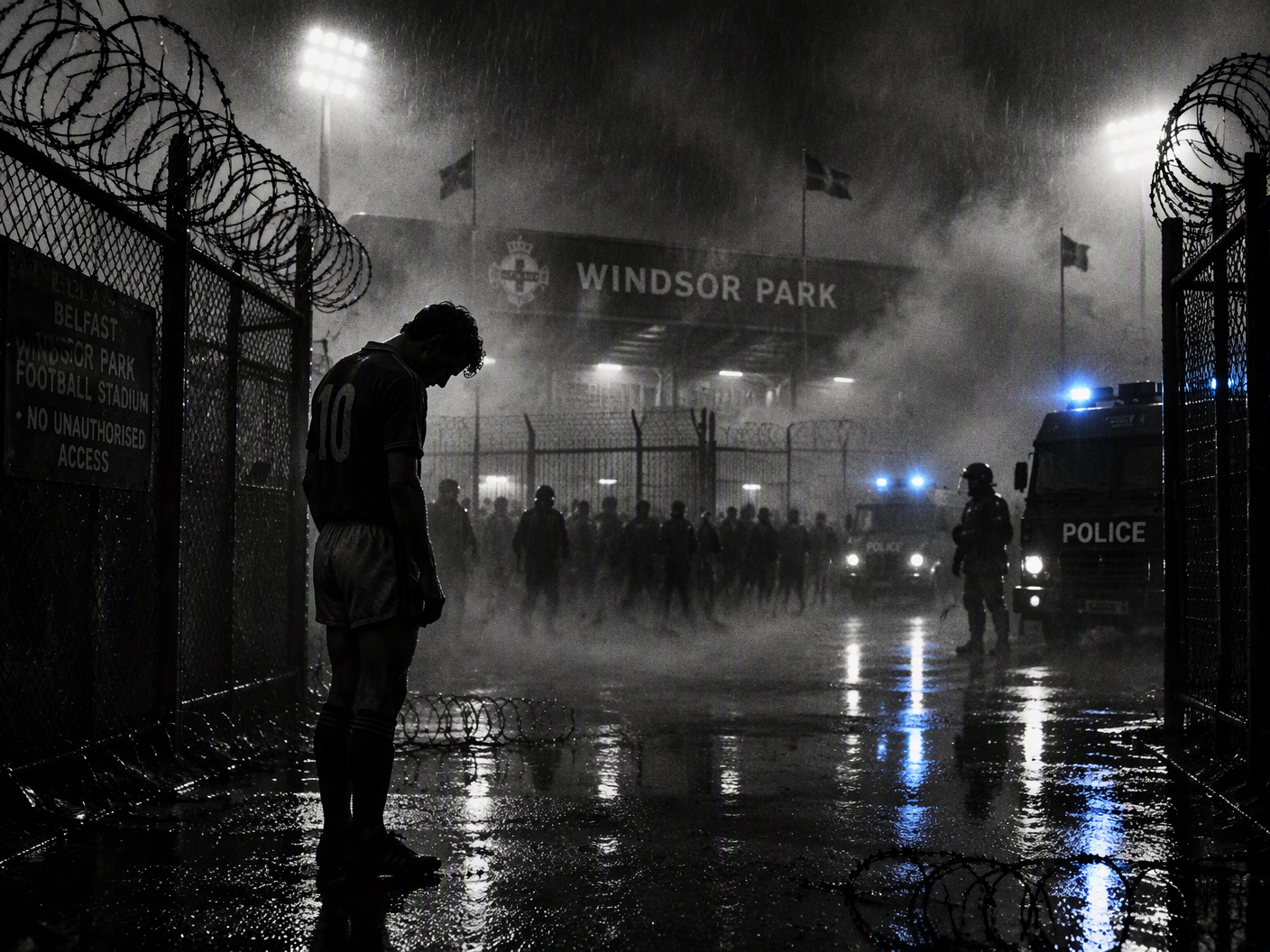
In the 1980–81 season, two football fixtures failed in Belfast, and the British Home Championship failed with them. Northern Ireland had been scheduled to host England and Wales, but neither match was played there after the visiting associations refused to travel. The four-team competition could not complete its programme. Its official outcome was not a winner, a rearranged title, or a shared distinction. The championship was declared void. For the first time, political conditions in Northern Ireland had interrupted the tournament’s calendar; they had not yet ended the tournament itself.
The abandoned fixtures belonged to a season of civil unrest surrounding the hunger strike at the Maze Prison. Belfast was not simply a difficult destination on an international schedule; it was the proposed site of two matches whose security and political setting had become inseparable from the sport. England and Wales did not make the journey. The consequence was administrative but permanent for that edition: matches left unplayed meant that the table could not produce a legitimate champion, and the championship’s governing associations voided the competition rather than complete it by substitution.
The distinction between that season and what followed became important only later. The 1980–81 competition had collapsed before all its fixtures were fulfilled, but the British Home Championship returned to the calendar. Northern Ireland remained part of the arrangement, and the four associations continued to treat the tournament as a functioning international contest. The Belfast failure therefore became a precedent for disruption, not the formal closing of the competition. Its final years would be decided through announcements, fixture lists, and completed matches rather than through another abandoned programme.
In 1983, the English Football Association announced that England would not enter the tournament after the 1983–84 Championship. The Scottish Football Association made the same decision. Their announcements set an endpoint while preserving one last competition under the existing rules. The arrangement now had a defined final season: the championship would be played once more, and then the two associations that had helped sustain it would leave. The choice shifted the story from whether Belfast could host international football to whether the old contest still deserved space on an increasingly crowded calendar.
Ted Croker, the Football Association’s secretary, described the practical pressure behind that decision. The fixture list did not contain enough gaps for both the leading international opponents and the Home Internationals. England’s schedule now had to accommodate higher-priority matches, while the traditional four-nation contest competed for dates that clubs and associations already needed elsewhere. The explanation did not erase the political interruption in Belfast. It placed that interruption inside a wider change in international football, where an old annual appointment was no longer automatically protected by custom.
David Lacey identified further pressures: the expanding demands of club football, European competitions, declining attendances, and crowd violence. None of these factors operated as a single formal cancellation order. Together they weakened the case for preserving a competition that required four associations to surrender scarce dates for matches whose commercial and sporting importance had diminished. Disorder belonged in that account, but it did not stand alone. The championship was being pressed from several directions at once—by the calendar, by changing priorities, by smaller gates, and by the conduct surrounding some fixtures.
The final campaign began on 13 December 1983 at Windsor Park, where Northern Ireland played Scotland. Billy Bingham managed the Northern Irish side during the last championship, and Norman Whiteside scored for the hosts in the opening match. The fixture carried the ordinary form of an international game—teams, a result, and points toward a table—but it also occupied a place already marked for disappearance. England and Scotland had announced that they would not return after the season. The tournament was continuing under notice of its own closure.
Northern Ireland’s campaign continued to Wembley, where England defeated them through a winning goal by Tony Woodcock. That match did not settle the championship, but it kept the final table open. The competition still depended on the last meeting between England and Scotland, and Northern Ireland remained within reach of the title. Unlike the abandoned season in Belfast, the final tournament was proceeding through its scheduled sequence. Its fate would be determined by the final result, not by a missing fixture or an administrative declaration that the programme could not be completed.
On 26 May 1984, Scotland and England met at Hampden Park in Glasgow for the last match. They drew 1–1. That score left Northern Ireland at the top of the table on goal difference, giving Bingham’s team the championship. The title was not awarded after a cancellation, and it did not emerge from a disputed rearrangement. The last edition reached its final whistle under the rules that had governed it. Northern Ireland became the final winners because the completed results placed them above England and Scotland.
The sequence separated two events that later retellings could easily merge. In 1980–81, England and Wales did not travel to Belfast, Northern Ireland’s home matches remained unplayed, and the competition was voided amid unrest surrounding the Maze Prison hunger strike. Afterward, the championship returned. In 1983, England and Scotland announced their withdrawal after the next season; in 1983–84, the matches were completed and Northern Ireland won. Political crisis explains the abandoned edition, but the later ending came through institutional withdrawal and a format that no longer fit the associations’ priorities.
The British Home Championship therefore ended neither at the moment Belfast lost its fixtures nor through a single act of crowd violence. Its last season remained playable, and its final table remained valid. What disappeared after May 1984 was the agreement to keep assembling the same four-nation competition. Northern Ireland retained the last title; England and Scotland retained their decisions not to return. The surviving shape of the tournament is consequently defined by two different records: one season marked void by matches that never took place, and a final season completed before the associations closed the arrangement.
Investigative Dossier & Evidence
Read the companion investigation notes, verified source claims, and primary documents.
Read the Companion Notes & Evidence Record →