
Tragedy · 1990s
The Tenth-Round Knockout That Left Gerald McClellan Blind
On 25 February 1995, Nigel Benn retained the WBC super-middleweight title by stopping Gerald McClellan at London Arena. McClellan collapsed after reaching his corner, underwent emergency brain surgery, and lived thereafter with blindness and lasting neurological and mobility problems, while later arguments about quitting, drug use, and responsibility remained disputed.
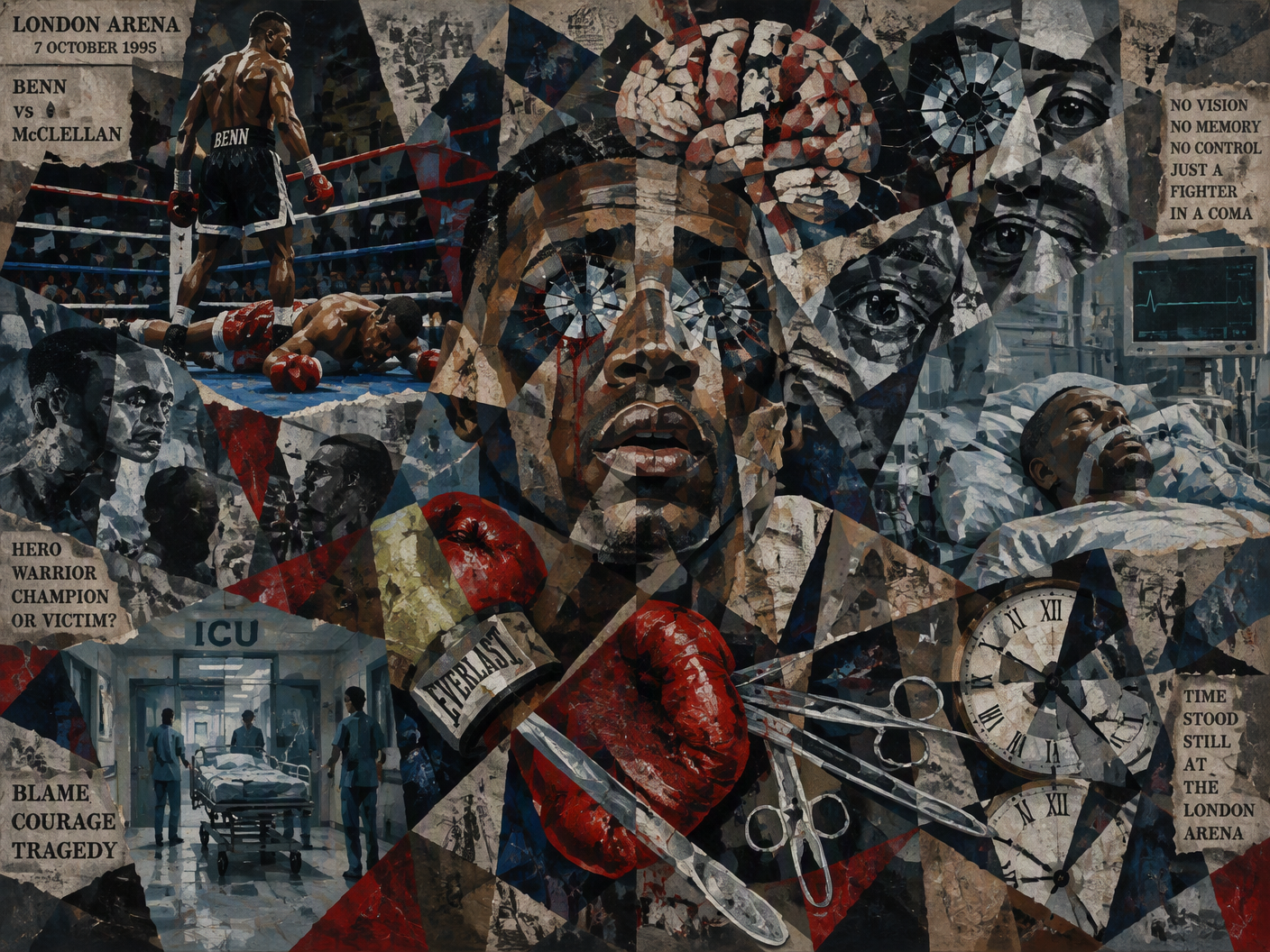
On 25 February 1995, at London Arena in London, Nigel Benn and Gerald McClellan entered the ring for the WBC super-middleweight championship. Benn held the title; McClellan had previously been a WBC middleweight champion. By the tenth round, the contest had become a sequence of exchanges ending in a count-out. McClellan dropped to one knee, and referee Alfred Asaro counted him out. Benn won by knockout. The official result fixed the championship. What followed in McClellan’s corner gave the evening its lasting human consequence.
McClellan reached his corner after the count and then collapsed. The movement separated the bout’s formal ending from the emergency that began around it: the referee’s decision had been made, but McClellan’s condition was still deteriorating. His trainer, Stan Johnson, was with him as the boxer went down. The incident did not remain an injury contained within the ordinary language of boxing—a knockdown, a stoppage, a loss. It became a medical crisis requiring immediate transport and treatment in London.
McClellan was taken to the Royal London Hospital, where neurosurgeon John Sutcliffe operated to remove a large blood clot from his brain. Doctors described him as critically ill. The intervention addressed the immediate pressure inside his skull, but it could not restore the life he had possessed before the fight. Sutcliffe stated that McClellan’s career as a boxer was finished. Don King, who had promoted the contest, was among those connected to the hospital aftermath as McClellan’s condition became public.
The crisis continued after surgery. McClellan fell into a coma that lasted two weeks, extending the consequences beyond the night’s final count. The title bout had been measured in rounds and seconds; the hospital period was measured in operations, critical updates, and waiting. Benn’s victory remained the sporting result, but McClellan’s survival and recovery became the central fact of the days that followed. The distinction was not abstract. His future would be determined by the damage that had already occurred.
By August 15, McClellan was back home in Freeport, Illinois. He was blind and unable to walk without assistance. His wife, Lisa McClellan, and his mother, Sandra McClellan, were part of the family life surrounding his recovery. The physical changes were severe, but one report also preserved a measure of continuity: McClellan still asked about boxing and whether he could return to it. The question belonged to the man he had been, even as blindness and impaired movement had altered the terms of every ordinary task.
The injuries extended beyond walking and sight. McClellan was left with hearing and memory problems as well as continuing mobility difficulties. The damage therefore reached the senses by which a fighter tracks an opponent, the memory by which a person organizes experience, and the physical independence required to move through daily life. His condition was not a brief interruption in a career. It was a permanent medical aftermath connected in public understanding to the bout at London Arena.
The fight also produced arguments about what had happened in its final minutes. One later version held that McClellan wanted to quit. Johnson disputed that claim. His position kept the question from becoming a settled explanation of McClellan’s conduct in the ring. Asaro, who had counted McClellan out, defended his handling of the bout. The disagreement placed the referee’s count, the trainer’s account, and the boxer’s collapse in the same contested field, without changing the medical sequence that followed.
Another dispute emerged around Benn himself. Johnson later alleged that Benn was using performance-enhancing drugs, describing him as “juiced up.” The allegation entered retrospective discussion of the fight, but it did not become a proven finding attached to the bout’s official result or McClellan’s hospital treatment. Benn’s victory remained a tenth-round knockout; McClellan’s clot, coma, blindness, and neurological impairment remained established medical consequences. The later accusation changed the argument around the fight without supplying a new conclusion about what caused the injuries.
In the years that followed, the contest was repeatedly revisited as a question of boxing safety and responsibility. The discussion moved between the referee’s decision, the corner’s actions, the force and duration of the exchanges, and the obligations of those who sanctioned and promoted the event. Those questions mattered because the injury did not end when Asaro completed the count. It continued through surgery, coma, rehabilitation, blindness, and the loss of McClellan’s professional future.
Retrospective coverage in the United Kingdom on 2 December 2011 described the Benn-McClellan fight as a lasting trauma and returned to the disputes that had gathered around it. Johnson’s account of McClellan’s supposed refusal to quit remained opposed to the version that portrayed the ending differently. The allegation about performance-enhancing drugs also remained an allegation rather than an adjudicated fact. More than sixteen years after the bout, the public argument had expanded, but its foundation was unchanged: a champion’s victory followed by an opponent’s catastrophic medical decline.
The enduring arrangement of the story is therefore not a single verdict about courage, blame, or drug use. It is the sequence that survived every later argument. On February 25, Benn won the WBC super-middleweight title fight at London Arena by tenth-round knockout. McClellan returned to his corner, collapsed, underwent surgery at the Royal London Hospital, and entered a two-week coma. He emerged blind, with hearing, memory, and mobility problems. The title changed hands in no legal sense; the consequences of the contest remained with the man who could no longer box.
Investigative Dossier & Evidence
Read the companion investigation notes, verified source claims, and primary documents.
Read the Companion Notes & Evidence Record →